
Pre Model# Terrier - Single Action Problem

SFIDEC

Member
Joined
Mar 22, 2017
Messages
647
Reaction score
2,987
City & State/Province
Alabama
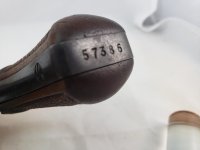
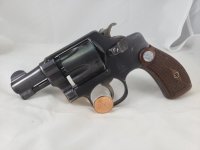
Recently traded into pictured 38 S&W 5 screw Terrier. I knew it was only functioning in double action when I traded. Traded a Beretta 81BB surplus Italian Police 32 auto for it. Had $330 in the Beretta. The Terrier is not in the best cosmetic condition but I like these Lil Darlings a lot.
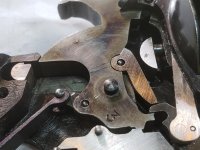
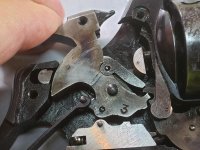
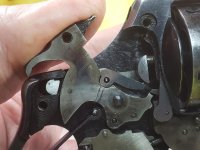
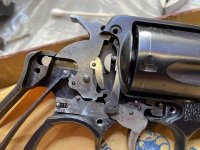
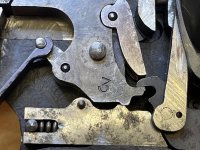
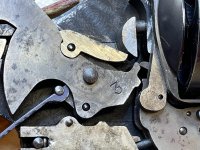
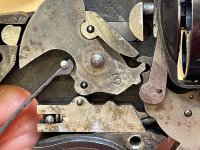
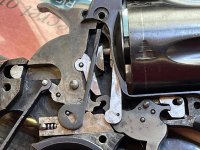
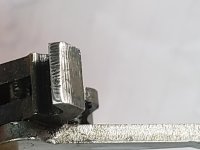
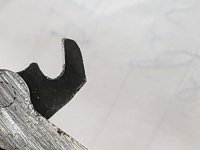
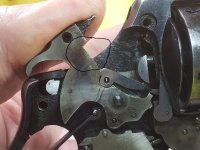
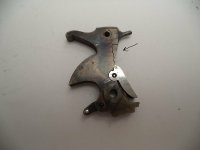
I've included 3 pictures of action in un-cocked, half cocked, and full cocked positions hoping someone can spot the problem that is keeping hammer from locking into single action position. I'm not hearing any clicks when hammer is pulled back. Double action works fine.
Any help will be much appreciated.
Thank you,
Ray
 

Attachments
  • S&W Terrier Pic 1.jpg
    S&W Terrier Pic 1.jpg
    53.5 KB
  • S&W Terrier Pic 3.jpg
    S&W Terrier Pic 3.jpg
    32.8 KB
  • S&W Terrier Pic 7.jpg
    S&W Terrier Pic 7.jpg
    109.4 KB
  • S&W Terrier Pic 5.jpg
    S&W Terrier Pic 5.jpg
    114.2 KB
  • S&W Terrier Pic 6.jpg
    S&W Terrier Pic 6.jpg
    94.8 KB
Last edited:
In your third pic it looks like the single action sear on the hammer is chipped at an angle. Probably going to need a new hammer.
This is a flat mainspring Terrier, pre-war I presume and a different hammer than the post-war coil mainspring type.
Very cool revolver, I've owned a number of coil spring Terrier's but never one of these.
 
Last edited:
It doesn't look like the hammer can be retracted far enough to engage the SA notch. Hard to tell from the pic but the SA hammer notch might be broken. This typically happens by dropping the gun while it's cocked.
Try pushing the trigger forward when cocking SA. The trigger return spring could be weak or modified (coils clipped off)?
One thing I've seen cause this is a bent hammer spur. That will keep the hammer from going back far enough to engage SA.
Lastly, make sure the mainspring strain screw hasn't been shortened.
This was sometimes done (not a good idea!) to lighten DA trigger pull.
That will cause cocking issues.
 
SFIDEC, I fear SDH has given you the correct diagnosis... unless you know a very talented micro tig welder who can work like a brain surgeon, it would appear that hammer is done for. The good news is that there are thousands of preWar hammers that would work, but the bad news is few or none of the I frame hammers for leaf spring will have the late modification for the hammer block safety. :( BTW, that seam visible on the hammer in images 3-5 may indicate that it has already been repaired, another reason I would personally seek a better replacement. I have the 32 HE version of the same gun from about the same time frame and it’s one of my all time favorites. I’ve been looking for a postWar example like that for a loooong time without success, so if you decide it’s more trouble than it’s worth... :rolleyes:

Froggie
 
I agree with Froggie, the hammer looks to be welded and probably is not within specs, the sear does not look like it fits to the hammer properly. For comparison, check out the attached photos of Terrier s/n 57465, shipped in March 1951 that appears to be identical to the OP's gun. It took me awhile to dig it out of the safe.

Comments??
 

Attachments

  • xgnpjUIvQu6E68x0VdQUgQ.jpg
    xgnpjUIvQu6E68x0VdQUgQ.jpg
    118.1 KB
  • E%9lLhKyRrOPj3gKRWRPJA.jpg
    E%9lLhKyRrOPj3gKRWRPJA.jpg
    138.4 KB
  • vKtLuJI0TuSiKKoNTvFAfQ.jpg
    vKtLuJI0TuSiKKoNTvFAfQ.jpg
    146.3 KB
  • BfoMzCFDSDGcDdcmQ3bHeg.jpg
    BfoMzCFDSDGcDdcmQ3bHeg.jpg
    140.3 KB
  • 0ylvxuDLQteNELtcaa05cw.jpg
    0ylvxuDLQteNELtcaa05cw.jpg
    126.5 KB
I agree with Froggie, the hammer looks to be welded and probably is not within specs, the sear does not look like it fits to the hammer properly. For comparison, check out the attached photos of Terrier s/n 57465, shipped in March 1951 that appears to be identical to the OP's gun. It took me awhile to dig it out of the safe.

Comments??
___________________________________________________
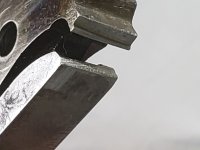
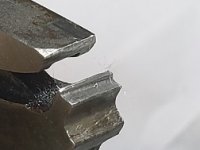
Wow goatsnguns! Thanks so much for going to all the effort to hunt your Terrier down and even go the extra-extra miles and remove the side plate for pictures. I've attached 2 more closeup pictures I took while I had my Terrier apart. Maybe they will reveal more damage evidence.
From looking at your pictures it looks like my hammer needs to move just a smidgen more toward rear to catch on the single action edge. The spur hits the frame not allowing it to go back any further. I also noticed the rebound slide spring is much shorter than other springs I've messed with in model 36's. Does the slide spring have any effect on function of single action?
Please forgive me with my attempts to describe what I see as I'm a true greenhorn at digging into the mechanics of this revolver. However, I do love a challenge.
Looking forward to more feedback.
Thanks!!!
Ray

PS: I was born March 1951. This may explain the trouble with me and my boogered-up Sear.
 

Attachments

  • S&W Terrier Sear Pic 1.jpg
    S&W Terrier Sear Pic 1.jpg
    120.2 KB
  • S&W Terrier Sear Pic 2.jpg
    S&W Terrier Sear Pic 2.jpg
    20.1 KB
SDH, cgt4570, and Froggie. Thanks for sharing your expertise too.
You guys are great!!!!!!
 
SFIDEC,

The engagement surface on the hammer looks to be at an angle. Could you post a couple of pictures of the engagement surfaces of the trigger?
That might help us to figure this out. Also you might want to check and see if the hammer stud is loose. When operating the action with the side plate off, I always loosen the strain screw a bit, you don't want to know how I learned this.

Gary
 
Last edited:
Do any of you know whether it would be possible to alter a preWar hammer to use in this postWar application? I’ve got a spare from a parts kit I bought for other parts one of my I frames needed.

Froggie
 
SFIDEC,

The engagement surface on the hammer looks to be at an angle. Could you post a couple of pictures of the engagement surfaces of the trigger?
That might help us to figure this out. Also you might want to check and see if the hammer stud is loose. When operating the action with the side plate off, I always loosen the strain screw a bit, you don't want to know how I learned this.

Gary
___________________________________________________
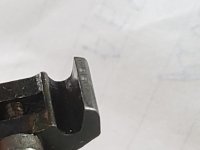
Gary,
I just happened to take a few closeup trigger pictures that may help when I had it apart. I didn't check hammer stud for looseness.
Thanks again,
Ray
 

Attachments

  • S&W Terrier Trigger Pic 1.jpg
    S&W Terrier Trigger Pic 1.jpg
    28.6 KB
  • S&W Terrier Trigger Pic 2.jpg
    S&W Terrier Trigger Pic 2.jpg
    47.8 KB
  • S&W Terrier Trigger Pic 3.jpg
    S&W Terrier Trigger Pic 3.jpg
    39.4 KB
Ray,

Thanks for posting the photos. The engagement surface looks a little rough, I'll have to check out some triggers I have and compare. Perhaps a stacking of marginal tolerances is contributing your single action issue.
 
Last edited:
Do any of you know whether it would be possible to alter a preWar hammer to use in this postWar application? I’ve got a spare from a parts kit I bought for other parts one of my I frames needed.

Froggie
___________________________________________________
Froggie,
I'm not sure if I'm having similar thoughts about whether an older I frame hammer can be altered. The Hammer Safety Block cut out seems to be the difference in the hammers. Could the cut out be done? Attached are pictures for comparison of my Terrier hammer (left) and an earlier hammer(right) without the cut out for the Safety Hammer Block.
Is that the difference in these two hammers?
Just curious. I surely don't have the skills to do that surgery.
Ray
 

Attachments

  • S&W Terrier Hammer Block.jpg
    S&W Terrier Hammer Block.jpg
    79.2 KB
  • S&W Early I Frame Hammer 2.jpg
    S&W Early I Frame Hammer 2.jpg
    87.8 KB
I have early postwar Terrier 56073 as well as a couple of prewar specimens. I confess to going a little gun simple in the presence of these fine little revolvers.

For the solution to push-off (or in this case, fall-off) problems, check out this thread in the S&W-Smithing subforum, which consists of a single long post. You will need to do a search on page for "push off" to find it easily, or you could just do an eye scan for the phrase "To correct push off" -- yes, in red -- as a section header on the left side of the page. It's a little less than halfway down the page.

http://smith-wessonforum.com/s-w-smithing/527760-faq-post139666619.html?527760=#post139666619

This narrative encouraged me to try to restore life to some sadly mistreated revolvers that I picked up when I first started collecting a dozen or so years ago.

I would try to stone the contact surfaces under discussion back into shape, but I'm not sure there is enough steel left to achieve a once-and for-all solution to the problem. A new hammer might be needed under any circumstances, and the contact point on the trigger would need some judicious smoothing.
 
Back
Top