Project NOVEMBERFRAME

RM Vivas

US Veteran
Joined
Nov 11, 2002
Messages
962
Reaction score
6,173
City & State/Province
ROCK/me/HARD-PLACE
Project NOVEMBERFRAME

I have many research projects going on right now and they are really making me into a much more rounded individual when it comes to Smith & Wesson firearms.

I may have very little interest in Model 19’s or in New Departures’, but as I wander through the archives I pick things up and while I may not be a Subject Matter Expert (SME) on those guns, I am developing a knowledge base that will let me speak more to them than I might otherwise have.

A downside to this cornucopia of archived information is that it is very easy to get distracted from one project and on to another. I am guilty of this and have several projects running at once.

I am going to try and focus on the two or three that I think are most important, both to myself and the SWHF and the collecting community in general. The two that I’m thinking on focusing on are this Pre-war N-Frame project (NOVEMBERFRAME) and my attempt to document all the Defense Supplies Corporation sales project (DISCUS38). I think these two will have the broadest reach within the collecting sphere; the Pre-war N-Frames because they encompass some iconic and groundbreaking models and the Victory data because they were so plentiful and are widely collected.

Up until now I have posted about the various projects in different threads and on different boards and I think the time has come to try and better organize things.

I am going to give each research project a weird name that does not usually come up on the web site search feature. This way, if I want to see if someone is referring to my project or using it in a post, I can search for that unique name and see where it is and follow along.

I am going to post a single thread that will detail my project and try to limit my mentions of findings and the like to that thread only.

There are three S&W forums that I post to and, generally, I will post the same to all three threads. I may post a more detailed entry on the Smith & Wesson Collectors Association (SWCA) forum because some information will be from sources proprietary to them.

I’ll be posting to:
https://smith-wessonforum.com/
https://www.smithandwessonforums.com/
https://forum.theswca.org/ (Private Forum for SWCA members)

Project NOVEMBERFRAME

The goal of this project is to produce an enhanced accounting of all Pre-war N-frames from s/n 1 through approx. s/n 62,500. The statements that I make here are specific to the N-frame pre-war records only.

Currently these guns are recorded using seven data fields:
  • Serial No.
  • Case No.
  • Model (or Registration number if Registered Magnum)
  • Ship Date
  • Recipient
  • City
  • State
I am not certain what is meant by “Case No.” as it appears in the records. I’m wondering if it might be the period equivalent of today’s UPS Tracking Number. It does make things a little easier, as I’ll explain in a bit, because shipments that contain multiple guns will have the same Case No. for all guns. Thus, if Joe Blow Gunshop orders twelve .38/44 Heavy Duty (HD) revolvers, each serial number sent will show the same Case No.

The model of gun is usually, but not always, listed but with a distinct lack of specificity; for instance, .38/44 could mean either a Heavy Duty, an Outdoorsman or even the seldom seen McGivern Target Model.

The same can be said for .44 Military Revolver, which could be a 1st or 2nd Model .44 Hand Ejector (HE) or a 3rd Model .44 HE a.k.a. a Model 1926.

A typical entry might look like this:

S/N Case No. Model Date Recipient City State
1234 567 38/44 2/1/36 Joe Blow Guns Brooklyn NY

Now, it is important to understand that currently all the serial data is in the form of microfilmed images of ledger books that have been scanned and saved as images. There are no searchable features and no way to find a specific gun or destination or date except by eyeballing the microfilmed records. The only order they are in is serial number order; you cannot search for any other data point except by sitting down and reading every page (which I enjoy). There are 100 entries per page, so for my purposes I am looking at approximately 625 pages.

My goal is to take all the entries and enter them into a database that will allow me to search by all seven data fields. On the face of it, this is relatively simple and straightforward. However, the lack of specificity in the records as to Model presents a quandary.

Let us say I want to compare how many Outdoorsman’s shipped in 1936 versus how many Registered Magnums shipped at the same time. If I have the database done, I can simply do a count of 1936 shipped Registered Magnums and come up with a figure; however, I can’t come up with a figure on Outdoorsman’s in the same manner because Outdoorsman’s and Heavy Duty and McGivern Target are all lumped under the single classification of 38/44.

So how does one fix this?

In addition to the microfilmed shipping ledger that contains the original data points, there is a limited amount of microfilmed shipping invoices. These run from December 1925 up through around 1947.

These ledgers are in chronological order but that’s about it. What I do is look at an entry like the one shown above. Ship date was 2/1/36. I pull up the digitized roll of microfilm that covers 10/25/35 through 4/12/36 (Roll 83) which is 1,994 pages (images) long and scroll through until I hit the first entry for 2/1/36. Then I scroll through the rest of the 2/1/36 entries until I find the one for Joe Blow Gunshop on page 1,234. The entry shows a single gun shipment labelled as a .38-44 Heavy Duty B 5” (.38/44 Heavy Duty Blued w/ 5.000” barrel).

I’ll make the notation in the database so now the entry will read:

S/N Case No. Model Date Recipient City State Notes Source
1234 567 38/44 2/1/36 Joe Blow Guns Brooklyn NY HD; B; 5.000” R83/1234

R83/1234 is a note so that whoever follows me knows the source of information for this entry was Microfilm Roll 83 Page/Frame 1234.

Now I have more searchable data fields. How many Heavy Duty’s were shipped in 1940? How many in nickel? How many to Wolf & Klar? What is the earliest N-frame s/n for 1940? What is the latest for 1940? How many McGivern Target Models were made and where were they shipped?

The ability to quickly and accurately answer those questions is the impetus for this project.

There are still some kinks to be worked out. For example, if the Joe Blow Gunshop ordered two guns, both labelled in the shipping ledger as 38/44 but the invoice says one was an Outdoorsman’s and the other an HD, unless they also list serial numbers (seldom) there is no way of knowing which serial number goes to which gun. In that instance I’ll tag the entry as an Either/Or (Schroedinger's Gun?) sort of thing and hope to find some more data later. One possibility is to take the serial numbers and run them through the Correspondence and Repair files and see if a few years later someone wrote a letter saying they were sending in their ”…Outdoorsman #xxxxx for repair…”.

A marvelous side benefit to this project is I get to look at a couple hundred invoices every day in searching out the subject N-frames and while doing so, I come across all manner of interesting things. One very valuable thing I have come across is shipping invoices that contain serial numbers for guns that appear on the invoice as going to the Acme Gun Shop or Podunk Police but appear in the shipping ledger as Open On Books. I anticipate getting at least some of these Open On Book entries resolved.

Part of this thread will be to highlight what I find in my travels, both in terms of actual guns and background things that one never really considered. For example, I found a number of invoices where S&W was taking in Colt revolvers from dealers at $5 and then disposing of them through their sales agents. Some familiar names turn up, especially people who ordered Outdoorsman’s revolvers and then their names appear multiple times in the Registered Magnum records. I guess these were the folks who developed a taste for hot .38’s in an N-frame with target sights and became the ‘early adopters’ of the Registered Magnum (Dr. Wishart and Dr. Hertzel spring to mind).

Also, as a way of keeping me motivated, I’ll be chronicling the progress I’ve been making. Right now I have about 2,500 entries complete but they are spread across a very wide range of serial numbers and dates. My immediate short-term goal is to complete a solid block of 1,000 serial numbers and then statistically dissect that and see what comes up. The block I am looking at is 44,000 through 45,000. At the moment I have perhaps half of it done and I have found some interesting things, such as a half dozen or so McGivern Target Models, a few famous people guns, some odd destinations and some interesting trends, particularly amongst export orders.

I figure in another week or so I -should- have the sample 1,000 entries done and once that happens I’ll nerd-out on a statistical kick and see if my theories are sound. I suspect they are.

Getting all 62,500 entries done will take probably a couple years. It’s hard to say. Entries from before the start date of December 1925 for invoices go in fairly quickly since I can’t cross reference them with the shipping invoices. Also, they will be almost all some variation of the .44HE since the HD and Outdoorsman’s didn’t come out until the early 1930’s

So, there you have it. I’ll try to keep everyone updated.

Best,
RM Vivas
 
“Census” information and the interesting details of provenance are what makes collectibles interesting. I’d love to know the numbers of my pieces’ relatives known to be out there and what their details are. Narrowing focus is a good approach.
 
It sounds interesting. When we had a 38/44 database I used to access it quite often to look for trends. I would then use some trends to sort of unofficially know if something for sale was likely correct. Mostly humpback hammer time frames and what the sharp shoulder time frame was. Known examples were much more informative than estimates.

I am curious what data and trends you will find on Open in the books guns. Will they be equally scattered through out or in clusters that might give you new insight as to what likely had been occurring.

Are you looking for any information from the group?
 
Perhaps “Case No.” was the number assigned by the shipping department and annotated on the shipping container that held the individual boxed guns…..a possible tracking method as you suggested.
 
Project NOVEMBERFRAME

Update:24FEB26

Rather surprisingly, I have finished the test block of 1,000 serial numbers.

I’ve managed to input the serial number, case number, model, ship date, ship destination for serial numbered pre-war N-frames 44,000 through 45,000. The actual number of guns in this survey is 1,001.

A few caveats:

I’m human and I make mistakes. It is almost certain that somewhere in here I have made a fumble-fingered mistake that has thus far eluded detection. If you see something in here that makes you want to drop a bundle of Benjamins on a specific gun based on my findings, DOUBLE CHECK THE DATA with myself or the Smith & Wesson Historical Foundation!

This survey is only 1,001 guns and while it does cover every single serial number within a certain range, it should be borne in mind that this is a small piece of a much larger and complex picture.

So let see what we have found thus far….

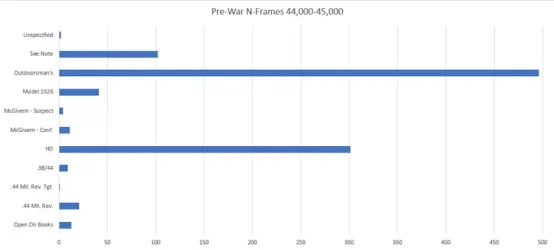
This data is specific for Pre-War N-Frames 44,000 through 45,000 inclusive.

The earliest ship date was 19AUG34 and the latest ship date was 15OCT36; a span of two years and two months form 1,001 serial numbers.

Of the 1,001 revolvers, the breakdown of entries was thus:

13 - Open On Books – This is an entry where there appears a serial number and absolutely no additional data. My experience thus far has been that one explanation for this can be that a gun was shipped but the paperwork just “fell through the cracks”. An example of this would be 44,488 which appears as an Open On Books entry but the revolver exists and is in the hands of a collector who contacted me for additional information (which has not yet turned up).

21 - .44 Military Revolver – These are guns that were listed on the shipping invoice as “.44 Military Revolver” with no further explanation. It is possible some of them may have been Model 1926/.44HE 3rd Models and the person making then entry simply shorthanded it to “.44 Military”. Absent of any proof otherwise, I’m counting those guns thusly.

1 - .44 Military Revolver Target – There was one gun listed on the invoice as “.44 Military Revolver Target”; lacking further details I have chosen to not speculate and have instead given it its own category.

9 - .38/44 – These are guns that were listed on the shipping ledgers as “.38/44” with no indication of whether they were an Outdoorsman’s or a Heavy Duty (HD). There were no shipping invoices for these guns, so they could not be checked by that means.

301 – Heavy Duty – These are guns that were listed on the shipping invoice as either “Super Police” or Heavy Duty”.

11 – McGivern Target Model - Confirmed – These are guns that were specifically listed on the shipping invoice as either “McGivern Model” or “McGivern Target Model“.

4 – McGivern Target Model – Suspected – These are guns that did not have the term “McGivern Model” or “McGivern Target Model“ listed on the invoice but had specifications that would classify them as such. These guns were listed as “.38/44 revolver, N(ickel); 5” Bbl.; Target with Marble ivory bead“. These were part of a single order. There was also a single entry for a gun listed as “.38/44 revolver, B(lue); 5” Bbl.; Target“ which seemed suggestive of a McGivern Target Model.

41 - .44 Military Model of 1926 – These are guns that were specifically listed on the shipping invoices as Model 1926. They may have also been listed as .44 Military Revolver – Model 1926.

496 – Outdoorsman’s Revolver – These are guns that were listed on the shipping invoice as “Outdoorsman’s Revolver”. All of these were listed as 6.500” inch barrels and Blued finish. No nickel guns were listed. There was a record of one seemingly non-typical Outdoorsman and that is noted in the See Notes category.

102 – See Note – These 102 guns were part of orders where the customer ordered a single shipment that contained both, HD’s and Outdoorsman’s but with no specificity as to the serial numbers of which guns. The result is you’d see an invoice for Joe Blow Gunshop receiving 2 HD’s and 3 Outdoorsman’s but since the serial numbers were not listed, it could not be determined which serial numbers were for the HD’s and which for the Outdoorsmans’. This leaves us with the Schrödinger’s Cat of the Pre-War N-Frame world. Within these 102 unidentifiable guns however was an oddity: a gun listed on the shipping invoice as “Outdoorsman’s; 5”; Target”. I suspect this may have been a McGivern Target Model and the person making the entry was not familiar with the term and thus simply described what he saw: a gun that looked like an Outdoorsman but with a 5” barrel.

2 – Unspecified Revolver – There were two revolvers, both shipped together, for whom no invoice could be found and who did not have a model number listed in the shipping ledger. My experience has been that -usually- when a Model is not listed in the shipping ledger, the gun is some variation of a .44.

Graph.webp

I was rather surprised by the number of Outdoorsman’s that were being sold, especially relative to the HD’s. Quite a few more Outdoorsman’s went to law enforcement than I would have initially believed. I would have thought the 6.500” barrel would have been considered a negative feature for law enforcement but the boys in blue seemed fine with it. On the HD’s I did notice that when agencies were placing large orders (fifty, sixty, eighty guns) they tended to specify the HD, while agencies placing smaller orders (less than twenty) seemed to gravitate towards the Outdoorsman.

The Outdoorsman’s were frequently the recipients of special order sights in a way -very- similar to the Registered Magnums (RM).

The more I read the correspondence on the Outdoorsman’s, the more I am convinced that it really did provide the impetus for the RM in a very big way. While I think everyone would agree with that, some proof may be found in the fact that many of the names I saw associated with the Outdoorsman’s appear later as early purchasers of the RM’s.

DB Wessons’ second favorite barrel length in the RM was the 6.500” Magnum and that’s basically an Outdoorsman bored out to Magnum. With so many LE buying Outdoorsman’s, it is very easy to see how the idea of the same gun bit with a bit more punch came about. He had to tout the 8.750” RM as the first choice because that was the barrel length that would get him optimum velocity, which was the selling point. Knowing that the average cop wasn’t going to strap the maximum Magnum on his belt, DBW may have then touted the 6.500” as being the second most ideal because he knew that length on that frame was already popular amongst the badge.

As time allows I am going to take the missing entry guns and the See Note guns and feed them through the Repair and Correspondence files and see what comes up. I’ve already had some luck with that.

As it stands now, I have 3,183 entries that I consider completed. For me, completed means that the data from the shipping ledger has been entered AND the data cross referenced to the shipping ledgers. Putting in the shipping ledger data is rather easy and relatively quick. I could bang out 400-500 per day if I had the time. The cross referencing however takes a while.

What I would really like to do is sort the entries by date and see how many guns shipped in one calendar year and how many of each model. The problem is that because S&W did not ship in serial number order, I would have to have all 62,500 entries done before I could do that and get hard definitive data.

Right now I’m thinking that I’ll start working the 45000-46000 range and see what pops up.

Speaking of popping up, I read about 4,000 pages of invoices (actually enjoyed it) and had some observations to share.

  • Within the 44000 through 45000 range, Hoegee and Wolf & Klar were the biggest recipients of guns.
  • DBW and S&W seemed to really like the Longmeadow, MA police department. Not only were loaner guns regularly going back and forth, quite a bit of ammo was sent their way.
  • The dishwasher repair invoices were mixed in and it’s interesting to look at the lists of places that had them. Also, there were parts invoices for what I think were token/fare boxes.
  • Many people provided specialized grips to S&W to have fitted their revolvers when they ordered them. This was particularly the case with pearl grips, with invoices often stating that the purchaser would provide the pearl grips and it would then list the company providing them, usually an outfit in NYC or Brooklyn.
  • Quite a few noteworthy people of that era ordered Outdoorsman’s and then Magnums when they came out.
  • S&W would buy and sell Colt revolvers through their sales agents, usually when they convinced an agency to switch to S&W. They would give a credit for the old guns and then flip them to their dealers. The price offered to dealers was between $5-$7.50.
  • While the N-frames were popular, they were not a huge presence on the export market. When looking at export orders, particularly to the orient, it’s the smaller frames and calibers that populate the manifests. To be sure, some N-frames did get exported but in those instances, they were the .44 caliber ones. For some reason, the mid-bore N-frames just weren’t big on the export market.
One interesting thing I did notice was that on the export documents where model names would be listed (M&P, RP, etc.) the Outdoorsman’s revolvers would be listed as .38 REB. I’m not sure why. I did see one internal document that referred to the M1926 as having the “…reinforced barrel…’ (referring to the shrouded lug), so I wonder if it may refer to that as a way of describing the Outdoorsman’s.

Anyway, back to the archives and spreadsheets.

Best,
RM Vivas
 
Last edited:
Well, one thing that’s going to “pop up” in the 45000 - 46000 range is the very early Registered Magnums.
Already have 5 listed so far. :)

For the Magnum years its actually pretty easy as I have a seperate spreadsheet that already lists all the magnums, their features, destnatinations, etc. I just merge that right in!

Best,
RM Vivas
 
Excellent (and also tedious) work, Robert...I suppose you buy Visine in the large economy bottles...o_O...Ben
No but I am seriously considering a link for people to support my research by donating funds for coke, cool ranch doritos and sushi. (possibly also Tullamore D.E.W.)

Best,
RM Vivas
 
Well, one thing that’s going to “pop up” in the 45000 - 46000 range is the very early Registered Magnums.
There are approx 100 RM's in the 45k-46k range. Technically, two of them are Non Registered Magnums and that would be the pair that went to Springfield Armory, one of which was re-barreled and the entry in the shipping ledger changed to show it going to Sales Rep Kirtz.

Best,
RM Vivas
 
Project NOVEMBERFRAME

Update: 03MAR26

The project to document 1,000 consecutive serial numbers (44,000 through 45,000) has, I think, shown that there is merit in my project. It has also shown that I need to refine techniques a bit more.

The transcription of serial number, case number, model (when listed), ship date and destinations is a pretty straightforward transcription job. There can be some challenges; destination names and dates can be hard to read.

The time-consuming part is cross referencing the shipping ledger entry with the shipping invoice entry. The reason for this is because let us say 2 Heavy Dutys (HD) went to Shapleigh on 8/7/34. I must find the roll of microfilm for that date. In this case it would be Roll 80 and cover the dates 4/4/34 through 10/16/34. Doesn’t sound too bad, right? Six months.

However, the roll contains 1,985 pages of invoices. Each page of invoices takes up one image frame. The image frames are not labelled by date, rather they are titled with what name frame they are on the roll of microfilm. I must pick a spot in that line of 1,985 image files and hit one at random; lets hit #693. Hmmm…. June 7, 1934. Ok, close that file and jump ahead a few. #1,338…..August 10, 1934. Close enough. Now I start cycling backwards from that image into the earlier images. Image #1302 is the last image for date 8/7/34. Now I keep scrolling and eventually work my way to an image that shows the invoice to Shapleigh. That took about 3 or 4 minutes. Multiply that by the 1,000 times I had to do it just for that small statistical sample.

It sounds like it should take a lot of time but there are many entries that contain multiple guns, such as agency shipments. In those instances it may take me 4 minutes to find a single entry but that single entry lets me clear maybe five, ten or fifteen guns.

Having said that, it was still necessary to go through about 4,000 pages of invoices to get the information I needed. This sounds awful but the stuff you find whilst skimming the invoices!!!!

The part that is an issue is that I was ONLY looking at guns in the 44,000-45,000 range. Thus, as I scanned through images, I might find an invoice for 43,995 or 45,039 and since those weren’t on my radar, I flew past them. Now, when I go into those respective serial blocks to create the next dataset, I will have to go through all those invoices again. And again for the next dataset. And so on.

The most efficient way to do this would be to do all the transcription first and then just start going through invoices and tagging things in chronological order. It’ll take longer because I’ll be annotating many more entries but I’ll only have to go through the records once.

My initial plan was to work backwards from the last pre-war entry (#62484, a Non Registered Magnum (NRM) on 10/22/41) so that I could examine shipment figures and trends as they were affected by the immediate pre-war arms buildup and contract obligations.

In that regard I have managed to construct what I call Basic Entries (serial number, case number, model (if listed) and ship date) for gun 56,001 thru 62,483. Many, but by -no- means all, of these entries have a notation as to where they were shipped (name, city, state) but not all do. Perhaps 75% do. Of that %75, perhaps half of those entries have been cross referenced.

People need to -truly- understand that S&W did not ship revolvers in any kind of serial number order. It’s not until you look at the records very closely that you really start to see this. Each digitized page I look at contains two hundred entries. I have looked at pages where there will be a span of DECADES between some gun shipments. It is not unusual to see an entry for one gun then the entry for the next in the serial number sequence shows a ship date ten or twenty years later!

Serial number 56,001 shipped 2/28/38 and 62484 shipped 10/22/41. That’s a span of a little over two and one-half years. Some folks will look at that and say “You should be able to glean statistical data for June 1939 with no problem, it’s squarely in the middle of that date window.”

You would think, right?

It just doesn’t work that way. There are so many ship date outliers that your statistics would be way off.

Having completed the sample 1,000 serial numbers, I am going to look at the 56,000-62,484 block and work backward on switching them from Basic Entries to the fully documented and annotated Enhanced Entries.

Since I do have the nearly 6,500 basic entries though, I will try and see what can be gleaned from that. One thing I have noticed within that block, is there are large blocks of guns that appears as Open On Record, especially in the last days of 1940. I’m talking blocks of thirty or fifty guns at a clip.

By the time I make the next posted update for this project I hope to have some statistical data on shipping destinations for Block 56-62.

I always say that this sort of stuff can’t be done without the support and assistance of the fine folks at the Smith & Wesson Historical Foundation. Support them because they support us/me. Join!

Best,
RM Vivas
 
RM, sounds similar to going thru pages of Czech microfilm. Eventually I started building an index for each file as I worked in it. A short time at the start (even logging a date from every 10th page) very quickly paid off when revisiting that file. And when looking between tenth pages, I’d add a few more page dates to the index. Eventually it’s quite quick.
 
Bob, I think your projects are fascinating and will prove to be of immense benefit to collectors and students of the different S&W models.

My tentative thinking about "Case" numbers is that these are sequential ID numbers for literal crates (or smaller containers) of revolvers shipped to a particular recipient on a specific day. I believe the maximum count for a case is 100 revolvers, so if S&W shipped 200 revolvers to a customer on one day, two different crate identification numbers would be used. If a small order of say, five revolvers was shipped to one recipient, that would still get a specific case number. From my limited awareness of the inventory logs, case numbers for shipments later in a year appear to be higher than case numbers shipped earlier in that year. I suspect the case count was reset every year on New Year's Day, but will be happy to be corrected.

Some deliveries do not have recorded case IDs. I have seen a register page of .38 HE Model of 1946 Target (Mexican) revolvers in which about a dozen guns were recorded as shipped on 30 June 1948 to Galef in New York. A couple of them are associated with a case ID, but the rest have no case number at all. There is another instance in which two different case numbers were assigned for revolvers shipped to Frank Jonas in New York. Case number 6730 contained seven revolvers, and 6732 contained two. There may have been additional revolvers shipped in these cases, but their serial numbers would lie outside the range of 200 that I was able to review.
 
Project NOVEMBERFRAME

Update:07MAR26

Having completed the first block of a solid 1,000 serial numbers (44-45) I decided to take a bigger bite out of the serial number pie and do a solid block covering all the guns from 60,000 through 62,500.

The actual number of entries is 2,487’ I went from 60,000 up to the last serial number before World War Two started.

It took less time than I thought to cover all 2,487 numbers. This was mainly due to my having done many of them for a previous project. Still, it took the better part of a week or so to get it done, including dedicating a couple full days off.

I have the data in a fairly basic form right now and will start refining it as time allows. I think ultimately I may want to organize it in a format similar to the one I use for Registered Magnums. It would certainly create a -much- clearer picture of what the .38/44’s were doing as far as options and shipping.

The block that I am looking at starts at serial number 60,000 and ends at 62,484. The earliest gun listed within that block is 60776/29DEC38 and the last is 60512/17NOV41. Excellent examples of the rule that S&W did NOT ship in any kind of order.

I’m going to present some figures with the warning that these are preliminary numbers, they are approximate and are subject to change as I refine the data:

Of the 2,487 revolvers within the 60,000 through 62,484 revolvers, the breakdown of entries was thus:

298 - Open On Books – There were 298 entries that were classified as Open On Book. These were mostly large blocks of s/n’s that have no information for them in the Shipping Ledger. Several blocks were 15-20 consecutive serial numbers in size and one block was forty-five consecutive serial numbers in size. On the bright side, I did manage to identify and append the records for sixteen Open On records guns, so that’s a win. I think as I start digging deeper, particularly as I cross reference other invoices and such, more of these Open On Books guns will be cleared.

45 – Registered Magnums – About 45 RM’s were listed although, as shown below, undoubtedly there were more but the records just did not show the Registration number. S&W was winding down the Registration process and this can be seen in the small amount of RM’s versus the greater number of NRM’s.

1,170 – Non Registered Magnums – 1,170 Magnums appeared in the Shipping Ledger and on the Shipping Invoices as not having a Registration number. This figure is approximate because it does include know Registered Magnums such as the KC MO guns which -did- have Registration numbers (as reflected on the order invoice) but these numbers somehow did not make it onto the Ledger or Shipping Invoices. Additionally, there were undoubtedly more NRM’s in the See Note category. Still, it is telling that at least half of the guns shipped in this serial number range were Magnums.

I’ll eventually be working on a statistical breakdown of barrel lengths and finishes for these NRM but I can tell you right now, the 3.500” model was extremely popular. Speaking of which……

52 – FBI Shipped NRM’s – Fifty-two guns shipped to the FBI. 18 were direct agency shipments (5.000”) and the rest private purchase (a number through Baughman). 3.500” barrels were the order of the day for most of the private purchase but almost a dozen 4.000” guns were in there as well.

23 - .38/44 – These are guns that were listed on the shipping ledgers as “.38/44” with no indication of whether they were an Outdoorsman’s or a Heavy Duty (HD). There were no shipping invoices for these guns, so they could not be checked by that means.

656 – Heavy Duty – These are guns that were listed on the shipping invoice as either “Super Police” or Heavy Duty”. The vast majority were 5.000” but there was a smattering of 6.500” and 4.000” guns.

1 – McGivern Target Model – Suspected – This gun was not specifically mentioned as a McGivern Target Model but it did have the characteristics, particularly a 5.000” barrel fitted with Target sights.

98 - .44 Military Model of 1926 – These are guns that were specifically listed on the shipping invoices as Model 1926. They may have also been listed as .44 Military Revolver – Model 1926.

5 - .44 Military Revolvers – This category is for guns that are listed on the invoice as .44 Military Revolver with no further details to suggest that they are or are not .44HE 3rd Modles (M1926; Wolf & Klar). It is entirely possible that are 3rd Models but they could just as easily be 2nd Models. Absent any other evidence, I’m going to presume they are as listed: .44 Military (2nd Model).

103 – Outdoorsman’s Revolver – These are guns that were listed on the shipping invoice as “Outdoorsman’s Revolver”. All of these were listed as 6.500” inch barrels and Blued finish. Still no nickel guns listed.

49 – See Note – These 49 guns were part of orders where the customer ordered a single shipment that contained both, HD’s and Outdoorsman’s but with no specificity as to the serial numbers of which guns. The result is you’d see an invoice for Joe Blow Gunshop receiving two HD’s and three Outdoorsman’s but since the serial numbers were not listed, it could not be determined which serial numbers were for the HD’s and which for the Outdoorsmans’.

Unspecified Revolver – there are perhaps two dozen records I am still piecing together. Another issue is that the Shipping Invoice book for mid-December 1940 onward until mid-1941 was imaged rather poorly and no details could be made out. This affected about 75 entries. I’m going to try and confirm/resolve these by going through the order invoices.

A few interesting findings thus far:

NRM #61785 – 6.500” - per ship invoice (R154/687) - “…extra charge for omitting checking on the rib and top of frame and finishing these parts in dull finish same as rear sight leaf finish…”

NRM #60355 ordered by Ed McGivern 12/11/39 and engraved TO DICK FROM HIS MONTANA BOYS. This one goes on my list of guns to investigate later.

Model 1926 #54872 – Gun appears in shipping ledger with ship date of 6/26/39 yet has shipping invoice dated 2/1/40. Invoice notes “….Shipped out on memo 6/26/39…” Quite a wait between order and shipment! Worth noting that this particular gun did receive a number of special features. (This gun cropped up in my narrow s/n range study because of the late ship date).

Quite a number of guns with shipping destinations listed as Coal Companies. Given the time frame (mid 1930’s) and the labor union movements of that time, it puts an interesting view on collective bargaining!

Interesting letter between S&W and KC MO PD about getting checkered replacement stocks. By June of 1946 the factory still was not putting checkered stocks on guns due to war production. They did observe, however, that they had recently gotten a government contract to repair and refinish 27,000 World War 1 .45 revolvers. They state that these will fit the Magnum frame and can be supplied in lieu of the checkered monogrammed grips, these military grips being smooth and lacking monogram (Ref. DVD3_03-16-2018\0\46\47112.tif )

Invoice for Light Rifles 9mm was observed while going through April 1940 invoices. (R154/193). Light Rifle to French Purchasing Commission, both semi-auto and full-auto (R154/628).

Some thoughts on those 52 FBI guns….

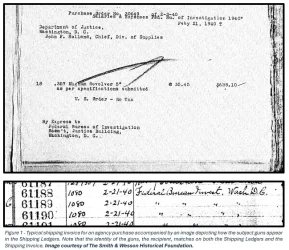
FBI guns, loosely, are broken into two groups: Agency purchased guns and individual purchase guns.

The agency guns may look like this:

030726-update-figure1.webp

With agency purchased guns, the trail is pretty clear. The only downside to the agency purchased gun documentation is that it doesn’t tell us what individual the gun went to.

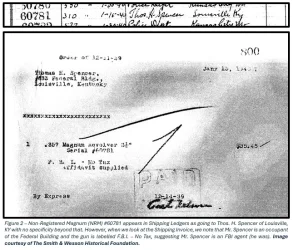
The private purchase guns are a different story and the demonstrate quite clearly the value of a SWHF “Deep Dive”.

Let us look at a private purchase gun:

030726-update-figure2.webp

This is actually an excellent example of one of the great things about the pre-war guns; S&W would ship directly to law enforcement, military and certain other people. If you see a gun going to a named individual rather than a business or agency, that’s worth following up.

It does, however, also point up an issue with that; a purchaser may be listed by name in the Shipping Ledger but without any further detail. If we simply looked at the Shipping Ledger and nothing else, we would be able to say “Your gun shipped on January 15, 1940 to Thomas H. Spencer of Louisville, KY”, however, by cross-referencing this to the Shipping Invoices, we are able to show that this gun went from a desirable gun to a highly collectable FBI gun!

This is one of the things I am looking to address with my NOVEMBERFRAME project. If I wanted to do a survey of how many NRM’s went to the FBI, I could pull up all the guns with shipping destinations of FBI, but would completely miss all the private purchase guns that went to FBI agents. My feeling is that those private purchase guns are arguably more collectible than the agency ones, since the private purchase ones can be traced to individual agents.

I always say that this sort of stuff can’t be done without the support and assistance of the fine folks at the Smith & Wesson Historical Foundation. Support them because they support us/me. Join!

Best,
RM Vivas
 
Bob, I think your projects are fascinating and will prove to be of immense benefit to collectors and students of the different S&W models.

My tentative thinking about "Case" numbers is that these are sequential ID numbers for literal crates (or smaller containers) of revolvers shipped to a particular recipient on a specific day. I believe the maximum count for a case is 100 revolvers, so if S&W shipped 200 revolvers to a customer on one day, two different crate identification numbers would be used. If a small order of say, five revolvers was shipped to one recipient, that would still get a specific case number. From my limited awareness of the inventory logs, case numbers for shipments later in a year appear to be higher than case numbers shipped earlier in that year. I suspect the case count was reset every year on New Year's Day, but will be happy to be corrected.

Some deliveries do not have recorded case IDs. I have seen a register page of .38 HE Model of 1946 Target (Mexican) revolvers in which about a dozen guns were recorded as shipped on 30 June 1948 to Galef in New York. A couple of them are associated with a case ID, but the rest have no case number at all. There is another instance in which two different case numbers were assigned for revolvers shipped to Frank Jonas in New York. Case number 6730 contained seven revolvers, and 6732 contained two. There may have been additional revolvers shipped in these cases, but their serial numbers would lie outside the range of 200 that I was able to review.
I think case numbers are the equivalent of UPS tracking numbers.

The way I came up with to test my theory is to look at a large, maybe 15-20 gun, order that crosses several different models and frame sizes. All the guns in the order should have the same case number in the shipping ledger. That binds all the guns together as a unit on paper.

From what I have seen, case numbers do get recycled but not for several months. Most case numbers are 2- or 3-digit with a smattering of 4-digit.

Best,
RM Vivas
 
Project NOVEMBERFRAME

Update:12MAR26

Part of the process for my little NOVEMBERFRAME project involves cross-referencing the Shipping Ledger with Shipping Invoices. Many times a picture that is incomplete when referencing one of those documents can be made whole by looking at them both.

The Shipping Invoices are very interesting. They consist of a page that has two entries. Each entry reflects a single shipment to a customer. The vast majority of the times it is firearms, but the Shipping Invoices also show shipments of dishwasher and flush valves assemblies and parts, details of foreign shipments, a few pages about fare boxes (?) and gun parts shipped as well as guns repaired.

It is a wealth of information and it can be quite overwhelming when one tries to separate the wheat from the chaff, historically speaking.

What I want to talk about is the Shipping Invoices regarding repaired guns. These are usually very straightforward and will simply say something along the lines of “Repair & bluing to 32 HE #xxxxxx” along with the date, name of the customer and shipping method. I never really gave the non-gun sales part of the Invoices any thought; I’m looking to thoroughly document the sales of new guns.

As you can imagine, I spend a great deal of time on the various gun forums. Focusing on N-frames right now, I read as many posts as I can to learn a bit more but also to try and gauge what is of interest to other collectors. Not so much the “Hey, I want a 4-inch Triple Lock, that’d be sweet!” but more along the lines of “Were there any 4-inch Triple Locks and what was the impetus for their creation? How many were there and where did they ship to.”

A few weeks ago I saw a thread on a forum about a fellow who had a Triple Lock that was chambered in.45 Colt and the discussion around the gun was whether it shipped as .45 or .455, whether it had been converted and, if so, was it done by the factory. This then segued into a conversation about whether the factory ever did such conversions.

As I was cruising through the shipping invoices I came across a couple where it simply said “Converting to .45 - .455HE #xxxxx”. I thought to myself that the fellow who owned that particular gun would have really been happy to have that invoice, as it would greatly enhance the value of his gun. True it had been re-chambered, but it was a factory job and therefore not as undesirable as a shade tree gunsmith job.

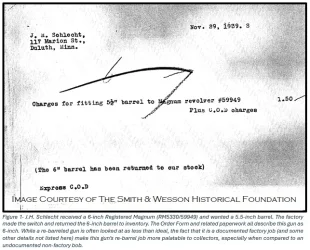
Where things become really interesting is in the world of Registered Magnums. I’ve noted a few Invoices that will refer to a “Cut & Crown” of a long barreled gun into a shorter one. This actually makes a great deal of sense. DBW was absolutely enthusiastic about the 8.750” (later 8.375”) barrelled Magnum. He felt it hung better on the target and, more importantly, the longer tube gave it the velocity that was the key advertising feature of the gun and cartridge.

Undoubtedly many people purchased their Magnum with the long barrel because DBW recommended it. Just as undoubtedly, some people decided that a shorter barrel would better suit their needs and returned the gun to the factory for a Cut & Crown (this was especially true on the second-hand gun market where a policeman might buy a used long-barreled gun and want it cut down for duty carry). While this made perfect sense at the time, it gives rise now to the inevitable collectors quandary of finding a 6-inch barreled gun that letters as an 8.750” and then trying to figure out if it was a factory job or not.

barrel shot.webp

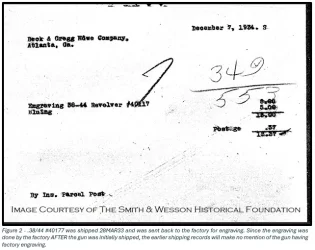
A similar issue arises with engraving. “Is it factory?” is the first question asked when presented with an engraved gun. With a new gun that was engraved by the factory, the paperwork for the initial sale will usually contain something to support a factory engraving job. The question arises though; “what about plain guns sent back to the factory for engraving?”

engrave shot.webp
In the case of both of the guns shown in the illustrations above, a search through the computerized SWHF database using the serial numbers, Registration number, dealer name and customer name pulled up some documents but none of those documents referenced engraving and only one mentioned a barrel job. The barrel job reference was located in a Correspondence file and unless a Deep Dive was done, might escape scrutiny.

To this end, I have yet again increased my workload by adding a new field to the database I am contructing: ADDENDUM. Now each gun listed will have a field for the addition of documents found elsewhere that add to the guns history. Reblue, repair, re-barrel, engraving, LE inquiry, etc. As I find these little mentions in the archive I’ll note them in that particular guns pedigree.

Where I think this will have the most beneficial effect is in guns that were factory refinished and factory re-barreled as these two issues affect value the most at the Registered Magnum level.

This wouldn’t be possible without the Smith & Wesson Historical Foundation. Join!

Best,
RM Vivas
 
Excellent work, Robert...I can add my own little side story...After presenting the letter on my .32-20 Model of 1905, I asked Mike helms for a deep dive, hoping for an invoice to add to my provenance...There was no invoice, only the shipping ledger entry, but Mike in his customary thoroughness searched for the recipient's name since the gun shipped to an individual and came up with an interesting letter from the factory concerning two guns bound for China in 1928...I was happy to add this to my little stack of documents... :giggle: ...Ben

263-9.jpg
 
Robert, regarding your comments relative to the KCPD for guns in the 60000 to 62500 serial# range, the following is for your information:

KCPD Serial# Range (4”)
The serial number ranges for the 3 shipments are:
09/07/39 shipment (250 guns): 58817 - 59899 (REG 4987 - 5236)
01/30/40 shipment (200 guns): 60780 - 61101
07/03/40 shipment (26 guns): 61936 - 62003

So any KCPD .357 Magnum above serial# 59899 does NOT have a REG#; only the 250 guns in the 09/07/39 shipment were marked with REG#.
 
Project NOVEMBERFRAME
Update:7MAY26

Recently I acquired a post-war .38/44 Heavy Duty 6.500” Blued revolver. Normally, I’m not into the post-war N-frames for my own reasons, but there was something about this gun that appealed to me. It turns out that this gun went to the Kansas State Highway Patrol (I initially thought Kansas City, but some record errors have cleared up) and while it appeals to me, I’m going to flip it to fund Cherry Coke, Doritos and sushi (and possibly a few bottles of Tullamore D.E.W.).

One of the thoughts I had about this gun was “How common is the 6.500” barrel?”. Looking at the SWHF archives I realized trying to answer that question for the post-war guns could be tricky but for the pre-war guns it actually seemed reasonable.

The SCSW 4th edition (my 5th is not handy right this moment) states that the pre-war .38/44’s started in April of m1940 at serial number 35,037 and numbered 11,111 until World War 2.

Serendipitously, the SWHF archives hold both the Shipping Records AND the Shipping Invoices for this period. If I cross-reference them (which is the goal of the NOVEMBEFRAME Project), I could, in theory, have a set of complete data for every single .38/44 made prior to WW2. I could then break that down statistically to answer all the questions about pre-war .38/44 production. The best part would be that once it was all done, it would, in theory, be canon; every single entry would have the record name and file number for the document that sourced the information. Thus, when I say xx guns were made in nickel and someone calls BS, I can pull up xx number of invoices and account for -every- gun!

To put my theory to the test, I selected a block of 1,000 serial numbers to start with and entered almost every single datapoint I could find. Since the .38/44 started, per SCSW, with 35,037, I figured I’d start with the 35,001 through 36,000 block of serial numbers.

It was fascinating. The data that could be gleaned showed me that if I can complete this, I will be able to definitively answer a great many questions about scarcity, trends and generally cool facts about our beloved pre-war N-frames.

I’ve updated the NOVEMBERFRAME search fields and they now appear thusly:

  • Serial Number
  • Case Number
  • Model
  • Book Ship Date
  • Book Destination (User/Destination):
    • Name
    • City
    • State
  • Ordered By/Through (per invoice/order form)
    • Name
    • Address
    • City
    • State
  • Ordered For/Ship To (per invoice/order form)
    • Name
    • Address
    • City
    • State
  • Caliber
  • Barrel Length
  • Stocks
  • Finish
  • Sights (FS/RS)
  • Notes
  • Shipping Inv. Roll/Image
  • Order Inv. Location
  • Special
  • ADDENDUM
A few things to note:

There is a very subtle but very important distinction between who ORDERED a gun and who a gun was SHIPPED to. In my case, the Shipping Ledger shows my gun going to the Kansas State Highway Patrol, but the Order Form is filed under the name of WAL Thompson. Thus, if I tried to find the Order Form by searching for Kansas State Highway Patrol, I’d have drawn a blank. Similarly, if we were looking at business practices and such, we may want to know how many M1926 revolvers Wolf & Klar ORDERED and that would be a more accurate accounting instead of how many were SHIPPED to them. They might have received 2,500 guns but have may have ordered 3,500, with the 1,000 gun difference being direct shipped from the factory.

The notes field is where I jot down things of interest: was the Excise tax paid, how many guns in the shipment, any special markings, any special delivery arrangements, etc.

The category Special is a data field for things like a quick notation that can be searched off of: FBI Gun, Engraved, Returned To Inventory, Memorandum Account, Advertising Account, etc.

The category ADDENDUM is for when I find ancillary documents elsewhere in the archive that relate to that specific gun. For example, the entry for a RMxxxx might say under Addendum: (Record location) – Date - Repair sheet – cut barrel to 5-inch. In this way, we can see -all- (or as close to all as we can get) the info available on a specific gun. It will certainly make Deep Dives easier!

So, having burned up the better part of a couple weeks logging data, what have I found?

Glad you asked!

Within the N-frame serial number range of 35,001 through 36,000 (inclusive):

HD’s: 960
M1926: 32
.44 Mil.: 2
45USA: 2
Blank/Open On Record: 2
Early McGivern?: 1
Invoice Missing: 1

Earliest shipped gun: 4/2/1930 (#35386)
Latest shipped gun: 3/17/133 (#35911)

Observations:

Whats In A Name? – At this time, the term Heavy Duty or HD was not being used in the invoices. The guns were referred to a “.38/44 Military Revolver”. There is ONE instance of the term Super Police being used and that was for #35911. However, despite this guns relatively early serial number, it did not ship until March 1933. That’s almost three years after the models introduction.

First HD – Once the first HD came out (#35037 per SCSW and consistent with my findings) –-NO— more .44’s were built in this serial number range (35,xxx). It seems like the factory went all in on the HD. I also suspect that had a fair sized pool of .44’s in inventory to draw upon. I base this on the fact that they are still shipping .44’s with pre-HD serial numbers years after the HD introduction; I suspect they built up an inventory and then moved production to the HD. Some support may be found for this in correspondence from DBW where he discusses different models and would say that the factory was tooled up for .38/44 production but would be running off some .44’s in a couple weeks.

McGivern Ancestor – The McGivern Target Model is generally recognized as either a cut down to 5.000” Outdoorsman or a Heavy Duty 5.000” fitted with Target sights; it’s a semantical difference although I guess the grooved straps/trigger would be the defining characteristic difference between the two. Even though the HD was introduced at #35,037, folks wasted no time in asking for modifications. #35056 was kitted out by request grooved straps, grooved trigger, 2.5-3 pound trigger pull and a Call gold bead front sight. No mention of the rear sight was made so we will presume it was unchanged from being a fixed sight. Technically, you’d need an adjustable rear sight to be a McGivern Target Model but you can see the direction this was headed in.

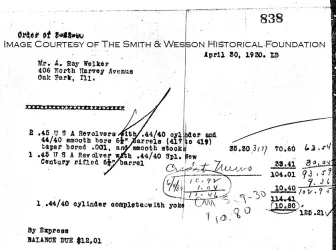
45USA Revolver - The man who ordered #35013 pretty much knew what he was about. He had some very specific ideas!
HD-USA revolvers.webp

#35029 – Another man who knew what he wanted: .44 Military Revolver Target “…handlapped barrel, grooved tang and backstrap, high bright blue finish and Circassian walnut stocks, no swivel…”

Large Orders – Quite a number of large (40-gun, 50-gun) orders were placed but the largest was by Shapleigh Hardware who placed a 100-gun order, all blued, for 6/13/30.

Export Orders – Of the 1,000 guns examined, quite a number went overseas.

Argentina – 6
Canada – 1
Germany – 1
Hong Kong - 3
Italy – 2
Mexico – 163
Switzerland – 1

It's worth noting that quite a number of guns were ordered by Mexican firms with instructions to deliver to Laredo, TX (river ain't too deep there ;)). Draw from that what you will.

Although it does not show up this early and does appear more in later records, the Far East was a recipient of a great many revolvers but generally of smaller proportion. Regulation Police and M&P’s were a frequent object of shipment, but very few N-frames seemed to have gone that direction.

VIP’s – I didn’t notice any VIP’s ,in this block of serial numbers. My detecting them is really based on their title (Special Agent, Senator, General, etc.) or my limited knowledge of events of that era.

I did recognize Dr. Artur A. Hertzler, one of the early RM adopters and a physician of some note at that time; he wound up with #35825. I believe he had a book published about “…The Horse & Buggy Doctor…”; he also founded the Halstead Hospital in Halstead, Kansas. Some good material on him and his works online if you want a decent read.

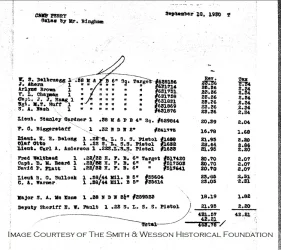
Camp Perry Sales – I did find a marvelous document detailing the sales of many different models by “Mr. Bingham” at Camp Perry. The beauty of this document is that it shows who bought what gun and lists the names and (where applicable) ranks of the buyers. Very interesting document!
perry.webp
Nickel – Forty-one of the HD’s were nickel.

Barrel Lengths – All the HD’s in this block had 5-inch barrels at this time.

Did you join the Smith & Wesson Historical Foundation yet?

Best,
RM Vivas
 
Last edited:
Bill Pattison assured me that I could claim that my HD # 35221, which shipped 4/24/30, was a first month gun. As I read thru your post, I was smiling the entire time, just remembering him. Fantastic guy devoted to a cause. Just like you. Many thanks.
Ed
 
Project NOVEMBERFRAME – Block 34,000-34,999
Update: 06JUN26

I have rather thoroughly gone through the block of serial numbers 34,000 through 34,999. I had them organized a little while back but have taken the opportunity to -REALLY- go through them.

I made a number of corrections and as a result have refined the techniques I use for refining the data and entering into the database.

On orders for more than one gun, I now include a note for that entry that shows the serial numbers of ALL the identical guns in the shipment. If Joe Blow Gun Shop ordered 5 M1926 .44 Special Blued 6.5-inch guns, the entry for each gun will have a note listing the serial numbers of ALL the other M1926 .44 Special Blued 6.5-inch guns in that shipment.

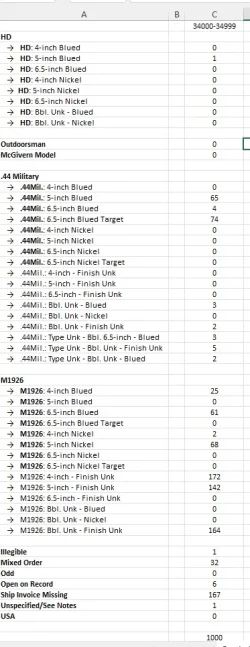
So, within this block of 1,000 Pre-War N-frame serial numbers, what have I found? Statistically, I found the following:
1780635506861.webp

I’m working on refining the categories, so expect them to change in the future. It was necessary to come up with specific classifications because the count kept varying when I would organize the data. I won’t bore you with the particulars but it is a learning process.

The biggest issues is how to categorize guns that are part of an order where you may have one type of revolver but a few different variations.

For example, on April 4, 1930 Wolf & Klar ordered 24 .44 Military (1926) revolvers. The order specifies that all the revolvers be 4-inch M1926 and 16 revolvers be blued and 8 be nickeled. The shipping invoice and the order invoice give no specificity as to the serial numbers of the blued guns. Thus, while we know the serial numbers of all 24 guns in the order, we can’t determine the specific finish on each gun; the only thing we can say definitively is that 16 guns were blued and 8 nickeled. In this instance, the individual guns in this order would be categorized as: M1926: 4-inch - Finish Unk.

Now let us look at that same order and suppose that all the nickel guns were 5-inch. Now we would have two separate barrel lengths and two separate finishes in the same order. Since we still have no way of knowing which finish and barrel length are for a specific serial number, we have to categorize the guns in this order as M1926: Bbl. Unk - Finish Unk.

In some orders we can see that an outfit ordered two .44 Military revolver; both were 6.5-inch and both were blued, but one was a Target Model and the other was not. In this instance, both guns in the order would be categorized as .44Mil.: Type Unk - Bbl. 6.5-inch – Blued.

Also, we see some orders that were for large amounts of N-frame guns but were a mix of HD’s; .44 Mil.’s, .44/40 Mils. and a few M1926’s. Again, since these guns are not listed by serial number on the shipping invoice or order invoice, the best we can do for that particular order is to categorize it as Mixed Order.

While these designations do not let us get as specific a picture as we would like, it will come more into focus once ALL the serial numbers are in the database. Then, we will still not be able to identify specific serial numbers by finish, barrel length etc., but we will be able to at least come up with a census of guns with those specific features. Simply put, we will know the census of a group but not the individual identities.

Some findings in this block (34,000-34,999):

Open On Record - There were 6 guns listed as Open On Record, meaning that there was no entry for them in the shipping ledger. It is possible that an entry for them may be found in the shipping invoices but that’s going to be a search much further down the road. Six Open entries out of 1,000 is actually not bad.

Ship Invoice Missing - There is a vexing gap in the shipping invoices. Specifically, shipping invoices for the period 1/30/31 to 4/9/31 (inclusive) are missing. It’s possible they may be folded into another set of records but that’s a very distant longshot. I had tried to reconstruct some of them from order invoices in another part of the database but the gap seems to extend to these as well. I suspect that when the records were salvaged, a book slipped between the cracks. We can still see what serial number gun was shipped to whom and when, we just can’t tell what kind of gun that particular serial number is. I’m working on this.

Wolf & Klar – Of the 1,000 guns in this particular block, 731 went to Wolf & Klar! If someone has the sales figures for the 1930’s, I’d love a copy. I’d like to see exactly how much of S&W’s Depression-era income was from the folks in Fort Worth.

6-inch Guns – Four guns are listed as export orders as having 6-inch barrels. If correct, these would be a nice variation. It is my belief that these barrel length entries are typos, as several other guns that were commonly made in 6-inch were also on the order. Speaking of typos, I was able to prove that there were more than a few instances of serial numbers being recorded on the wrong orders. These instances were detected by comparing shipping invoices against shipping ledgers and finding that occasionally a gun for Buyer A would get listed under Buyer B and vice-versa.

There were no shipments that stood out to me. Nothing to Ed McGivern (in this block), no special guns to DBW. There were a few tricked out guns, but nothing outrageous:
  • There was a .44 Military 5-inch made up as a Target gun, which is a bit unusual but not unheard of (#34060)
  • A rather nice .44 Military revolver (#34115) went to Cuba “…handlapped barrel, grooved tang and backstrap, high bright blue finish and Circassian walnut stocks, no swivel…”
  • One .44 Military revolver that shipped with an extra cylinder in .44/40 (#34126)
The technique I'm using for categorizing has some merit, I think, and I am going to try and incorporate it into the 35,000-35,999 block and then run analytics on both blocks together. Because of some minor nuances in how I parse the data, larger samples give me much better glimpses of how things were being done. Figure a week or so and I should have something more.

As always, none of this would be possible without the folks at the Smith & Wesson Historical Foundation. If you haven't joined yet......

Best,
RM Vivas
 
I don't know how you do all this. Just reading it makes my head explode. One more correction though. It's 05JUN26.

Keep up the good work.
 
Astounding work, Robert...I'm going to pass the hat at the S&WCA to buy you a new pillow to use on that folding bleacher seat you use in your office... :cool: ...Ben
 
Astounding work, Robert...I'm going to pass the hat at the S&WCA to buy you a new pillow to use on that folding bleacher seat you use in your office... :cool: ...Ben
I'm working on a new website that will highlight my research and findings. It'll have a "Click to donate to Cherry-Coke, Sushi & Whiskey Fund" button.

Not kidding.

Best,
RM Vivas
 

Latest posts

Back
Top