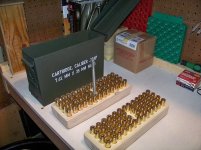
Reloading kits

Rlharwood

Member
Joined
Feb 27, 2020
Messages
7
Reaction score
6
I am thinking about learning to reload due to the current ammo environment. I have read at least one book for beginners just to see if this is for me.
The question I want to ask is about the various parts of the kit. Are any parts need to be bolted down to a work bench?
 
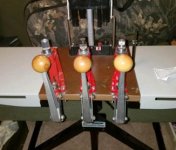
The reloading press needs to be bolted down, ideally. You may get away C-clamping it to a bench, but the bench needs to be very sturdy. The case trimmer also needs to be secured some way. You could screw it to a piece of 2X4 and then C-clamp that down. Same with the powder measure and stand.
 
Yes, the press should be secured to a strong bench that can take many pounds of pressure when loading some of the bigger rifle cases, and really should be pretty secure for pistol cases too. I even reinforced the right side of my bench with 1/2" plywood where I mounted the press and it's held up for almost 50 years now.

Most everything else can be mounted on wood blocks and then C clamped to the bench for convenience and to keep your working space open when they are not in use.

Let me say that if you decide to start reloading, you will enjoy the fruits of your labor much more than factory loads.
 
Last edited:
As noted above, the bench needs to be very sturdy with a heavy top. I’ve tried C clamps with a RCBS Rockchucker and it doesn’t work. Bolt it down. I used some heavy duty lag bolts. My bench is an old woodworking bench that came out of a high school woodworking room when the course was discontinued. They needed the room for a computer lab.
 
There are some types of loading equipment that are strictly hand held, but the production rate is in the Dozens per hour, instead of two or three hundred per hour (after you get use to it.)

There are Arbor press dies, than you could use a mallet with, but again they are in the Dozens per hour.

I own a few of each of the systems. The best place to start (as designated by 1) best quality ammo, 2) best production rate, & 3) within a reasonable cost) is a single stage press using standard 7/8-14 threaded dies!

The other systems were for special purpose or the need for extream space and portability. I have found then to be rapidly frustrating and quite taxing for strength!

Ivan
 
I have to say that each of my presses are bolted to their own chunk of 2X6, which I then C clamp to my bench. It has worked fine for the last 48 years or so. I did bolt my P-W 900 shotshell press directly to the bench, but the rest are C clamped.
 
I recently updated my bench. I went from two 3/4” pieces of plywood glued and screwed together to a really dense desktop that was ordered in the wrong color and couldn’t be returned to the manufacturer.

I got four 24”X48” tops free! Using two of the four I retopped my 24”X96” bench. To say it’s rigid is an understatement. No give, no flex with anything I’ve sized.

It is tougher to drill and I had to get longer screws, but it works great.

I was looking at old desks when this opportunity appeared.

I bolt down anything I frequently need that requires lots of pressure in any direction. The press is a definite, my old electric (Spring Loaded) RCBS case trimmer is too.

I use clamps for powder measures, primer pocket tools, etc.
 
I am thinking about learning to reload due to the current ammo environment. I have read at least one book for beginners just to see if this is for me.
The question I want to ask is about the various parts of the kit. Are any parts need to be bolted down to a work bench?

Reloading is one of my more relaxing hobbies, and opens up many options for shooting whatever caliber you reload for. Lots of good suggestions here, the press definitely needs to be securely anchored, the powder throw is easier to use if secured to a table (depending on what you get), but most other items can be hand-held to start with. I'd recommend starting with a single-stage press and a basic kit, many companies make a "starter kit" that has all you need for basic reloading except the dies, which are caliber-specific. It's an economical way to start, and if you get more volume oriented, a multi-stage press allows for faster reloading with fewer steps and changes.

All that said, if you plan to reload for the long-term, now is the time to start setting things up, but if you want to reload for the short term, check availability of required materials. Right now, it's almost impossible to find primers, especially small pistol; without primers, nothing else matters, even if you can get them by the boatload.
 
Last edited:
Reloading is a great hobby, and a great excuse to shoot more! I have been doing it for almost 50 years.

I suggest getting a good book on reloading and reading it through before buying a bench. "The ABC's of Reloading" comes to mind. It's outdated, but the fundamentals are the same. It covers almost everything.

Have a blessed day,

Leon
 
after reading the intention of the Op to reload and the replies I feel it is important to mention this. I have been shooting for decades and only recently desired to learn reloading. Having acquired a Buchanan LCL press along with almost all the necessary components to reload .38 Special, there is one item that cannot be purchased within reason. The small pistol primers. This isn't meant to discourage but inform with realtime information, additionally equipment for reloading is sold out and on backorder.
 
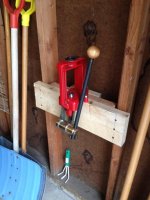
You don't have to have a bench. I nailed a couple 2x8's together. My press is bolted to the edge of that, and the ends are screwed to a couple studs out in the garage.

Very compact. The press sits back in the space between the studs. It's easy to bring a small container of brass over for each pass.
 

Attachments

  • PressMt.jpg
    PressMt.jpg
    59.9 KB
I don't have a reloading bench inside my house or at my office .
I reload all handgun ammo , everything from 32 auto to 45 acp , 41 Magnum and 30-30 rifle with a Lee Hand Press . It's a hand held , single stage C press .
Do not let the lack of a heavy bench stop you from reloading handgun ammo ! While not as convenient or as fast as a bench mounted press ... not all of us have a bench . The hand press uses standard dies and comes in handy for little odd jobs .
It doesn't have the leverage for easily sizing large center fire rifle... it will do 30-30 easily .
If you are not sure about reloading then check out the Lee Hand Press Kit , get a set Of Lee Dies and it comes with shell holder, primer seating tool and powder scoop ... even if/when you up grade the Lee Hand press has many uses.
I have 5 bench mounted and two hand presses ... I'm starting to use the Hand Press more than the bench mounted press lately .
Also it's compact ... I put everything I need to reload in a range bag , stores in the closet and sometimes goes to work with me so I can reload at my desk ... it's a very portable reloading setup !
Gary
 
Last edited:
In response to your original question, yes, buying a "kit" by one of the major manufacturers will usually save you some money. As mentioned, the only thing you need to add is a set of dies.

I started with a Lee classic loader kit and then to an RCBS single stage press. If you are reloading for handgun, I would suggest a turret press. Most turret presses will also load rifle calibers. I can't recommend the Lee Classic Turret press enough. It is a sturdy built press, changeovers only takes seconds and you have the option of using the auto index feature to speed things up. IMO, it is a good compromise between a single stage and a true progressive press. Good luck and enjoy! :-)
 
A couple thoughts...

1) You need a solid bench. Solid is important as it has an impact on how easy the press is to operate and how accurate/consistent the powder measure will be.


2) A solid bench isn't hard to make if you have a drill or power screw driver and a saw. There are a couple ways to go.

A) There is the portable option. This was lasted 15 years and 3 ***'s plus a couple other moves and still lives in the garage. It's very stable and used the weight of the components stored in it for for additional stability. It'll fit in a closet if your available space is minimal. It's made from a sheet and a half of 3/4" ply and a couple of 2x4s screwed together at the base, and for the shelf supports.

e935709e-c042-4f91-8a80-889f3da4ff11_zps121bf9a7.jpg


15743576-f278-4037-aeee-09744c788eca_zpsfd692719.jpg


B) You can build a torsion beam bench. Basically, it uses three 2x4s glued and screwed together to for the beam at the front side of the bench. The back is a 3x4 screwed to the studs and the front and back are connected by 2x4s. The top is 3/4" plywood screwed to the front, back and ribs.

The legs are made from two 2x4s screwed edge to edge.

Beyond that you can add drawers shelves, oak facing to make it look pretty, a tile top, etc.

This covers the process pretty well...

Inexpensive No-Flex Bench How-To | The High Road

I made one once we moved into our current house 7 years ago. I faced it with oak and added some shelves and recessed lights. I also used tile on top. It's easy to clean and durable. I left them lose but snuggly fitted so it I ever break one (I haven't yet) I can just replace the broken tile. The most difficult part was drilling the holes in the tile for the press mounting bolts.

E7D9FB2D-D28A-41A3-9AC3-AC7100B204FF_zpssyohjzjl.jpg


3) You'll get lots of advice on a starter press. I've been reloading since I was 12 and started with an RCBS Junior (a non compound leverage, single stage press).

I also have a Lee hand press that I use for various things, but mostly .45-70 and .38-55 black powder cartridge loads that more often than not I'll reload in the field.

However, 99% of my handloading gets done on a Dillon 550B. It's a manually advanced progressive press. Dillon makes great stuff, they have great customer service and they warranty their stuff for ever.

Now...the controversial thing I'm going to say is just start with the Dillon 550B. Right now heads are exploding as people read this, but hear me out.

The 550B is a manually indexed progressive press, which means the shell plate doesn't rotate when you pull the handle, but instead just sits there until you manually rotate it.

That means you can operate the press as a single stage press by just swapping the dies in the same position on the tool head (or just get a tool head for each die). Alternatively you can get an aftermarket kit that converts it to a single stage press.

single%20stage_zpsdn7lad9c.jpg


Either way, you can use it as a single stage press until you are ready to move up to something faster.

Once you are ready to move up, just put the dies in a single tool head, put a single case on the shell plate and rotate it through all the stations. In effect you are operating the press as a turret press, just rotating the shell plate rather than the head of the press.

Once you have that down, just put a fresh case on the shell plate after each pull on the handle and operate it as a progressive press.

I can load about 450 rounds of handgun ammo per hour without working hard, and I can load 110 rounds per hour including time to manually operate a BR3 measure on the press (using their 3/4 Powder measure adapter) and check the powder weight on a scale.

I do that when I load precision ammo on it. Using Whidden floating tool heads, a clamp kit, and standard dies, I get runout of .0015" or less.

The Dillon measures work well and offer different sized adjustable charge bars that cover everything from .32 ACP to large magnum cartridges. Aftermarket support for it is awesome with all kinds of accessories from Dillon and other companies that let you customize it to do exactly what you want to do with it.

In short, it's a "buy once, cry once" approach that won't leave a trail of no longer used presses you've outgrown.
 
Whatever route you take, stay organized and keep the work space neat, with only the powder, primers and bullets you are currently loading in the work surface.
IMG_0264_2_zps3bf8ca4e.jpg


I also keep my primers well marked even in the tubes and on the press.

IMG_0257_zpsecb6ebea.jpg


IMG_0259_zps8aebd44c.jpg


Same with the powder in the measure(s).

IMG_0263_zpsfa4ca66d.jpg


It pays to keep things neat and organized and pay attention to details.

I've been handloading for 44 years making literally hundreds of thousands of rounds for a large number of cartridges.

I've had a single kaboom in that time and that was due to buying a batch of surplus military unfired TW 73 head stamped 5.56 brass. One of them had a soft case that came apart in an AR-15, melting 3 of the locking lugs and blowing the bottom out of the bolt carrier. As it turns out, a lot of TW 73 brass was rejected due to being excessively soft and was sold as scrap. However, an unscrupulous middle man in the process sold some to handloading component suppliers.

I've also had just one squib load in those hundreds of thousands of rounds.

Both kabooms and squibs are and should always be very, very rare events. Handloaders who have them on a regular basis (more than 1 per 100,000 plus rounds) need to have garage sale, sell their reloading equipment and just stick with factory ammo.
 
I've only recently started reloading myself. I went with the Lee Challenger set, and I've added a couple of things since - dies for the different calibers, a Hornady case trimmer being the main items.
For now, I have the press and the powder dispenser mounted on a 1x12 that is C clamped to a B&D workmate. Takes up minimal space, and if I need the workmate for something else, easy to move the board.
It's been mentioned already, but keep it neat. I put everything away between sessions - unused powder goes back into the container, primers are put away. I figure if I have to start from scratch each time, I'm much less likely to make a mistake
 
You don't have to have a bench. I nailed a couple 2x8's together. My press is bolted to the edge of that, and the ends are screwed to a couple studs out in the garage.

Very compact. The press sits back in the space between the studs. It's easy to bring a small container of brass over for each pass.
This is a great idea. Well done.
 
I am thinking about learning to reload due to the current ammo environment. I have read at least one book for beginners just to see if this is for me.
The question I want to ask is about the various parts of the kit. Are any parts need to be bolted down to a work bench?

I hope you’re happy with yourself. You have opened the can and spread worms all over! The ducks are no longer in a row, they’re chasing the worms. :D

While this section of this forum will let you “dip your toes” into reloading it is in no way definitive. You have a range of commonly available startup options for reloading;

1) No bench is needed to utilize the old Lyman 310 Tong Tools and their clones or the various “Whack-a-Mole” sets like the Lee Loader sets. These are sometimes referred to as “kitchen table reloaders.”

2) With a hand press such as the cheapest from Lee to the high end from Buckingham, one can load without a bench or secure the hand press to the bench if desired. These have the advantage of utilizing standard loading dies if you wish, and offer more complete processing of the brass cases.

3) A true bench press may either be bolted directly to a bench or to a short plank and clamped to the bench. This is the strongest but least portable means. If you have a limited amount of bench space available, swapping out a press or three can be good, and stashing the press away completely I also possible.

I would suggest you might want to explore all of this further on a reloading specialty website... my personal favorite is Cast Boolits dot Com, but there are several good ones.

If you are considering reloading to assure a supply of ammo, this will work well until one or more components go short (like primers are now.). If you want to do it to save money, you probably won’t. I’ve been loading for over 40 years now and am waiting for the savings to begin! :rolleyes:

Regards,
Froggie
 
Here's another approach I found online... poor man's Dillon? :)
 

Attachments

  • lee3.jpg
    lee3.jpg
    16.5 KB
When I moved....

I am thinking about learning to reload due to the current ammo environment. I have read at least one book for beginners just to see if this is for me.
The question I want to ask is about the various parts of the kit. Are any parts need to be bolted down to a work bench?

..from my bolted down garage bench to a desk in my house. I bolted the press to a 3/4 board and recessed the bolts with a spade bit. Two C clamps and it' solid as it if it were bolted down.
 
Guys,
Thank you so much for your great responses!!

You have given me a LOT to think about!
 
I might add, regarding the bench, that you do not need a dedicated bench. I use threaded inserts in holes in my workbench. When I want to reload, I mount the press(es), powder thrower, sizer, etc., using the predrilled holes with the 1/4” threaded inserts. I have different hole patterns for each piece of equipment. When done, I unbolt and put everything away.
 
I finally stopped being lazy and started reloading earlier this year. Have everything setup and bolted to two boards from a junk IKEA bookshelf.
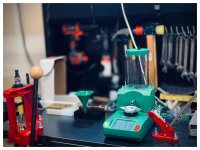
Side note, the RCBS Chargemaster is pretty neat and simple enough my 6 year old daughter can already run it.
 

Attachments

  • FADB4803-2EC4-4E86-8D29-5F2E43CB2462.jpg
    FADB4803-2EC4-4E86-8D29-5F2E43CB2462.jpg
    57.9 KB
Find somebody who is remodeling a kitchen or bathroom. Used cabinets and vanities make good reloading benches.
 
I started re-loading due to 2 things: How much I love to shoot my 500 and the cost of the Ammo for it!! I went from about $3.00/round to about $.35-$.88 per round depending on whether I'm loading target, RN, or Hunting, JHP XTP's...

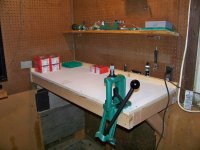
I started with the RCBS Rockchucker Supreme Master Reloading Kit and I added a few more things like a digital powder scale and such.. Here's a pic of my set-up/bench that I had in my Manshed in Va..

Hope this helps and have Fun with it!!
 

Attachments

  • 100_1613 resize.jpg
    100_1613 resize.jpg
    108 KB
  • 100_1634resize.jpg
    100_1634resize.jpg
    78.8 KB
I have reloaded since the early 1970's,,
Today, I loaded 300 AAC Blackout for the first time,,

210 grain bullets with Hodgden CFEBLK powder

It was as much fun as the first time I bolted a reloading press to a workbench,,

I reloaded about a dozen, took them outside and made sure my AR15 pistol liked them,,

Then loaded a BUNCH more,,

Tomorrow, I am gonna load a hundred of the 150 grain bullets,, :D
 
Just be glad that you are thinking of just "Metallic" reloading of rifle or pistol, ammo.

Now if you were thinking of getting into reloading for shotgun ammo........

that is a really big can of worms for you to work with and learn.
 
And all along I was hoping this was a thread about a "reloading kit" that included primed cases and bullets and which was CURRENTLY AVAILABLE...!

"Where have all the primers gone? Long time passing...
Where have all the primers gone, a long, long time ago?"
 
Back
Top