Russian Model Rimfire Conversion

Giorgio Italy

Member
Joined
Jul 13, 2021
Messages
128
Reaction score
260
City & State/Province
Padova Italy
Hi all
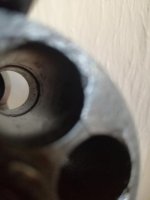
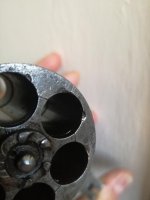
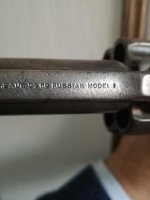
This my Russian 3# model I think is definitely in centerfire .44 russian
But the frame would seem to be converted from a rim fire

The number on the cylinder is barely noticeable and it is almost impossible to read it
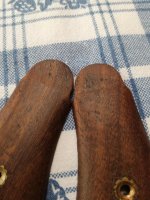
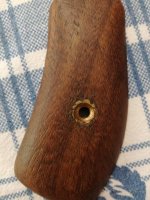
The corresponding number under the stocks is not seen
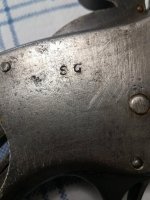
That SG is indecipherable!

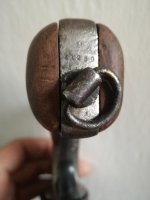
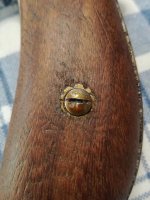
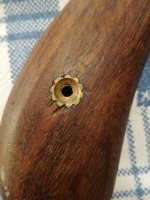
Do you think the stock is original? In my opinion, no!

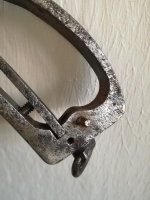
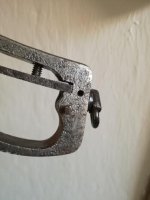
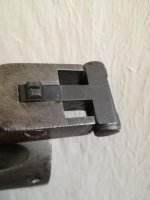
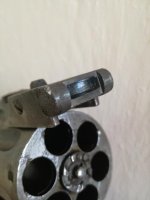
And finally ... has the barrel catch been rebuilt?

Thank you for your answers

Giorgio
 

Attachments

  • 1.jpg
    1.jpg
    60 KB
  • 2.jpg
    2.jpg
    36.8 KB
  • 3.jpg
    3.jpg
    31.8 KB
  • 4.jpg
    4.jpg
    20.3 KB
  • 5.jpg
    5.jpg
    22.1 KB
  • 6.jpg
    6.jpg
    28.4 KB
  • 8.jpg
    8.jpg
    54.5 KB
  • 10.jpg
    10.jpg
    37.1 KB
  • 7.jpg
    7.jpg
    29.7 KB
  • 11.jpg
    11.jpg
    68.2 KB
  • 16.jpg
    16.jpg
    63.3 KB
  • 17.jpg
    17.jpg
    66.4 KB
  • 18.jpg
    18.jpg
    77.6 KB
  • 19.jpg
    19.jpg
    76.4 KB
  • 12.jpg
    12.jpg
    32.5 KB
  • 13.jpg
    13.jpg
    27.7 KB
  • 14.jpg
    14.jpg
    33.7 KB
  • 15.jpg
    15.jpg
    43.1 KB
Last edited by a moderator:
The stocks are replacements. All original 44 Russian stocks were smooth walnut with convex top rounds like the ones on my gun above. Your gun was heavily rusted before cleaning and has pretty much destroyed the assembly numbers, but I believe that it can be determined that there were numbers on the front toe of the butt-frame. They are completely unreadable today.

attachment.php

attachment.php
 

Attachments

  • 6.jpg
    6.jpg
    42.5 KB
  • 8.jpg
    8.jpg
    75.2 KB
44 Rimfire Conversion?

Giorgio,
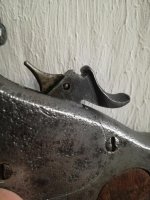
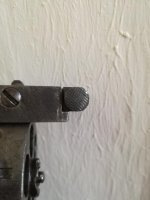
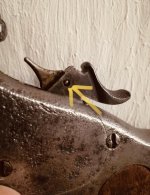
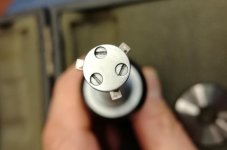
That is a fabulous example. The 44 Rimfire conversions are a book in and of themselves. Notice the photo of your hammer? Very professional conversion from a 44 Rimfire hammer to centerfire with a perfectly inserted pin.
(Photo 1)

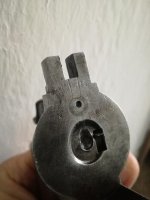
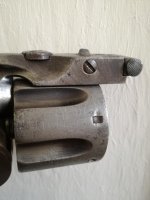
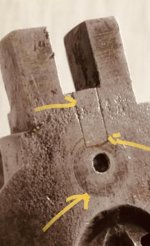
Then when we look at the recoil shield? We see a machined insert to "fill in" the rimfire channel and a machined centerfire boss. Also, if you look closely, you'll notice the circular machined scribe still partly visible. This is a "professional" alteration. NOT a blacksmith alteration. This is in line with a later cartridge conversion pistol type work. Some factory did this in my opinion on contract.
(Photo 2)

The reason the 44 Rimfire story is long and hard to evaluate is about 10 fold but I'll cut it short.

1) There are Belgian made 44 Rimfires in both SAA and Smith & Wesson.
2) The European conversions are often converted to a European caliber.
3) They can be found converted to 44 Henry Flat centerfire, 44 Russian, 44 WCF, 44 Webley, 44 Colt, and several European calibers as well.
4) Finally, it's extremely difficult to determine who, where, why, they were converted and to what caliber it was finally intended for since all those that I've seen are NOT caliber marked!

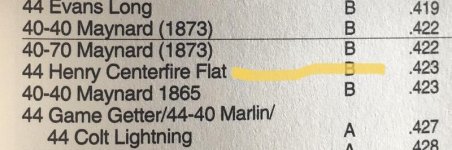
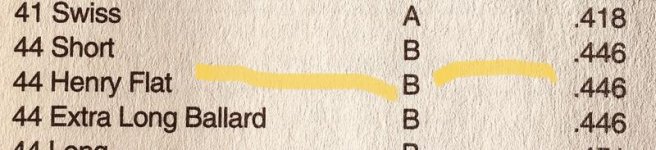
So, basically what you have to do is mic' the cylinder and most importantly? the bore. There is a huge difference between all the calibers mentioned. Dialing in a round that was originally intended when altered is honestly a simple task. Just mic everything!!

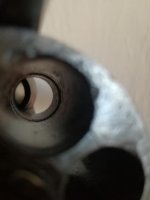
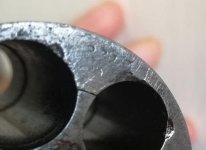
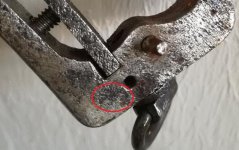
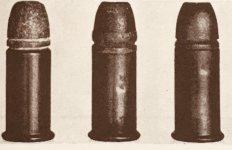
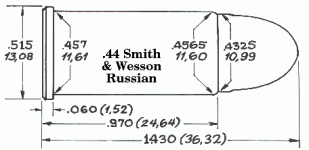
You CAN NOT convert a .44 rimfire to a .44 Russian! CAN NOT be done!! without a cylinder change and barrel change. The original .44 Rimfire was an outside lubricated bullet that measured .446... The Russian Centerfire measured approximately .430 originally. Also, the case dimensions are not compatible.
(Photo's 3&4)

The one exception is the 44 WCF caliber. That caliber is "close" to the original .44 Henry rimfire. Often within 3 thousandths of an inch...Which is pushing it but I've seen several SAA's that still have the original 44 rimfire barrel with a 44 WCF cylinder and altered hammer to centerfire. I've also seen several altered "back" to original 44 rimfire to increase value.

So, these conversions are a huge pile of mystery without resolve. Your only solution is with a caliper in hand and careful measurements taken. "Slug the bore"!! measure your findings.

Very neat piece of history. I apologize for the "odd" label in my previous post. Poor choice of words on my part... More like Historically unique? I like them a lot.

Lots of collectors out there that pay big dollars for them also.

Murph
 

Attachments

  • 985E3F11-3DCD-4121-AF36-F1972D6BDC1C.jpg
    985E3F11-3DCD-4121-AF36-F1972D6BDC1C.jpg
    66.1 KB
  • 681EC973-FE2C-49CA-9101-1BE8950DBB51.jpg
    681EC973-FE2C-49CA-9101-1BE8950DBB51.jpg
    41.7 KB
  • B5268418-61C8-48E8-8BFD-863987C292E7.jpg
    B5268418-61C8-48E8-8BFD-863987C292E7.jpg
    45.7 KB
  • 3D0B7F1D-543C-4D48-8727-0DF707E9FFAC.jpg
    3D0B7F1D-543C-4D48-8727-0DF707E9FFAC.jpg
    39.6 KB
Last edited:
Thank you very much
Very interesting information
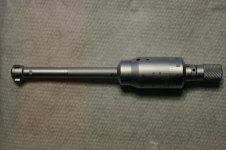
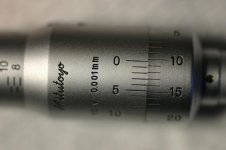
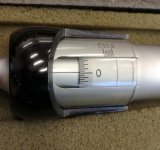
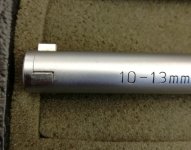
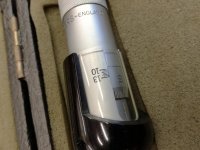
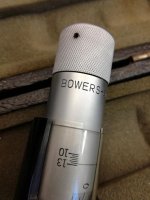
I will get this Mitutoyo from a friend and measure the chambers, throats and barrel ..
We'll see if they are compatible with the .44 russian

Giorgio
 

Attachments

  • IMG_3915.jpg
    IMG_3915.jpg
    60.6 KB
  • IMG_3924.jpg
    IMG_3924.jpg
    52.2 KB
  • IMG_3925.jpg
    IMG_3925.jpg
    13.8 KB
I moved the posts concerning this gun from the other thread. A new thread avoids confusion.
 
Excited!

I don’t mind telling you Giorgio that I’m kinda excited about your conversion. Why?

It will help greatly to establish insight as to : “ What they were thinking at that time”?

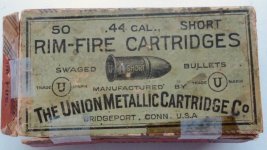
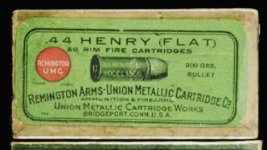
It’s long and boring for most but there were Several firearms at that time that chambered different variations of .44 Rimfire. Both Henry Long and Short, the identified “Flat” variation, Bulldog variation, Forehand & Wadsworth Rifle, Allen & Wheellock, Moore, the list is endless.

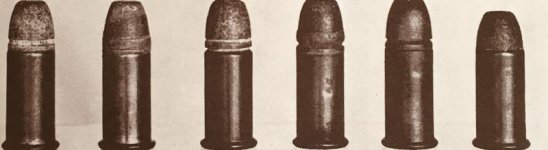
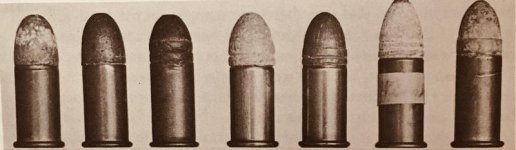
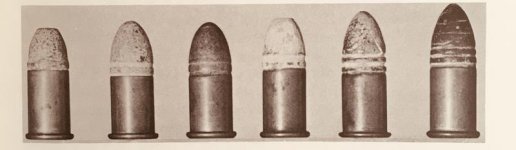
See photo’s of just 18 of the over 26 proven cartridges.

They vary from The tubular Flat Henry type Rifle bullet in .418 diameter to the pistol/ Bulldog/ rifle Round nose as high as .461 diameter! All are the same caliber 44 Rimfire! All designed for different guns!!

This is “exactly what I’m trying to convey” regarding the Black Powder Era. It’s extremely complex and should never be considered standardized.

Example: If I claim the .44 Rimfire was .446 in bullet diameter? I must be specific to the exact Antique firearm that chambered that diameter round.

I’ve found the following diameters: .418, .436, .439, .441,.443,.461, etc. All specifically designed to be chambered and fired in one singular firearm! The question is which one?

See photos of only some documented! No two are the same!

Murph
 

Attachments

  • B237AA25-B85E-4D50-BE4C-4DBFEF4C60B6.jpg
    B237AA25-B85E-4D50-BE4C-4DBFEF4C60B6.jpg
    24.6 KB
  • 24BB7FB6-E9D0-4F09-8137-3E52AAAF2843.jpg
    24BB7FB6-E9D0-4F09-8137-3E52AAAF2843.jpg
    28.8 KB
  • 0A9F5383-1080-42D9-AC2C-C54BDA38BC35.jpg
    0A9F5383-1080-42D9-AC2C-C54BDA38BC35.jpg
    23.4 KB
Last edited:
Just tossing out ideas, here, but in 1877~78 S&W produced several thousand (3000ish?) Russian 2nd Models, not for Russia, but for TURKEY, and in .44 Henry RF. This was one of the factors that led Russia to first have Loewe build guns for them, and for them then to start their own production lines.
That means that the FACTORY produced this gun in .44 Henry with an RF frame and RF hammer--so, was there a larger-bore cylinder and barrel fitted to be compatible with the fatter .44 Henry RF, or did S&W just get by with the smaller-bore .44 Russian barrel and hope for the best, what with soft lead bullets and low chamber pressures?
Of course, this doesn't explain the conversion (of a conversion?) from RF to CF of a gun that started out as CF, nor does it answer what cartridge this gun was intended to fire post-conversion.
 
Last edited:
44 Rimfire storyline

The 44 Rimfire is a cartridge that is not thoroughly understood nor has it been properly labeled or researched. Everyone seems to just call it the 44 Henry rimfire. That is not at all accurate.

The 44 Henry Flat was specifically for the tubular magazine Henry rifle design having bullets with flat tips for safety reasons. Not unlike the 44WCF. For what reason I don't know since the round was a rimfire not a centerfire? Makes little sense to me personally.

Then you add the large number of pistols that chambered a 44 Rimfire both Long and Short depending on frame type and then you start diving into errors in identification.

Pistol bullets are round nose bullets!! PERIOD... That's what they were at that time. Round nose.....Not flat nose. Pistols chambered the 44 Rimfire Long or short "Pistol round" NOT the Henry round... FACT.

Not enough research has been performed regarding this round and frankly, not a lot of information is out there. Most is lost to history. This was a very early period of cartridge firearms.

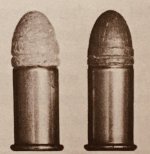
See photo's. The rifle round is the flat bullet....The pistol round is the conical bullet. The conical bullet was the round for the Smith & Wesson revolver. NOT the Henry Flat bullet.

That's why we need those measurements. I have measured several Colts that chambered the 44 Rimfire and "NONE" of them match the Henry round...NOT ONE!!


Murph
 

Attachments

  • E14498B7-3ECA-4FB9-A0FF-5FF56A74C567.jpeg
    E14498B7-3ECA-4FB9-A0FF-5FF56A74C567.jpeg
    164 KB
  • 12ECE166-F202-4651-B7B3-147D4E3A659E.jpeg
    12ECE166-F202-4651-B7B3-147D4E3A659E.jpeg
    101.8 KB
  • 90644581-5C9D-4F13-9C70-6565958D4BA6.jpg
    90644581-5C9D-4F13-9C70-6565958D4BA6.jpg
    54.8 KB
  • 5E7D24D2-A064-42DB-ADD9-7829837708A2.jpg
    5E7D24D2-A064-42DB-ADD9-7829837708A2.jpg
    47.3 KB
Last edited:
Hi
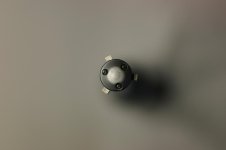
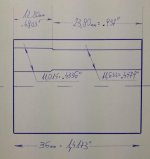
I measured the cylinder chambers with the caliber you see in the picture. I must say that they are very well bored, despite corrosion, and all perfectly the same.
Is its length of only 36 mm compatible with its standard?
To measure the bore of the barrel I will have to make a sulfur swab! Or something similar
 

Attachments

  • 1 (2).jpg
    1 (2).jpg
    33.8 KB
  • 2 (2).jpg
    2 (2).jpg
    36.9 KB
  • 3 (2).jpg
    3 (2).jpg
    65.9 KB
  • 4 (2).jpg
    4 (2).jpg
    76.9 KB
  • 6 (2).jpg
    6 (2).jpg
    80.9 KB
It seems to me, however, that a .44 russian cartridge fits a little tight!
Giorgio
 

Attachments

  • 7 (2).jpg
    7 (2).jpg
    43.6 KB
  • 8.gif
    8.gif
    8.4 KB
44rf converted

Giorgio,

It does look like your cylinder is for a 44 Russian cartridge. It’s probable that yours is a factory conversion from an obsolete 44 Rimfire frame to the more modern 44 centerfire S&W Russian cartridge.
Unfortunately your numbers are no longer readable per your post.
The barrel must mic at .430-.432 Groove diameter for the old 44 Russian specs.

Assuming this was a factory frame conversion from Rimfire to centerfire? Sure would like to know more about it. The 44 Rimfire really is a very interesting caliber and storyline. Just very hard to iron out the particulars.

Murph
 
The 44 Rimfire is a cartridge that is not thoroughly understood nor has it been properly labeled or researched. Everyone seems to just call it the 44 Henry rimfire. That is not at all accurate.

The 44 Henry Flat was specifically for the tubular magazine Henry rifle design having bullets with flat tips for safety reasons. Not unlike the 44WCF. For what reason I don't know since the round was a rimfire not a centerfire? Makes little sense to me personally.

Then you add the large number of pistols that chambered a 44 Rimfire both Long and Short depending on frame type and then you start diving into errors in identification.

Pistol bullets are round nose bullets!! PERIOD... That's what they were at that time. Round nose.....Not flat nose. Pistols chambered the 44 Rimfire Long or short "Pistol round" NOT the Henry round... FACT.

Not enough research has been performed regarding this round and frankly, not a lot of information is out there. Most is lost to history. This was a very early period of cartridge firearms.

See photo's. The rifle round is the flat bullet....The pistol round is the conical bullet. The conical bullet was the round for the Smith & Wesson revolver. NOT the Henry Flat bullet.

That's why we need those measurements. I have measured several Colts that chambered the 44 Rimfire and "NONE" of them match the Henry round...NOT ONE!!


Murph

If only it were that simple, but it's not. First, the modern shooter/collector has to "lose" their modern SAAMI spec line of reasoning as that didn't exist in the 19th century. The reason why many .44 Rimfire rounds won't chamber in Colt '72 Open Tops is because Colt specifically chambered those for the .44 Rimfire Stetson Patent ctg. (1871) that had slightly tighter specs. The other .44 Rimfire ctgs. were made by several different makers who generally tried to make ammo to fit the Henry/Win. '66 firearms.
The .44 American was essentially a .44 Rimfire converted to CF.

The earliest .44 Russian rds. were OUTSIDE lubricated bullets and not inside as most believe. The also had an approx. 270 gr. bullet. My theory is that S&W had come to despise the Russian inspectors and their petty nitpicking and constant alterations during manufacture and merely made stepped . 44 Russian chambers, but let the ammo be. That was changed in the 1880's when a famous American target shooter complained about .44 Russian ammo fouling (I think it was Bennett?) and only then was ammo converted to inside lubed bullets.

FWIW, the first inside lubed U.S. ctg. was the .50 Springfield Carbine rd. which was for the 1865 Spencer and today called the 56-50 Spencer.

Finally, know that ammo production in the post Civil War was a constant battle between engineers and patent lawyers. That U.S. Gov't then was very frugal and hated to pay patent royalties, e.g., Alin Conversion & Grant's veto of the Rollin White Patent extension (which was unconstitutional). As well, the Gov't did not want to pay Hiram Berdan royalties so they avoided the Berdan primer and used the Martin and later the Benét. Winchester switched to the Orcutt primer.

As you can see, it is all very, very complicated. Note however that bore/groove diameters then were all over the map with some '73 Win. Models as an example gauging anywhere between 0.425 to 0.434!!! Some Marlin 1881's go way into the 0.460's!!
 
Last edited:
Back
Top