
S&W Reloading Tools - Help!

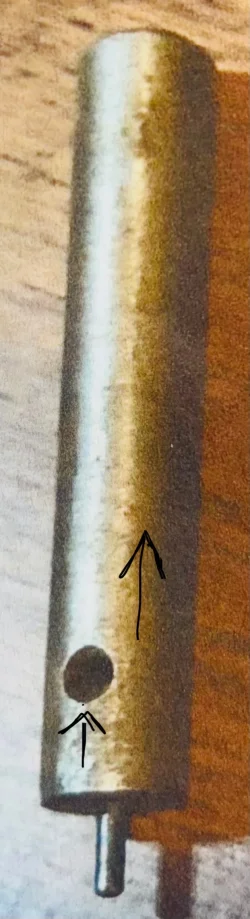
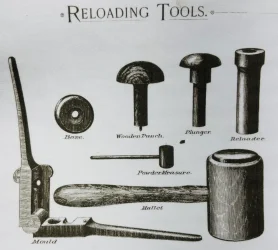
The primer punch deserves a little history review.
The first punches were actually wooden with a mushroom cap.
Replaced soon thereafter by a mushroom cap punch made of mild steel.
Then with the improved kit came the punch in question.
The cross drilled hole in my opinion was to insert a key and allow impact applied to remove a bad pin without damage to the rod and also remove a broken pin by punching into the hole and bending it, punching again until drops out.
They were pressed in.

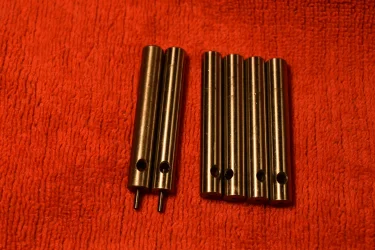
Each caliber came with a different diameter and length primer punch from my collection. IMG_6971.webpIMG_6973.webpIMG_6969.webp
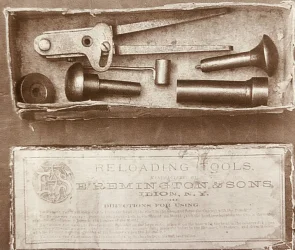
 
Hi There,

I noticed there is a great deal of similarities between
the Remington tools and the early S&W tools. I suspect
One of the three dies I cannot identify may be a Reming-
ton die.

From the books I have consulted on early reloading tools,
the bullet molds Remington made are very close to the
early bullet molds made by S&W (the type w/o the latch
or wood handles). I wonder if any of my early 'S&W' molds
are actually a Remington mold. The way one tells them
apart is the shape of the end of the handles.

Cheers!
Webb
 
Last edited:
Hi There,

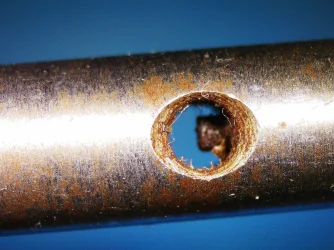
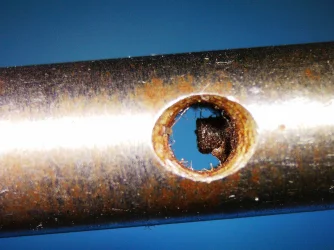
Here are a couple of close-up pics of the hole and
pin in the punch. It still seems undetermined as to
whether the pin is held in by threads or not. I've
thought about using a de-rusting agent but I don't
want to remove the blue on the pin.

2020_0829_204559_067.webp
2020_0829_204607_068.webp

If one looks close, these two pics appear the same
but the focus is a little different. The second pic
is focused on the pin inside the hole.

Cheers!
Webb
 
I can only guess as I do not have a reloading kit to try. Knowing that S&W wouldn't waste a penny, they would not squander the money to bore a hole in the body of a punch or, much less, chamfer the hole, if the pin was threaded. My gut feeling is that the primer punch pin is replaceable and can be driven out of the punch body using a tapered wedge or pin punch.
 
Hi There,

I
I can only guess as I do not have a reloading kit to try. Knowing that S&W wouldn't waste a penny, they would not squander the money to bore a hole in the body of a punch or, much less, chamfer the hole, if the pin was threaded. My gut feeling is that the primer punch pin is replaceable and can be driven out of the punch body using a tapered wedge or pin punch.

I also believe these pins are 'pressed' in instead of
being threaded but the rust pattern on the end of
the pin (inside the punch) just makes it look threaded.
But, I asked the questing to make sure. A small drift
punch would be the tool I would try.

Thanks for all the responses so far!
Cheers!
Webb
 
Hi There,

Well, I have been working on making some
more of the primer punches. Here is my
progress so far.

DSC_0160.webp

The original is on the left and my first completed
repro punch next to it. The other four bodies are
completed but I haven't made enough pins yet.

I discovered through careful measuring that the rear
of the pin does taper. So, these have a .0675" hole
reamed for the small end of the pin to enter.

It is hard to see but I put concentric rings on the small
tapered end to help identify the small end. Maybe S&W
did the same with theirs? It would be an explanation
for why the original looks like it had threads on it.

Cheers!
Webb
 
Those punches look very nice. With black powder and corrosive primers the service life of the pin part of the punch could have been pretty short and a good punch needed to knock them loose
 
Hi There,

From what I have read, early primers were
made from exceedingly soft copper, brass
or bronze alloys and were very easy to push
out. older priming punches with the mush-
room head are evidence that a good smack
or push with the palm of the hand would
push them out. At least, when the reloading
was done soon after shooting.

Leaving them alone for a long time would
tend to corrode them more.

A thought occurs. Seeing that early primers
tended to be Mercury Fulminate compounds,
I'm surprised there wasn't more trouble with
split cases (because Mercury tends to embrittle
brass). Of course, those primers may not have
had as much deleterious effect on the copper
colored cases (which were a 95% copper 5%
tin alloy). Food for thought.

Cheers!
Webb
 
Hi There,


A thought occurs. Seeing that early primers
tended to be Mercury Fulminate compounds,
I'm surprised there wasn't more trouble with
split cases (because Mercury tends to embrittle
brass). Of course, those primers may not have
had as much deleterious effect on the copper
colored cases (which were a 95% copper 5%
tin alloy). Food for thought.

Cheers!
Webb

From what I've read the black powder fouling tended to reduce the effect of the Mercury from the primers. Basically, the primer fouling was largely absorbed into the residue from the black powder so little of it actually contacted the cartridge case. The problem really reared its head when smokeless powders began to come into use as they did not leave the heavy fouling that black powder did and allowed more of the Mercury residue to come into contact with the shell casing. Resulting in brittle cases that wouldn't hold up to being reloaded. Combined with the fact that smokeless required much more care in reloading this led many companies to discourage people reloading their fired cases.

Improved primer compounds largely eliminated the case embrittlement problem by the early 1900s. US makers had largely abandoned Mercury fulminates for Chlorate based primers by that time though some foreign countries continued using Mercury for quite a few years. Many gun and ammo companies continued to discourage reloading for some time though it was largely due to fear of people overloading with smokeless (and increasing sales of factory ammo too!).
 
Hi There,

Improved primer compounds largely eliminated the case embrittlement problem by the early 1900s. US makers had largely abandoned Mercury fulminates for Chlorate based primers by that time though some foreign countries continued using Mercury for quite a few years. Many gun and ammo companies continued to discourage reloading for some time though it was largely due to fear of people overloading with smokeless (and increasing sales of factory ammo too!).

Unfortunately, Chlorate priming compounds caused after
rusting and it took several years to discover the reason
and priming compounds changed again in 1920's to
things like lead styphnate.

Cheers!
Webb
 
Hi There,

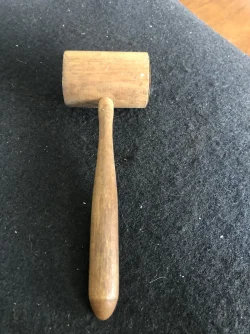
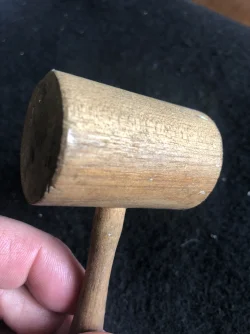
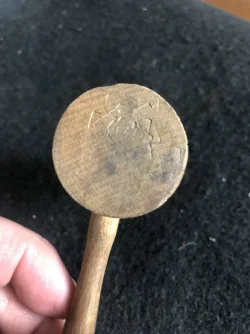
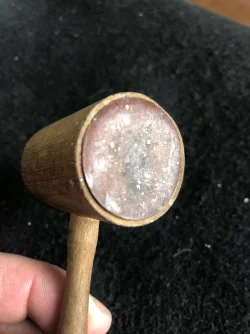
I purchased a mallet off of eBay that looks like the ones
used in the S&W (and others) reloading tool sets. Tell
me what you think.

mallet 4.webp

Mallet 1.webp

Mallet 2.webp

Mallet 3.webp
It looks pretty close to me. Certainly usable for the
intended purpose. I haven't received it yet but it
should come in later this week. The seller's description
said:

"Vintage Small Wooden Mallet. It is 6” long. Head is
2” long and about 1 3/8” across center. Was purchased
with reloading and ammo equipment. One side of head
has a soft cover on it. See pics.
"

So, I am hopeful.

Cheers!
Webb
 
Hi There,


Unfortunately, Chlorate priming compounds caused after
rusting and it took several years to discover the reason
and priming compounds changed again in 1920's to
things like lead styphnate.

Cheers!
Webb
Yep! Chlorate had its own issues and people were slow to realize exactly what they were. They left a residue in the bore that required cleaning with a water based solvent to remove the salts. With proper solvents they were not an issue so long as they were cleaned properly after use. They were also very reliable with a good shelf life and even after the non-corrosive lead styphnate compounds became available they continued in use for quite a while. Primarily for military ammo where proper cleaning was pounded into recruits heads from the start! The US military first issued a non-corrosive primed caliber with the 30 Carbine in WWII. Military 30-06 and 45ACP didn't switch until the early 1950s when civilian users had been able to use non-corrosive loads for years!
 
Hi There,

Yes, the Chlorate would break down and release Chlorine
which is very reactive. Even with scrubbing and cleaning,
the Military still sometimes had after-rusting appearing
a day or two later. At the time, the Army adopted a two
session cleaning procedure in which the rifle was cleaned
right after shooting and then again 24 hours later.

Chlorine salts are very soluble in water and scrubbing with
hot water would usually remove the chlorine residue.

Cheers!
Webb
 
Back
Top