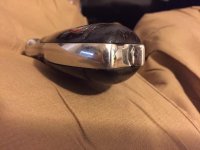
Safely remove plating?

LionWeight

US Veteran
Joined
Jul 19, 2014
Messages
55
Reaction score
23
City & State/Province
SE Michigan
I have a Model 3 Russian that was re-plated in it's past. So much plating that the serial number can't be read. Is there a way to remove some of that and not damage the metal? Damaging is not an option in my opinion. Any tips or ideas?
 
As far as I know, removal of plating is pretty much a matter of removing all of it or none of it. I don't know that removing or reducing the depth of plating in one spot is even possible.

Now you say it was re-plated at some point and the plating is so thick that the serial number is illegible. Could it be that there was rust and this piece was polished to the point that the serial number was erased or so nearly erased that the plating obscured the serial number?
 
Brownells has a chemical solution to remove nickel plating without harming the base metal. If the numbers are still illegible you may be able to have them chemically “raised”
 
Over the years, here's what I've learned on this forum about this issue:

All nickel plate removable methods use reverse electrolysis which involves immersion and a low voltage electric current. Therefore it's impossible to 'spot' remove nickel.

Methods to make serial #s reappear:

1. This can be done with nitric acid, or "nicodate" sold in coin shops. After application, the # will magically appear. It's actually exposing the compressed metal from the stamping appear in a contrasting darker gray to the surrounding metal.
Is this a legal serial number?

2. Another method is to bead blast the area where the s/n was with a very fine grit. Again it will show contrasting shades of gray.

3. Fry's reagent "serial number restoration fluid."
FRY'S REAGENT RESTORATION FLUID - 2 OZ Fry's Reagent Restoration Fluid - 2 oz. | ShopEVIDENT.com

Development of new reagent for restoration of erased serial number on metal plates - ScienceDirect
Where to buy: fry's reagent where to buy - Google Search

I think #2 above is your best chance. I would just do the butt of the grip frame. That's the location that must be readable from a legal stand point. Once the # shows you can find sand the area and polish it by hand with 2000 grit sand paper and Flitz polish to blend in with the shiny nickel.
 
Last edited:
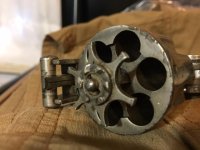
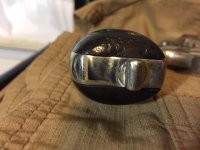
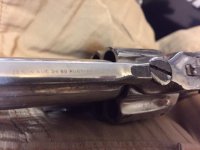
phone pics

This shows how deep the plating runs in those areas. On the butt I hand polished using a jewelry polish a little and stopped. It still polished some of the scratches out.
 

Attachments

  • close up cylinder.jpg
    close up cylinder.jpg
    35.9 KB
  • frame butt.jpg
    frame butt.jpg
    37.6 KB
  • end barrel rib.jpg
    end barrel rib.jpg
    30.7 KB
Is that some sort of lanyard ring welded on the butt? I'm pretty sure it's not thick nickel plate that's the problem, there's a lot of metal that's been ground off before plating.
 
Welding?

This is a better picture so you can see there was no welding or grinding done. What looks like a crack is a reflection.
 

Attachments

  • lanyard close up.jpg
    lanyard close up.jpg
    34.4 KB
Thx for the better photo. Although it shows even more clearly that the grips overhang the grip frame. Metal has been removed. The bump on the butt is not factory so welding had to be used to attach it.

And there's no nickel plating that's thick enough to completely fill the # digits like it shows w/o a trace of depressions.

Have you taken the grips off to see if the serial # was restamped on the side of the grip frame?
 
That lanyard ring base or what ever it is, can't really tell in the picks could have been simply soldered into place.
Most plating will cover soft solder because of the tin content in the solder.
Hard solder will plate perfectly too as will braze. But they require much higher heat, the latter nearing weld temps.

Anyway, that area behind it sure looks like it was filed down quite low before plating. That's judging by the grip fit being above the metal even as worn as they are.

I know that labs can sometimes recover a stamped image like a ser# from a surface that been ground out or filed a way quite deeply. But it all depends on how much force was applied in the strike to make the orig marks,,the compression of the metal.

If you want to try,, I'd go ahead and mechanically remove the nickel from the butt area,,that means polish it right off with grit paper backed up on a file to keep things a flat as possible.
They aren't too flat to begin with, but you'll soon see where you need to work and where not to.
I can just about guarantee there's no number under that plating,,filled in or otherwise,,visible.
All you will find and all you need to dig down to is clean steel in the area that the ser# is supposed to be in.

What you may find is not clean steel,,but a combination of filler in the steel. That being hard solder or braze used to fill grinder hollows or rough file marks when a # was removed.

The ser# may have been right in the middle of the butt,,not off center to the rear where the hollowed out area is. If that added base has a shank that required a drilled hole through the butt,,then there went for eternity part (at least) of the ser#.

If the ser# was all in that hollowed out area and there is just clean steel under that plating (and you won't know till you polish it away),,then there is a slight chance home brew acid lift methods will faintly make it reappear for you.

With all that, there's that nagging issue of Altered, removed, obliterated ser#'s on firearms.
The #3 is considered an Antique Status firearm I think no matter the ser#,,so does that remove that issue?
I don't know the answer.
Then what does the State of Michigan think of the handgun w/it's ser# removed.
Just asking cause I really don't know.

I'd like to see the oldie fixed up again
 
Lanyard

The lanyard loop post on the butt is pinned in place, not soldered. There are a couple places on the gun where the plating has chipped. Where that has happened there is a distinct shoulder or lip in the plating. Maybe this is a chrome plating since it polished up so much with just a little effort on the butt area.

There is an assembly number stamped on the frame under the grips. That number matches on the latch and on the barrel by the latch.
 
Last edited:
Back
Top