Safety Hammerless

Joined
Apr 4, 2007
Messages
350
Reaction score
588
City & State/Province
North Alabama
First post on this part of the forum, my Smith & Wesson addiction to this point has not gone back this far. A friend has a .32 Safety Hammerless first model, 3.5" barrel, nickel finish with pearl grips that have S&W medallions. Overall I'd call it good condition, the grips have no cracks or chips. Serial number is 3xx. Could you guys give me a ball park value on this? He wants to sell. Thanks!
 
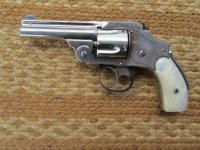
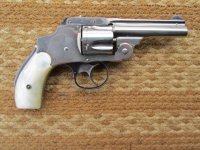
Without photos, it's hard to tell. Original finish or re-nickel? Good condition means different things to different folks. Pearls are desirable, but the medallions were available around 1893-5 and that low serial number would be 1880s in my estimation. This sounds like a nice New Departure but there are a few questions that need answering. The grips (stocks, in S&W lingo) are valuable by themselves.
 
Not sure the value of yours without photos. I paid $300 for this 38 caliber.
Walt
 

Attachments

  • Lemon Squeezer Left.JPG
    Lemon Squeezer Left.JPG
    156.6 KB
  • Lemon Squeezer Right.JPG
    Lemon Squeezer Right.JPG
    156.1 KB
Last edited:
There were over 91,000 32 Safety, 1st Model revolvers made, from 1888 to 1902. With a 3 digit serial number, it would almost certainly been manufactured the first year, so non-medallion pearls would be appropriate.

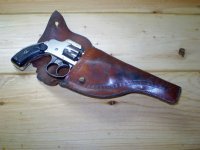
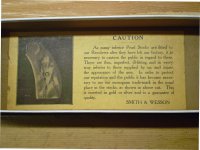
As for value, I have to admit that $300 is quite steep for this model, even though condition is very good. There are many of these guns in near perfect condition, due to the facts that they were often purchased for a desk or bureau drawer, and overall a very weak cartridge that precluded many from using them as a carry gun. I picked up the example below a couple years ago for $110 with holster at a local gun show. Pearls may be original, but tons were installed by distributors and purchased by owners as well. They are selling for $100+/- on average, while hard rubber stocks are selling for $50, so only a $50 added value. There might be a pencil mark on the inside of the right stock indicating a serial number?? Can you measure the total thickness of the stocks? S&W stocks were substantially thicker than almost all non-factory examples. Those that I have measured indicate that many replacement stocks were a 1/4" or less thick at the base, while factory stocks average 3/8" thick. The complaints must have been heavy with the thin stocks, since S&W started placing sections in their catalogs and in gun boxes about the inferior quality of non-factory stocks.
 

Attachments

  • P1010002.jpg
    P1010002.jpg
    110.2 KB
  • P1010006.jpg
    P1010006.jpg
    105.3 KB
  • 6.jpg
    6.jpg
    131.5 KB
Back
Top