
Strange Kaboom

sjs

Member
Joined
Sep 16, 2003
Messages
348
Reaction score
189
City & State/Province
SC
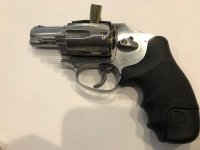
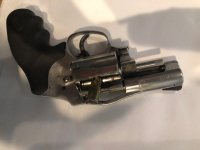
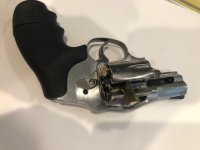
Brand new 640 shooting mild 357 plinking rounds. It is sad for me because it will not be replaced. It is good for me that I was not injured. And it is clear that I made a mistake in my loading. Not sure what it was, pulled the remaining rounds from that batch and saw nothing wrong, but this cannot happen without a reloading error.

But it is also strange. I did not notice any increase in recoil when it went off. I also did not notice any increase in sound. There were two other gents there observing and they also did not notice anything strange in the report of the shot. I would have thought there would have been a noticeable difference with a kaboom.

I called Smith and Wesson to discuss and I knew that I did not have warranty coverage because it was my fault but they sent me a mailing label anyway and it is now in their hands. I cannot imagine it can be repaired.
 

Attachments

  • IMG_0921.jpg
    IMG_0921.jpg
    49.4 KB
  • IMG_0922.jpg
    IMG_0922.jpg
    49.8 KB
  • IMG_0923.jpg
    IMG_0923.jpg
    49.3 KB
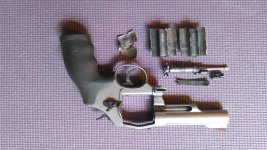
Join the club. I blew up a 69 with a colossal overload. No unusual recoil or noise, as much of the extra energy went into disintegrating the cylinder and bending the frame. Shooter unharmed, all the bad stuff goes sideways.

What you will get from sending the revolver back to Smith is a discounted price on a replacement, or (as I did) apply the dollars towards a different Smith (a snub 66-8).
 

Attachments

  • IMG_20170906_165623.jpg
    IMG_20170906_165623.jpg
    133.3 KB
Last edited:
  • Like
Reactions: sjs
Maybe a barrel obstruction like a squib load? I had one squib load. There was little difference in recoil, sound, but nothing hit the target. Sure enough, there was a bullet stuck halfway down the barrel.
 
  • Like
Reactions: sjs
Looks like a classic double charge. The barrel itself is not swollen, which I'd expect if it was obstructed, like you'd shot after a squib round.

What powder and bullet were you using, and was it .38 Spl. loads or .357 brass you were using? It's easy enough to get a double charge of a fast powder into a downloaded .357 brass case and still be able to seat the bullet. Do you use a single stage or progressive press?

Glad you weren't hurt, luckily your face is an arm's length away, but that could have really torn your hands up.

You didn't feel extra recoil because most of the force went up instead of forward, countering some of the normal recoil from the bullet travelling forward and the powder charge exhaust from the barrel.
 
Last edited:
I'd tend to agree on the over-charge. I take it there's nothing in the barrel. It would be good to know the details of the load and process. Only to learn from it and perhaps prevent the same thing from happening to others / ourselves.

I have loaded an obscene amount of ammo over the last 40+ years but still feel..........."There but for the Grace of God go I."

I like to guard against complacency.
 
That type of failure does not indicate a bullet obstructing the next shot, but seems to often if not always related to a double-charge. Not saying I know how the OP reloads, but there could be problems if using a high speed progressive loader. When one gets to the point of totally trusting your equipment and stops looking down into each case before placing the bullet, problems are possible. These things often happen when the loading sequence is messed up while the turret is full of brass, or a powder charge stuck in the tube, resulting the the dropping of a double charge in the next case. If you ever run into a glitch while reloading with a progressive, check each and every case in the reloader and pull the bullet out of last few of cartridges you just completed. Better safe than sorry.

I reload most calibers with my trusty Rock Chucker press. Fill all 50 cases with powder, grab the flashlight and ALWAYS check each and every case before seating bullets. Where possible, I use Trail Boss since a double charge will always over-flow the case. Might try some Trail Boss for those using progressive loaders where possible? Many reloaders say that single stage reloading is too slow, but isn't going slow the main point when reloading to insure safety?
 
Join the club. I blew up a 69 with a colossal overload. No unusual recoil or noise, as much of the extra energy went into disintegrating the cylinder and bending the frame. Shooter unharmed, all the bad stuff goes sideways.

What you will get from sending the revolver back to Smith is a discounted price on a replacement, or (as I did) apply the dollars towards a different Smith (a snub 66-8).

At least the grips look ok.

Have a blessed day,

Leon
 
Many reloaders say that single stage reloading is too slow, but isn't going slow the main point when reloading to insure safety?

Most definitely it's safer, IMO. I never considered a progressive press, my single stage and I can crank out whatever I need in a long rainy day. Like you, I never seat bullets until I've visually checked all the charged cases.
 
I'm so glad that you're okay! In just over 41 years of reloading, I've never had this happen to me. But seeing pics of things that have happened to others, keeps me diligent and aware of what I'm doing.
I've loaded ammo starting with a Lee Classic Loading kit, RCBS Reloader Special single stage, Lee Turret Press with auto advance and Lee Pro 1000 progressive. No matter what equipment you use, safety is #1 priority.

Hope you get some good news from S&W and also hope you figure out what went wrong. Let us know on both counts.
 
The OP wasn't kidding when he posted on 7/3 that his 640 was "already gone"...!

Glad to hear no one was injured!
 
Glad you did not get injured.Admire you being honest and S&W will probably work better with you for it.I believe S&W revolvers are good enough it had to be overcharged.It's still worth something for parts or fancy paperweight.Good luck with it.
 
Most definitely it's safer, IMO. I never considered a progressive press, my single stage and I can crank out whatever I need in a long rainy day. Like you, I never seat bullets until I've visually checked all the charged cases.

Progressives are rarely the source of double charges - at least not auto-indexing progressives. Guys having brain fluffs while working with a single stage, and guys running Dillon 550s make all the doubles.

The more the human is involved, the greater the chance of error.

And I've seen this about a billion times, so I'm going to guess that TiteGroup was used.
 
Well, to answer some questions in the interest of somebody possibly learning something, I was shooting a starting load of Zip under a 180gr Missouri Bullet Co. SWC, CCI500 primer and once fired Starline brass. I have used this load before and was about 20 rounds into this batch when it happened.

I am 72 and only shoot mild plinking loads, except for a few full power 357 loads to remain familiar with the recoil. My full power 357 loads are factory. I use an ancient RCBS single stage and shooting and reloading my 357 and 38 loads is my hobby, I am retired and I do not golf.

So, I go slow when reloading because I enjoy going slow when reloading, not just for safety. I use 3 loading blocks, with empty primed cases in the first upside down so I can quickly check primer seating before loading. I place 3 cases in a second loading block and load them, weighing each and every charge to .1 grain on a small electronic scale. I then place the 3 cases in a third loading block. after every row of 10 cases is charged I view them with a flashlight to avoid a double charge. After all 50 cases (my usual batch) are done I flashlight check them again. Then I l seat the bullets, measure OAL a few times and crimp with a Lee factory crimp die.

It is a process that has worked for over 30 years but not this time. I don't know where I messed up but it had to have been an overcharge. I was probably distracted by my beautiful young wife of 71.
 
It's OK to become both Anal and OCD about getting one , and ONLY one , powder charge in a case . No powder charge is just as bad as two .

50+ years ago while using a powder dispensor / aka measure , I missed getting a charge in a case ... The Good Lord was looking after me ... the bullet lodged between the forcing cone and chamber mouth so I couldn't pull the trigger again ... That was so close it impressed the importance of getting powder into cases .
I use scoops sometimes and always double and triple check powder in cases before I seat a bullet ... Get Anal - Get OCD ...develop a method of checking and double checking powder levels in cases . It's been over 50 years since I went Powder OCD-Anal but I've never had another incident .

ATTABOY !!!
I am applauding your action of taking responsibility for your loads , many others want to pass the buck and claim everything but themselves caused the problem . The most ludicrous excuse is " Detonation" ...
No usually it's just no or two charges in a case .
I know I caused mine because I was doing the reloading ...
And it wasn't Global Warming either ... Live and learn !

I just noticed in your last post , you and I are about the same age ...hopefully some starters will read this and learn a few things from our experiences .
Gary
 
Last edited:
Being distracted by the missus is a valid excuse. I agree, you messed up somewhere and double-charged, but thank goodness no one was hurt. When we get too old to learn we're too old to live -- so congrats on living and learning!
 
  • Like
Reactions: sjs
Glad you are ok.

Could you have experienced bullet 'set back'. Any chance of a less than adequate crimp allowing the projectile to compress the powder charge during recoil?

Always trying to think in terms of what could go wrong and build safeguards into the process...

I reload 7 calibers on a 550B.

I use powders that make a double charge obvious. (Abandoned Bullseye decades ago when I went to the progressive.)

Good light over the bench.

I have a small telescoping handled 'tool box' mirror mounted on the press with duct tape so I can see into the case and check for no or double powder as one of my visual cues before indexing the shell plate. I did that because over 40 years I have experienced several squib (no powder)
loads. Assuming It would be just as likely to double charge I decided I needed to SEE the powder every time.
 
My commiserations, Im very glad you were not hurt.
I blew up a lovely engraved USFA 45 long colt single action with what I thought was 8.5 of Unique and a Keith 250 grain bullet. I had just shot off 50 rounds in a Ruger Bisley with no issue but when I fired the first round from the USFA the top chamber detonated and the chambers on either side sympathetically detonated as well. I was not hurt. The top strap fragmented into several pieces, one lodged in the roof of the range a two were on the ground in front of the firing point. The cylinder walls folded back but did not detach and the cases at 10 o'clock and two stayed in the chambers but with the inboard sections blown inward.
I was using an electronic scale from a well known company and when I got home I calibrated the scale following the manufacture's instructions and broke down all of the remaining rounds from the batch and weighed each one. Each one was within a 1/10th of a grain according to the scale. Just on a whim I broke out my balance beam and weighed one charge and, low and behold, it showed a charge of over 14 grains! I comparison weighed out several additional charges and found the electronic scale to consistently read under the actual weight. I returned the scale to the company and they were gracious enough to replace my revolver to me. I declined their offer to replace the scale.
I sent my Bisley to Ruger and they replaced the cylinder as a precaution but they felt the revolver was not in damaged in any way. Much later after examining a piece of the blown top strap the failure line looked a bit granular and I wondered about the depth of penetration of the case hardening. I but the piece on my anvil and hit it with a 3# hammer and it shattered. You folks can draw your own conclusions.
 
?s for the OP

A starting load of ZIP for 180gr would probably be under 6gr...?

Have you broken down and check weighed any of those same loads?

Have you checked your scale's calibration with another scale?

Small electronic scales have an unfortunate tendency to wander (a "nice" term for it?) or work intermittently, or just flat stop working (or ZERO, etc.) as they age. Just a couple years before the typical warning signs develop is not uncommon...

Just some suggestions.

Cheers!
 
  • Like
Reactions: sjs
Well, to answer some questions in the interest of somebody possibly learning something, I was shooting a starting load of Zip under a 180gr Missouri Bullet Co. SWC, CCI500 primer and once fired Starline brass. I have used this load before and was about 20 rounds into this batch when it happened.
I've never used Zip, and not familiar with load data for .357 using it, so I don't know how much a starting load is. It's a pretty fast powder, and if you've cut way back on how much you use in a load, you may have experienced a low density detonation. This can occur when the ratio of the volume of powder to the case volume is low, and occurs with fast burning powders. Additionally, since you're using a pretty heavy bullet for a .357, the pressure spike will be higher anyway, because of the inertia involved getting that big slug to start moving. There's an article came out several years ago that talks about low density detonations.

Light loads in large cases can explode (2007 update) - Reload Ammo | Founded By M.D. Smith in 1996


........reloading my 357 and 38 loads is my hobby, I am retired and I do not golf.

I like you already.
 
50+ years ago while using a powder dispensor / aka measure , I missed getting a charge in a case ... ... That was so close it impressed the importance of getting powder into cases .

Similarly, I once traded a Ruger 22-250 varmint rifle complete with a batch of my reloads.

Just to be sure that I didn't make any reloading errors I weighed each and every one of the reloads before compleing the trade. Lo and behold I found a light one that turned out to be empty!

As far as I can tell that was the only reloading error that ever slipped by in over 40 years of lots and lots of reloading.

The new owner of the rifle reported back to me that not only was the rifle a gem, but all of my reloads were tack drivers :-)

To this day I'm still very very happy that the mistake was discovered and didn't squib that gun. If I had not let that rifle go, I very well may have ruined it myself!
 
I am glad you are ok. That could of been a lot worse.
I have been reloading since 59-60 and have not had an accident. Reading this kind of thing reminds us that it can, indeed, happen to anyone.
Being kind of a Luddite I still use a beam scale to set my powder measure and a single stage press. It is slow sometimes, but maybe a good thing.
Again glad you and shocker are ok.
 
  • Like
Reactions: sjs
sjs - Sorry about your incident and glad you walked away from it! I am also not familiar with Zip. But, as I go up in years (four behind you), I use bulkier powders, lately Blue Dot for 9mm & .40. Single charges almost fill the case in 9mm. The .357 (and .38) cases are so tall that they present a special problem for us folks with vision issues. I addressed that issue by switching to MBC cast bullets and Trail Boss for range use.
 
Interesting that in one of the discussions an SEE (Secondary Explosion Effect) is specifically limited to low density loads of SLOW (vs. fast) BURNING POWDERS in large cases.

Multi-mllions of 2.7gr Bullseye & 148gr wadcutters would seem to bolster that opinion...?

Cheers!

P.S. They guy fire-forming 470 Ackley cases out of 45/70 brass with an undersized .458" bullet STILL has me scratching my head!
 
I wish I had a dollar for every post I've ever read that touted the superior safety profile of the single stage press. After reading many incidents of this type and the circumstances surrounding them I have come to the conclusion that it just isn't so. In fact, that very belief may be a contributing factor in and of itself.

Sometimes a post will say something like "it's just not possible because of my process". Well, that right there is the problem, their belief that their process is infallible when clearly nothing is infallible.

As for myself I find I pay much closer attention with a progressive because...well...you kind of have too. The problem I have with single stage presses is it's so boring. So boring I have a hard time maintaining focus on the 100th identical operation. The simple repetitiveness of it allows my mind to wander. I find myself double-checking what I just did all the time. Much more so than when I'm running the progressive.

So be honest with yourself. Do you ever find yourself wondering where you're at when loading? If that happens to you it's a warning flag.

It doesn't matter what you use. It's about your process but more importantly how well you are able to follow it and how well it suits you. This is what suits me, it might not be right for you. I spent decades operating far more complex equipment than reloading presses so perhaps it's just suited to me.

Yes, the bulky powder solution is a good one. Pretty hard to double charge a case when it won't fit. But you sure are limiting yourself. But if that's what you came up with because it's what suits you, I'm fine with that.
 
Late on this thread but the OP said,

“ But it is also strange. I did not notice any increase in recoil when it went off.“

it’s not strange at all as the pressure was released out through the cylinder walls. Sorry if this was already noted

Addendum: a very common reaction with cylinder blown revolvers

Rick
 
Last edited:
Single stage press, weigh each charge on a beam scale, dump from scale pan into primed case, do not set case down, insert bullet into case, insert case into press and seat bullet. Examine completed round, and if it passes then it can be placed in tray. (No need for speed. This is a hobby, not a business.)

Have used this process for handgun and rifle for about 47 years, had one squib load in a .44 mag target load with simi wadcutter. That load had unburnt powder in case and barrell, and therefore must have either had a weak primer or somehow I contaminated the powder or primer. (Moisture or lub on fingers only possibility I could come up with to have a 1of 50 malfunction.)

That is the way a gunnersmate taught me while in service, and I have seen no reason to try to change or modernize the process.

Glad the OP was not injured.
 
Many years ago, American Handgunner had an article on SEE. I have never thought of 2400 as being a fast pistol powder.
 
Back
Top