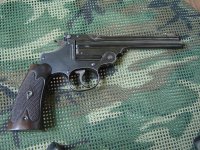
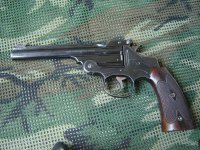
The most obvious advantage of the 3rd Model (over 1st and 2nd) is the rear sight---it being the first one with precisely adjustable windage (whereas the windage setting on the earlier examples was merely movable---exact vs. best guess). Now we should think about what remained pretty much the same.
It is my opinion S&W went to great lengths to minimize what I'll call the felt differences between the top break single shots---1st/2nd/3rd. I don't know where the impetus came from to keep the balance of all three as close to the same as possible, but S&W clearly went out of their way (and spent time and money they didn't have to) to do just that. Recall the vertical grooves on the side of the frame on the second model----and the third. Why are they there? S&W spent money to put them there-----how come? I used to think they were there purely for aesthetics-----to break up a large open space. Then I thought about the cost of having them there, and wondered how long I'd have had a job after Mr. Wesson found out I'd approved them for aesthetics. Then there's the machining on the bottom of the barrel lug on the third model----to make it flat so it'll fit that frame. But they didn't just make it flat, they made it what I call "fancy flat"---and that cost extra too. Then, and I'm not sure why, I started thinking about what they were trying to do----and why. I knew the answer almost immediately after I wondered why----weight. Not for the sake of weight reduction per se, but for the sake of balance.
At that point it was time for some (at least quasi) scientific investigation. I took two identical folding chairs, and put them back to back---about two feet apart. Then I got a wooden dowel rod about a yard long, put it on the backs of the chairs, and hung three single shot pistols on it----by the trigger guards---a 1st, a 2nd, and a 3rd---all with 10" barrels. Now it wasn't as scientific as it might have been because the 1st Model had an aftermarket front sight on it which weighed more than the factory sights on the 2nd and 3rd---not a lot, mind you; but it's hanging all the way out at the end of the barrel; so it made a difference.
The bottom line is the balance of these three pistols hanging on a rod was almost the same---------------and it damn well would not have been except for the odd-ball whittling somebody thought was important.
And that's it----the tale of three single shots---hanging on a stick.
Ralph Tremaine