Top break double action 32 cal

Drewcobs91

Member
Joined
Mar 25, 2015
Messages
13
Reaction score
1
Hello. I have an old smith & wesson double action, top break, 32 cal, six shot revolver. As far as I know it's the 2nd model. I think it's a fairly common gun but the serial number is 1608. I was wondering if you could tell me anything about the history of this gun or what it could be worth with the low serial number. Thank you
 
I have never heard of any top break 32 double action with six chambers. The only six shot .32 top break that I have ever seen is the New Model #3 in 32-44, but it is a single action
 
Well this one is defiantly an old model and it's double action. The last date on the barrel is 1880. It could maybe be a 38? It does have a hammer as well.
 
Last edited:
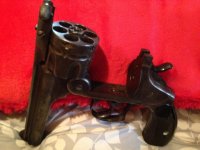
Welcome to the Forum. A few more details would be helpful. First, can you confirm the number of charge holes in the cylinder? If it is 6 shot, does the barrel lift up or break down when opened? The only jointed frame S&W 6 shot ever made was the Model 2, which was a tip-up single action rimfire revolver. If it is anything else, it has to be a copy. There were many European gunmakers who closely copied S&W revolvers, as well a a few US firms. Pictures would be very helpful.
 
Yes it is a 6 shot. The barrel breaks down but again I'm not sure what the caliber is.
 

Attachments

  • image.jpg
    image.jpg
    90.2 KB
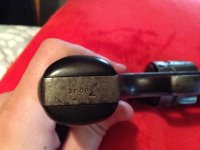
Is there any way to tell what caliber it is? Something to look for on the gun? I can find this serial number 3 times on this gun.
 

Attachments

  • image.jpg
    image.jpg
    83.3 KB
Also, the hammer doesn't stay back when you cock it. It clicks a little bit but it won't stay back. At first I thought it was just worn but could it be that it is just a double action only?
 
You have what is called a 32 Double Action, Second Model, shipped around 1891-1892. It fires 32 S&W caliber ammunition. Correction As Tom pointed out, I missed the fact that it has 6 holes in the cylinder, so it is a 44 Double Action revolver. The cylinder looks short and if it is 1 7/16" long, it is a 44 Russian caliber. If it is a 44 Russian, it would have shipped around 1881. The other caliber could be 44-40, but that would take a 1 9/16" cylinder. If it is a 44-40, it would have shipped around 1888. Check the cylinder length and that should give you the caliber answer.

There is quite a bit of wear on the gun and chances are that the internals are either very dirty or worn. I would first remove the sideplate and either soak the revolver in a solvent to loosen up the crud, or use an aresol carberator cleaner to spray the mechanism. After it is cleaned and dried, lubricate and try the action again. Hopefully, that will solve the single action operation and yes the revolver should function in both SA and DA. I assume it works in double action?

Forgot to mention that you should remove the hard rubber stocks before cleaning. Take care in removing and do not pry them, since there is a stud pin in the bottom of both stocks holding them in place.
 
Last edited:
It can't be a .32 DA of any model, because it has 6 chambers that can be seen in one of the photos. It is a .44 double action, and an early one by the serial number.
 
Thanks for the double check Tom. The short barrel and small photo made it look like a small caliber revolver. Glad we have lots of contributors to keep everyone in line.
 
Thanks Tom! Yeah you are right. I should've checked into it more. And based on the length of the cylinder it is a 44-40 frontier.
 
Any idea what something like this is worth? Or if it's worth it to restore it?
 
Definately not worth restoring as you will put more money into the gun than you would get out of it. The 44 Frontier is heavily worn, including the stocks, so would be of little interest to the hardcore collector, but it would fill a void in many collections. I would be hard pressed to put a value above $800 even with it being scarce. An accurate evaluation should be done with a firearm in hand as it is very hard to truly judge by photographs alone.
 
Just a couple more things Gary. This is a 5'' barrel. Is that more common than other lengths? Also can u tell what finish the barrel is? Blue or nickel? I have a friend that specializes in restorations of old gun and he said he would restore and repair this gun for me but if it isn't going to raise the value of the gun I would rather leave it original. What do you think?
 
Looking at the SWCA, the most uncommon barrel length reported is the 6 1/2". The 4", 5", and 6" comprise roughly one third each. It is up to you whether you want it refinished, but with the rounded edges and overall wear, it will be all but impossible to bring it back to anywhere near original.

My opinion is that you will end up with a gun that screams refinish and it will actually lower value over what you could expect today. I would say that the original finish was probably blue, since even worn nickel guns will show evidence of plating under the stocks or in the cracks and crevasses. The trigger guard, trigger and hammer would have been case hardened and not blued.
 
What about if I would get replacement grips for it? Would that be a bad idea? Also would it work to clean it with an ultrasonic cleaner?
 
Last edited:
What about if I would get replacement grips for it? Would that be a bad idea? Also would it work to clean it with an ultrasonic cleaner?

You can look for original replacement stocks on ebay, or find reproductions on vintagegungrips.com. Just make sure you keep the originals, since they are probably numbered to the revolver. An ultrasonic cleaner should work well on your revolver, but make sure that you use compressed air to blow out the mechanism to dry everything. Oil the mechanism and all surfaces to protect from rusting.
 
Back
Top