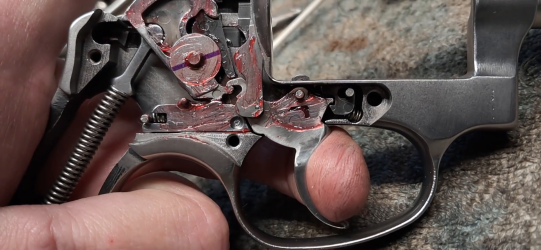
Trigger pops as its pulled.

Joined
May 12, 2017
Messages
18
Reaction score
24
On a mod 60-14, in double action, the first part of the trigger pull.. pressure is applied, it pops and has a slight movement, then it's solid and smooth pulling. I have smoothed and polished everything, I'll remove the side plate and watch and see if I can find what's the cause again but this has me baffled, anyone else have this or are they all nice and tight from the start .
 
Can you feel the "pop" sensation in your thumb if you lightly rest it on the hammer while you move the hammer back by pulling the trigger?

Does it make this sound when you cock it SA?

Sounds like an issue with the DA sear not being let out enough, or cut at the wrong angle. Smith and Wesson calls this "clicks starting" or "sear clicks". Only happens in DA.

BTW, don't work the action under mainspring tension with the sideplate removed.


Carter
 
Last edited:
Only with DA..
It's like it binds up, then let's off only to stop on the DA sear, then the pull is normal.. I've looked at and tested as .uch as I could with it open, trying to understand what's actually happening.
Broke it down, broke out the Dremel and Flitz, started with 800 grit sand paper and 1000 grit, then Flitz.. Beautiful polish on internal parts, added hammer shims and got to order some for the trigger..
Problem seems worse if to much side pressure is put on the trigger. Thinking shims may help a bit..
It's nothing i'll worry myself sick over, would like it gone, love the pistol, actually can shoot soda cans at 50 yards most of the time..
 
On a mod 60-14, in double action, the first part of the trigger pull.. pressure is applied, it pops and has a slight movement, then it's solid and smooth pulling. I have smoothed and polished everything, I'll remove the side plate and watch and see if I can find what's the cause again but this has me baffled, anyone else have this or are they all nice and tight from the start .
Are you talking about the slight "click" at the very beginning of double action trigger motion, before the hammer ever moves, or do you get a "hitch" in the trigger right as the hammer has started to travel backwards in double action?

If the former, that is just a tiny amount of take-up clearance between the trigger ledge and the DA sear on the hammer, before the trigger makes contact with the DA sear. It is just a slight DA sear fitment issue as Armorer951 said. It's really nothing to be concerned with.

If you mean the latter where you feel a "hitch" in the trigger at the beginning of double action hammer travel, then most likely you have a slight mismatch in the lower surface of the hammer at the bottom of the single action ledge on the hammer. You can think of the trigger/hammer interaction as like a gear. At first during the double action pull, the trigger is pressing upward on the DA sear, but as it continues in its arc, the secondary double action sear below the top sear surface on the trigger takes over and engages the very bottom of the hammer below the single action notch. If the bottom of the hammer is a tiny bit too wide, the bottom of the hammer and the secondary DA ledge on the trigger momentarily collide and bind before that little ledge on the trigger finally slips below the hammer. That secondary ledge on the trigger is what is actually engaging and carrying the hammer through the very last stage of double action, and when the hammer breaks from the trigger in DA mode, it is actually being released from that lower ledge on the trigger, not the top ledge.

If the second scenario is what is happening, the fix is to stone maybe a couple .001" off the very bottom of the hammer, under the SA ledge. You must be very careful with this, as it only takes a tiny amount of stoning to fix it and you don't want to stone off too much material. Gunsmith Nelson Ford describes this in a short Youtube video here:


I've done this once before, and it works as he describes.
 
A lot of bad information In this Youtube video....

The action should never be cycled under mainspring tension with the sideplate off. This leaves the hammer, rebound and trigger studs unsupported. Doing this can result in damage to the frame and the interior components.

The video is not describing the problem with the OP's revolver, but a completely different issue that S&W calls "stubs". The malfunction in the action shown in the video occurs because the sear is too short. This causes the camming surfaces on the trigger and hammer to impact during the transition from the DA sear in the hammer over to the DA cam on the bottom of the hammer. If the DA sear is fit to the proper length, the cam on the hammer will enter the transition window just above the camming surface of the trigger.

There is nothing wrong with the hammer or the trigger in this video scenario, and neither of them should be modified to correct this malfunction.

The proper solution to the "stubs" issue in the video is to properly fit a new double action sear. The camming surfaces on the hammer and/or trigger should never be modified. Modifying these camming surfaces can result in the cylinder not carrying up fully in double action, and a host of other problems.

Be very careful concerning the information on the internet, and specifically Youtube. Many of these people are not factory trained and have no idea what they are talking about.


Carter
 
Last edited:
A lot of bad information In this Youtube video....

The action should never be cycled under mainspring tension with the sideplate off. This leaves the hammer, rebound and trigger studs unsupported. Doing this can result in damage to the frame and the interior components.

The video is not describing the problem with the OP's revolver, but a completely different issue that S&W calls "stubs". The malfunction in the action shown in the video occurs because the sear is too short. This causes the camming surfaces on the trigger and hammer to impact during the transition from the DA sear in the hammer over to the DA cam on the bottom of the hammer. If the DA sear is fit to the proper length, the cam on the hammer will enter the transition window just above the camming surface of the trigger.

There is nothing wrong with the hammer or the trigger in this video scenario, and neither of them should be modified to correct this malfunction.

The proper solution to the "stubs" issue in the video is to properly fit a new double action sear. The camming surfaces on the hammer and/or trigger should never be modified. Modifying these camming surfaces can result in the cylinder not carrying up fully in double action, and a host of other problems.

Be very careful concerning the information on the internet, and specifically Youtube. Many of these people are not factory trained and have no idea what they are talking about.


Carter
I understand what you are saying, but I respectfully disagree with a couple points you made. I didn't know which problem the OP was describing, so I asked for clarity.

For the stubber issue, yes you can certainly buy another DA sear and fit its length. That is the most ideal solution and the old style pinned DA sears are easy to find. However the new MIM DA sears like he has are a difficult part to get from what I've seen, especially the J-frame DA sears. From most sources I've seen you have to buy the whole hammer assembly, and there's no guarantee you won't run into the same problem with a short DA sear. So your best bet there is to send it back to S&W...but trying to describe the problem to them and getting it resolved properly is a roll of the dice.

What I described and is shown in the video I posted removes maybe .002" at the most to fix the stubbber issue and doesn't require buying anything. You certainly don't want to remove much material and you can affect timing if you go to far. But the tiny amount of material removal required to fix the stubber doesn't affect carry-up timing in DA if timing was correct to begin with... the cylinder locks and the hand has begun to sweep beside the ratchets well before the hammer is released from the trigger cam in DA. As long as hand width is sufficient to lock the cylinder well before the end of the DA stroke, you're fine. I've done this before without issue and the cylinder still locks up well before hammer release.

I agree that you don't want to cycle the action with the sideplate removed with full mainspring pressure applied. I don't know if Mr. Ford relieved any pressure from the strain screw or not when he made the video. But the only way he can describe the issue in the video is with the sideplate removed.
 
I understand what you are saying, but I respectfully disagree with a couple points you made. I didn't know which problem the OP was describing, so I asked for clarity.

For the stubber issue, yes you can certainly buy another DA sear and fit its length. That is the most ideal solution and the old style pinned DA sears are easy to find. However the new MIM DA sears like he has are a difficult part to get from what I've seen, especially the J-frame DA sears. From most sources I've seen you have to buy the whole hammer assembly, and there's no guarantee you won't run into the same problem with a short DA sear. So your best bet there is to send it back to S&W...but trying to describe the problem to them and getting it resolved properly is a roll of the dice.

What I described and is shown in the video I posted removes maybe .002" at the most to fix the stubbber issue and doesn't require buying anything. You certainly don't want to remove much material and you can affect timing if you go to far. But the tiny amount of material removal required to fix the stubber doesn't affect carry-up timing in DA if timing was correct to begin with... the cylinder locks and the hand has begun to sweep beside the ratchets well before the hammer is released from the trigger cam in DA. As long as hand width is sufficient to lock the cylinder well before the end of the DA stroke, you're fine. I've done this before without issue and the cylinder still locks up well before hammer release.

I agree that you don't want to cycle the action with the sideplate removed with full mainspring pressure applied. I don't know if Mr. Ford relieved any pressure from the strain screw or not when he made the video. But the only way he can describe the issue in the video is with the sideplate removed.

Sears are inexpensive, hammers are not. With all due respect to Mr. Ford, he's wrong in this particular set of circumstances. The procedure he shows in his video is not the proper way to solve this problem.

The DA camming surface on the bottom of the hammer should never be modified to solve this issue. Removal of any material here causes the hammer to fall earlier at the end of the double action cycle, and can cause a host of issues, including problems with incomplete carry up of the cylinder in DA.

New MIM and older double action sears are readily available. Many of the new MIM sears require no fitting at all.


Carter
 
Last edited:
Sears are inexpensive, hammers are not. With all due respect to Mr. Ford, he's wrong in this particular set of circumstances. The procedure he shows in his video is not the proper way to solve this problem.

The DA camming surface on the bottom of the hammer should never be modified to solve this issue. Removal of material here causes the hammer to fall earlier at the end of the double action cycle, and can cause a host of issues, including problems with incomplete carry up of the cylinder in DA.

New MIM and older double action sears are readily available. Many of the new MIM sears require no fitting at all.


Carter
I realize that we are probably not talking about the OP's problem here, but understand that his gun has MIM parts.

I have read a lot of your posts and I respect you immensely, so understand I am not being critical of you or trying to argue with you. In general, I agree with you, but the old rules have changed when we're talking about the new guns with MIM parts. Parts availability for the new guns isn't the same as with the old pre-MIM guns.

If we were talking about the old case hardened hammers and pinned sear, I would agree with what you are saying, but we're not. Where are you going to find a MIM DA sear for his gun outside of S&W itself? I buy enough parts from Numrich and Midwest that I should probably have my own parking space there by now, and neither of them have one in stock, unless I'm missing something. You can buy the whole hammer assembly but not the DA sear by itself. Brownells and Midway doesn't have them. Jack First doesn't carry any of the new MIM S&W parts. If you know of another source, I'd sure like to know about it.

The MIM parts are drop in parts; they aren't fitted at the factory and aren't designed to be fitted; you get what you get. They can be fitted because they are through-hardened, but they aren't designed to be, so you can't buy oversized MIM factory parts. Therefore any "fitting" here is all luck of the draw that maybe you get one on the upper end of the length tolerance. That's a gamble. The days of buying a replacement oversized DA sear and fitting it on the new MIM guns are gone.

Yes, of course when you remove material off the bottom of the hammer you do cause the hammer to fall earlier in the DA cycle, but there is already variance in hammer fall from gun to gun just based on the normal tolerance stackup inherent with normal dimensional variation between individual hammers, triggers, stud positions and between gun to gun. That happens already between individual samples from the factory. You already have variances in hammer and trigger dimensions from part to part based on the achievable tolerance of the MIM process that exceeds the amount of material removal I'm talking about. You likewise have variances in hammer and trigger stud true positions from frame to frame that affect where and how the hammer and trigger interact with each other. These new MIM parts are not fitted at the factory; they are designed to be drop-in, so sometimes you have stubbers right out of the box. If you can't get another DA sear, what then?

The beauty of the S&W "bypass" hand function vs Colt for example is that its carry-up timing offers a bit of leeway since the sear release happens after the hand has already bypassed the ratchet and cylinder is already locked, if the gun was in proper time to begin with. If you have the proper width hand, typically you get cylinder lock way before the hammer completes full DA arc and fall. The hand has already swept beside the ratchets and is continuing to slide up beside the ratchet before hammer fall. What I'm describing might alter fall a half a degree earlier at most.

For someone who doesn't work on their own guns, the real solution to a stub is to send the gun back to S&W. But if you are a DIY'er, you don't have another option I can see if you can't get another DA sear. I sure would like to know a source that sells them.
 
I cannot tell from southern’s video where his noise is coming from. It is definitely not the Stubbs thing though.
I have watched Ford’s video several times trying to see armorer’s point.
Ford’s stoning technique appears to be expert to my non expert eyes. The camming surface on the bottom of the hammer is not smooth and uniform, and his minimal modification fixes it.
The great flaw in his video, IMHO, is that he does not explain how this could go wrong when I try it.
I would be curious if Thad and armorer would comment further on the greasy video, i.e. post #4 Thanks!
 
I realize that we are probably not talking about the OP's problem here, but understand that his gun has MIM parts.

I have read a lot of your posts and I respect you immensely, so understand I am not being critical of you or trying to argue with you. In general, I agree with you, but the old rules have changed when we're talking about the new guns with MIM parts. Parts availability for the new guns isn't the same as with the old pre-MIM guns.

If we were talking about the old case hardened hammers and pinned sear, I would agree with what you are saying, but we're not. Where are you going to find a MIM DA sear for his gun outside of S&W itself? I buy enough parts from Numrich and Midwest that I should probably have my own parking space there by now, and neither of them have one in stock, unless I'm missing something. You can buy the whole hammer assembly but not the DA sear by itself. Brownells and Midway doesn't have them. Jack First doesn't carry any of the new MIM S&W parts. If you know of another source, I'd sure like to know about it.

The MIM parts are drop in parts; they aren't fitted at the factory and aren't designed to be fitted; you get what you get. They can be fitted because they are through-hardened, but they aren't designed to be, so you can't buy oversized MIM factory parts. Therefore any "fitting" here is all luck of the draw that maybe you get one on the upper end of the length tolerance. That's a gamble. The days of buying a replacement oversized DA sear and fitting it on the new MIM guns are gone.

Yes, of course when you remove material off the bottom of the hammer you do cause the hammer to fall earlier in the DA cycle, but there is already variance in hammer fall from gun to gun just based on the normal tolerance stackup inherent with normal dimensional variation between individual hammers, triggers, stud positions and between gun to gun. That happens already between individual samples from the factory. You already have variances in hammer and trigger dimensions from part to part based on the achievable tolerance of the MIM process that exceeds the amount of material removal I'm talking about. You likewise have variances in hammer and trigger stud true positions from frame to frame that affect where and how the hammer and trigger interact with each other. These new MIM parts are not fitted at the factory; they are designed to be drop-in, so sometimes you have stubbers right out of the box. If you can't get another DA sear, what then?

The beauty of the S&W "bypass" hand function vs Colt for example is that its carry-up timing offers a bit of leeway since the sear release happens after the hand has already bypassed the ratchet and cylinder is already locked, if the gun was in proper time to begin with. If you have the proper width hand, typically you get cylinder lock way before the hammer completes full DA arc and fall. The hand has already swept beside the ratchets and is continuing to slide up beside the ratchet before hammer fall. What I'm describing might alter fall a half a degree earlier at most.

For someone who doesn't work on their own guns, the real solution to a stub is to send the gun back to S&W. But if you are a DIY'er, you don't have another option I can see if you can't get another DA sear. I sure would like to know a source that sells them.

I disagree.

MIM and pre-MIM has nothing to do with this malfunction or sourcing correct parts. There is a correct way to repair this problem, and the correct procedure does not involve stoning the DA cam surface on an otherwise undamaged hammer.

A DIY "work-a-round" because parts are unavailable is not necessary. Also, keep in mind that not all MIM parts are "drop in" despite close tolerances in the current revolvers. A good example is the revolver in the video, which Mr. Ford referred to as "new, out of the box". This gun should have never left the factory, but that's a completely different problem.

As I said, MIM sears are readily available, either from S&W or from various online vendors. New old stock sears are also available from various online sources, including Jack First. MIM sears cost between $5.00 and $12.00 depending on the source. New OEM MIM K-frame hammers are $49.00 -$69.00. I would much prefer purchasing and fitting a new sear than ruining a perfectly functioning hammer assembly.

For those poor souls "unable" to find MIM sears and other parts:

https://usagunsandgear.com/products...del-10-12-thru-386pd-sear?variant=32711045258

https://usagunsandgear.com/search?q=MIM+K-frame+hammer&options[prefix]=last

The S&W recommended repair procedure for the malfunction for stubs (short DA sear) is as simple as can be, and doesn't involve jeopardizing the integrity of the hammer.

Be sure to verify what you are shown and told on Youtube, and other internet sources. Many of these so called experts are not factory trained, and have no idea what they are talking about.


Carter
 
Last edited:
I disagree.

MIM and pre-MIM has nothing to do with this malfunction or sourcing correct parts. There is a correct way to repair this problem, and the correct procedure does not involve stoning the DA cam surface on an otherwise undamaged hammer.

A DIY "work-a-round" because parts are unavailable is not necessary. Also, keep in mind that not all MIM parts are "drop in" despite close tolerances in the current revolvers. A good example is the revolver in the video, which Mr. Ford referred to as "new, out of the box". This gun should have never left the factory, but that's a completely different problem.

As I said, MIM sears are readily available, either from S&W or from various online vendors. New old stock sears are also available from various online sources, including Jack First. MIM sears cost between $5.00 and $12.00 depending on the source. New OEM MIM K-frame hammers are $49.00 -$69.00. I would much prefer purchasing and fitting a new sear than ruining a perfectly functioning hammer assembly.

https://usagunsandgear.com/products...del-10-12-thru-386pd-sear?variant=32711045258

The S&W recommended repair procedure for the malfunction for stubs is as simple as can be, and doesn't involve jeopardizing the integrity of the hammer. Be sure to verify what you are shown and told on Youtube, and other internet sources. Many of these so called experts have no idea what they are talking about.


Carter
Trying to understand.
You mean that the hammer modified by Ford in that YT is ruined? Maybe that I will risk ruining mine when I try this?
 
Trying to understand.
You mean that the hammer modified by Ford in that YT is ruined? Maybe that I will risk ruining mine when I try this?
No, it is not. What Armorer describes can happen if you go overboard, but it isn't ruined in the gun in question. I've done that mod before and not had an issue. It's a case by case situation and there is always "more than one way to skin a cat." I've done things that aren't supposed to be the "proper" way before, but bottom line if the end result is it works, it works.
 
Trying to understand.
You mean that the hammer modified by Ford in that YT is ruined? Maybe that I will risk ruining mine when I try this?
Potentially yes. Mr. Ford doesn't comment on whether or not the cylinder still carries up after the removal of material from the hammer.

The proper remedy is very simple actually. Buy a new MIM sear, which is potentially a "drop in" fix, or send the gun back for repair and wait 4 - 6 weeks. (and hope the gun doesn't sustain further damage while it's in for repair)

Or, send the gun back. The decision for the "new out of the box" revolver in the video is not to ruin the hammer, but to send it back to the factory for repair. New revolvers that cost upwards of a thousand dollars or more should function properly when they are received by the customer.

In this video, the warranty on the gun has been voided by intervention by someone who is unaware of the correct procedure to repair the issue.

In terms of gun repair, this is not a "two ways to skin a cat" DIY scenario. Carry up problems can result in catastrophic failures.


Carter
 
Last edited:
I disagree.

MIM and pre-MIM has nothing to do with this malfunction or sourcing correct parts. There is a correct way to repair this problem, and the correct procedure does not involve stoning the DA cam surface on an otherwise undamaged hammer.

A DIY "work-a-round" because parts are unavailable is not necessary. Also, keep in mind that not all MIM parts are "drop in" despite close tolerances in the current revolvers. A good example is the revolver in the video, which Mr. Ford referred to as "new, out of the box". This gun should have never left the factory, but that's a completely different problem.

As I said, MIM sears are readily available, either from S&W or from various online vendors. New old stock sears are also available from various online sources, including Jack First. MIM sears cost between $5.00 and $12.00 depending on the source. New OEM MIM K-frame hammers are $49.00 -$69.00. I would much prefer purchasing and fitting a new sear than ruining a perfectly functioning hammer assembly.

https://usagunsandgear.com/products...del-10-12-thru-386pd-sear?variant=32711045258

https://usagunsandgear.com/search?q=MIM+K-frame+hammer&options[prefix]=last

The S&W recommended repair procedure for the malfunction for stubs (short DA sear) is as simple as can be, and doesn't involve jeopardizing the integrity of the hammer.

Be sure to verify what you are shown and told on Youtube, and other internet sources. Many of these so called experts are not factory trained, and have no idea what they are talking about.


Carter
Thanks for the usagunsandgear links. I have looked at buying parts from them from time to time but I forget about them because they seldom seem to have what I need when I need it so I seldom check with their site. I disagree that MIM sears are readily available outside of S&W itself though. I've not found that to be the case at all. Jack First absolutely does not offer any current gen MIM lockwork parts at all; only the old parts. MIM and pre-MIM most definitely has relevance because you cannot buy oversized MIM parts because they don't exist. MIM parts are designed to be in tolerance or at worst near-net right out of the mold and if any fitting is needed, it is very minor. That's the whole reason manufacturers went with MIM to begin with, to eliminate hand fitting. If you do buy MIM parts, you are just hoping that they have enough material on them to allow fitting, but there are no guarantees.
 
Potentially yes. Mr. Ford doesn't comment on whether or not the cylinder still carries up after the removal of material from the hammer.

The proper remedy is very simple actually. Buy a new MIM sear, which is potentially a "drop in" fix, or send the gun back for repair and wait 4 - 6 weeks. (and hope the gun doesn't sustain further damage while it's in for repair)

Or, send the gun back. The decision for the "new out of the box" revolver in the video is not to ruin the hammer, but to send it back to the factory for repair. New revolvers that cost upwards of a thousand dollars or more should function properly when they are received by the customer.

In this video, the warranty on the gun has been voided by intervention by someone who is unaware of the correct procedure to repair the issue.


Carter
I know him and have talked to him personally multiple times. The revolver shown does time properly because I talked to him about that very video on the phone. Mr Ford is a Colorado School of Trades graduate and has been working on S&W revolvers for decades. He is well respected in the gunsmith trade. He is not some hack.
 
I know him and have talked to him personally multiple times. The revolver shown does time properly because I talked to him about that very video on the phone. Mr Ford is a Colorado School of Trades graduate and has been working on S&W revolvers for decades. He is well respected in the gunsmith trade. He is not some hack.

I didn't say he was a "hack". those are your words, not mine. Mr. Ford is a well respected, highly trained and very competent gunsmith and gun builder.

What I'm asserting here is that Mr. Ford's recommendation to use this procedure in this instance is wrong. There are only two factory approved remedies for this particular malfunction:

#1 Send the gun back for repair.
#2 If you know what you're doing, replace the sear. If you are unsure or don't have the proper training, see option #1.


Carter
 
I cannot tell from southern’s video where his noise is coming from. It is definitely not the Stubbs thing though.
I have watched Ford’s video several times trying to see armorer’s point.
Ford’s stoning technique appears to be expert to my non expert eyes. The camming surface on the bottom of the hammer is not smooth and uniform, and his minimal modification fixes it.
The great flaw in his video, IMHO, is that he does not explain how this could go wrong when I try it.
I would be curious if Thad and armorer would comment further on the greasy video, i.e. post #4 Thanks!
In the "greasy" video, it looks like he's just showing loose initial take up in the trigger before it makes contact with the DA sear due to a short sear. The trigger overcoming rebound spring pressure causes the clicking sound when the trigger makes contact with sear. It does appear that he has a short sear. Maybe the OP isn't the original owner of the gun and someone before him modified the sear for some reason.
 
I didn't say he was a "hack". those are your words, not mine. Mr. Ford is a well respected, highly trained and very competent gunsmith and gun builder.

What I'm asserting here is that Mr. Ford's recommendation to use this procedure in this instance is wrong. There are only two factory approved remedies for this particular malfunction:

#1 Send the gun back for repair.
#2 If you know what you're doing, replace the sear. If you are unsure or don't have the proper training, see option #1.


Carter
OK, well I was responding to your statement when you said "many of these so called experts are not factory trained, and have no idea what they are talking about." I assure you he does.

I realize there are two factory approved remedies. The factory has to err on the side of caution because they can't know the competency of who they are dealing with.

What I'm saying is that there are no oversized MIM parts available, so replacing the sear may not work, as the sear you get may very well be shorter than the one you had. If you can't get a longer sear, you're out of other options if you're doing the repair yourself. Again, we are only talking about the reality with the MIM parts here.

I would say the best approach is to send the gun back to S&W for repair. But speaking personally, I don't trust the shipping carriers and I don't even totally trust S&W to get things right. This particular case being a very simple, quick fix that I have done before with success, I personally would opt for the route I explained, but I respect the fact you disagree and I understand your reasons for disagreeing. Yet, the fact remains I have done it and it did work without negatively affecting timing. When you work on your own guns, you always accept some element of risk.

But again, that isn't what's going on with the OP's gun anyway.
 
I've been at this a long time, and as I see it, one of our responsibilities as S&W trained armorers is to prevent these obvious errors from being perpetuated and disseminated. That's one of the reasons I often respond to these posts and try to give factual, informative, factory based information to our members here on the forum.

Many of these "go arounds" that deviate from the correct course of action can cause needless harm both to the firearm and, potentially, to the end user. Most of us here on the forum have witnessed these bad decisions, or like me, have made them in the past.

In the final analysis, there is often an obvious right way and a wrong way to proceed, however, ultimately, the gun owner is free to choose, and must take responsibility for what decision is made regarding intervention.


Carter
 
Last edited:
My problem is it binds before any movement, the pop is when it releases, the pop sound is before it hits the DA sear.. and I only put the grease on it to see if that helped and it didn't, and I normally don't work the action without the side plate, have a few times trying to find this issue. Doesn't do it if not under tension..
Thank you for all the reading and wisdom from people who know more about this than I do..
I am an amamateur gunsmith, mostly full disassembly and cleaning, smoothing actions and so on, definitely not a real smith.. just don't want to make a mistake, if I know what to replace and it help I will, and definitely won't touch the sear surface other than polished the DA sear face..
 
And yes I got it used, was Cerakoted, scratched to hell and back, stripped it all off and now smoothing out the finish, bring it to almost a polish and then wire brush it.. swap out front sight with the XS brass bead. Will be my under the pillow gun..
 
I've been at this a long time, and as I see it, one of our responsibilities as S&W trained armorers is to prevent these obvious errors from being perpetuated and disseminated. That's one of the reasons I often respond to these posts and try to give factual, informative, factory based information to our members here on the forum.

Many of these "go arounds" that deviate from the correct course of action can cause needless harm both to the firearm and, potentially, to the end user. Most of us here on the forum have witnessed these bad decisions, or like me, have made them in the past.

In the final analysis, there is often an obvious right way and a wrong way to proceed, however, ultimately, the gun owner is free to choose, and must take responsibility for what decision is made regarding intervention.


Carter
I can totally appreciate what your saying and the reason you're saying it Carter... but the game has changed a bit post-MIM. I work in the CNC machining world in my job, and I've been a gunsmith on the side for 35 years too. We aren't talking about the old pinned-in DA sears that would give you some fitting allowance.

As it pertains to the MIM DA sears, there are no oversized sears available. You get what you get. If you order a new sear it may very well be shorter than the one you already had. It's a total roll of the dice. Sometimes the hammer toe is thicker on one hammer vs another too and will give you a stub even with a long DA sear. So, I have to ask rhetorically: What do you do if you have a stubber, you buy a new DA sear, and it isn't longer than the one you already have?

I just mic'ed the thickness of the toes on 3 different K/L MIM hammers I have on-hand out of guns where I replaced the factory hammers with Power Custom tool steel hammers. None of these hammers stubbed with the factory parts and none received any modification. The dimensions I got were 0.063", 0.066", and 0.068". That's 0.005" variance just on those 3 random hammers I have sitting in my parts bin! That's way more than I have ever stoned off the bottom of the toe to fix a stubber. Measured gap between top of toe and bottom of DA sear on these three are 0.072", 0.078", and 0.070" respectively. You don't think each of these unmodified factory MIM hammers will have different DA release points as-is straight from the factory? And this is before factoring in trigger tolerance variances, hammer and trigger stud true position tolerances, and the resulting tolerance stackups. Again, rhetorical question...what do you do if you have a hammer toe on the thick side and you can't get a longer MIM DA sear?

This is where you have to sometimes get creative and deviate from accepted practice, if you want to actually fix the problem. If you send it to S&W, what they will do is pull a bunch of parts out of inventory and find one that is a little longer that works. The average guy doesn't have a pile of sears to test fit.
 
My problem is it binds before any movement, the pop is when it releases, the pop sound is before it hits the DA sear.. and I only put the grease on it to see if that helped and it didn't, and I normally don't work the action without the side plate, have a few times trying to find this issue. Doesn't do it if not under tension..
Thank you for all the reading and wisdom from people who know more about this than I do..
I am an amamateur gunsmith, mostly full disassembly and cleaning, smoothing actions and so on, definitely not a real smith.. just don't want to make a mistake, if I know what to replace and it help I will, and definitely won't touch the sear surface other than polished the DA sear face..
Since you said the pop happens before the trigger contacts the DA sear, it couldn't be the usual "sear not let out enough."

It might be that a piece of the rebound spring is catching on the edge of the rebound slide. Since you said you bought it used, someone may have clipped a couple coils off the spring to lighten trigger pull and cutting coils caused the last coil to flare out so it snags on the top edge of the rebound slide slightly when you depress the trigger. If so, you can try flipping the spring 180. Or, replace with a new 14 - 15 lb spring.

Another possibility is the surface of the hammer rebound lug on the top of the rebound slide could have a groove or rough spot on it that slightly hangs on the corresponding lug on the bottom of the hammer. Polish those mating surfaces up a little if so.
 
A lot of bad information In this Youtube video....

The action should never be cycled under mainspring tension with the sideplate off. This leaves the hammer, rebound and trigger studs unsupported. Doing this can result in damage to the frame and the interior components.

The video is not describing the problem with the OP's revolver, but a completely different issue that S&W calls "stubs". The malfunction in the action shown in the video occurs because the sear is too short. This causes the camming surfaces on the trigger and hammer to impact during the transition from the DA sear in the hammer over to the DA cam on the bottom of the hammer. If the DA sear is fit to the proper length, the cam on the hammer will enter the transition window just above the camming surface of the trigger.

There is nothing wrong with the hammer or the trigger in this video scenario, and neither of them should be modified to correct this malfunction.

The proper solution to the "stubs" issue in the video is to properly fit a new double action sear. The camming surfaces on the hammer and/or trigger should never be modified. Modifying these camming surfaces can result in the cylinder not carrying up fully in double action, and a host of other problems.

Be very careful concerning the information on the internet, and specifically Youtube. Many of these people are not factory trained and have no idea what they are talking about.


Carter
Gotta agree with you on this. I NEVER mess with the hammer or trigger surfaces! I also posted just about a week or so ago a warning not to operate the action of a S&W revolver without the side plate on. Not only can the studs be broken or bent, the upper part of the frame can easily get chipped from the hammer riding up on the stud and falling onto the frame - chipping it. If the action must be operated to find a problem, I use a vastly reduced tension rebound spring and loosened main spring screw so there is minimal pounds of pressure on the studs and action. I make SURE the hammer is all the way down on the stud for every pull and do not operate anymore than I need to in finding the issue. I also try to stop the hammer from free falling with my thumb if I can. In last week's post I compared an stud supported only on one side to a chinning bar only having one bracket on one side - no matter how tight that one side is, the bar will move on the other side. I also posted that my feeling is most of the broken or loosened studs (assuming they were installed correctly from the factory in the first place) are the result of working the action with the side plate off. Unless absolutely necessary, the action should not be operated under spring pressure without the side plate on.

BTW, I never use grease inside a revolver - never! Grease collects gobs of debris, dirt, unburned powder residue, pocket lint etc. That in turn will gum up and cause reduction in primer hit pressure while slowing down the action. The proper way to lubricate the action is to use a minimal amount of gun oil and then remove the excess before reinstalling the side plate. In this case, less is more.
 
Greetings Chief38!
I always enjoy your input.
You are talking about the smoothing those contact surfaces, which I am sure I will never understand except maybe as one of those gun rules that must never be violated. I think TB addressed that especially with his measurements of parts from other guns.
We got distracted from the original post maybe because we cannot answer him.
Anyway I am curious, what do you think about southern’s trigger?
Thanks for the benefit of your experience,
Brian D
 
I've replaced the trigger rebound spring with a Blue, starting to think it has to do with the trigger link arm or what ever it's called. It's apart right now still working on the outside finish, I'll try leaving out the springs and test some more.
Thanks guys.
 
Good Luck !
I learned years ago that I was no Gunsmith ... I could take them apart real well ... it was the putting back together correctly that got me ... no You-Tube either back then !
But had a Good Local Gunsmith that fixed all my faux pas's and had access to Clark Custom Guns ... them boys could work magic with a trigger job !
I hope you get it all straightened out ...I can't offer any help ...
don't even know any Florida Gunsmith !
Gary
 
Back
Top