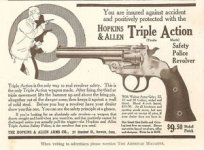


Here's a Hopkins & Allen "Triple Safety Police" I recently picked up.

These were H&A's "dying gasp" revolvers made 1908-1916.
This was after recovering from a fire that pretty much burned their factory and machine tools and when they finally went under in 1916. The quality is a bit better than their earlier offerings and is quite interesting in the mechanics of the "Triple Safety". Iver Johnson had brought out the "Hammer the Hammer" transfer bar safety system (which,I believe, is now used by Ruger in their revolvers.)
The H&A solution to this was in the unique "cammed" hammer that actually moves up and down during its rotation. I don't know of any other gun to use this system other than one that used a gear cog linkage between the trigger and hammer for a shorter DA pull. (Dan Wesson??)

Anyway, if you look closely at the upper two pictures, you can see the difference in hammer height with the trigger forward and then pulled back. The lower pictures show the step in the hammer that contacts the frame above the firing pin when the trigger is forward and then lowers itself to hit the FP with the trigger back. The pictures of the parts, below, shows the eccentric that the hammer rotates on and the gearing between the trigger and eccentric that rotates it.

I'm not sure where the "Triple" part of the "Triple Safety" comes from, unless it includes the British "squeeze" barrel latch. (Differs from S&W's "Lift" latch.)

These were H&A's "dying gasp" revolvers made 1908-1916.
This was after recovering from a fire that pretty much burned their factory and machine tools and when they finally went under in 1916. The quality is a bit better than their earlier offerings and is quite interesting in the mechanics of the "Triple Safety". Iver Johnson had brought out the "Hammer the Hammer" transfer bar safety system (which,I believe, is now used by Ruger in their revolvers.)
The H&A solution to this was in the unique "cammed" hammer that actually moves up and down during its rotation. I don't know of any other gun to use this system other than one that used a gear cog linkage between the trigger and hammer for a shorter DA pull. (Dan Wesson??)
Anyway, if you look closely at the upper two pictures, you can see the difference in hammer height with the trigger forward and then pulled back. The lower pictures show the step in the hammer that contacts the frame above the firing pin when the trigger is forward and then lowers itself to hit the FP with the trigger back. The pictures of the parts, below, shows the eccentric that the hammer rotates on and the gearing between the trigger and eccentric that rotates it.
I'm not sure where the "Triple" part of the "Triple Safety" comes from, unless it includes the British "squeeze" barrel latch. (Differs from S&W's "Lift" latch.)

 . Hope this is helpful.