victory model question

Joined
Jul 31, 2011
Messages
2
Reaction score
0
Hi, I had a S&W Vicitory - 38 special calibre - and the only military mark was a Flaming Bomb on the butt. it was an early one - 140.XXX I think. there was no US property on the top strap and no P and no other US marks. Only flaming Bomb on butt. At a gun show the new owner was told that since it did not have the US property it was sent to factory guards, but I felt it was just an early variation. That early in the war I would guess all guns were going to the front and not to factories? I always thought that there were a number of variations of makings and finish on the Victorys over the long run of guns. is it true that if it only has the flaming bomb that it went to a factory guard?

Also recently picked up a "pre-victory" 38 S&W in Blue. A 1941 gun. I have not seen one before. Only the parked ones mostly sent to Brits or Ausies? Would love some input./
 
Last edited:
pre victory

BTW/
the pre victory has UNITED STATES PROPERTY on the side of the top strap.
it is WB inspected.
\ Waldemar Bromberg I believe?
 
A V 140xxx (from fall 1942) without the US NAVY property marking on the topstrap could have still gone to the Navy, but it is very unlikely if it has only the flaming bomb. In that time frame and serial range, quite a few guns like that went to civilian authorized recipients like police or defense contractors and the Maritime Commission, unstamped on top. Yours almost certainly did too.

A pre-Victory British Service model from late 1941 with the UNITED STATES PROPERTY, signifying Lend-lease, and still blued, is possible. The switch to the dull utility finish occurred after the start of Lend-lease shipments. It would depend on the serial and the type of blue whether I’d consider the blue original or suspect a refinish; and not without good pictures ;)
 
I agree, if it had no "UNITED STATES PROPERTY" topstrap stamp it was very likely to have been a Defense Supplies Corp (DSC) revolver which went to some authorized essential stateside civilian user, such as into law enforcement service or for defense plant security guards. Other possibilities, but less likely, are to the Merchant Marine or OSS. I have listed several Victories in the V140xxx SN range (later 1942) which were lettered as being DSC guns. WB is (Lt Col) Waldemar Broberg, not Bromberg (used to about serial number V151350).

"Also recently picked up a "pre-victory" 38 S&W in Blue. A 1941 gun. I have not seen one before. Only the parked ones mostly sent to Brits or Ausies? Would love some input."

Blued finishes prevailed throughout 1941, especially the polished bright blue civilian finish which continued until at least early December 1941. Checkered wood grips with the S&W medallions were also used until early 1942 when the change to smooth wood grips without medallions was made.
 
I don't think it really was a gun that "went to the front" much. It was more widely used in the Navy with aviators. I'm not saying none of them made it to "the front". But the 1911's were the ones mainly used by the Army for Combat soldiers. With a smattering of 1917's. And I'm sure some other oddballs were there.

I don't have anything to back that other than the umpteen zillion pics I've looked at in books.
 
Of course, many of the S&W revolvers made for the British Commonwealth were employed in ground fighting on the front lines, but the vast majority of the Victories made for the US military went to the Navy during WWII, mainly for aviation service (but not entirely). Some of those probably fell into USMC hands and saw some ground action. But many of the old WWII Victories were later brought out of mothballs and used in ground service in various capacities clear through the Vietnam conflict. I am unaware of the US military ever surplussing out any Victories for civilian sale, and those seen today were probably obtained through extra-legal means.
 
Last edited:
I recently picked up a very clean Pre-Victory model. It is a 5" barrel .38 S&W. It has the "WB" on the butt with a flaming bomb mark on the butt. Sn 9150xx. Odd marks high on the backstrap above the grips and below the hammer. Appear to be a two line markings....a "7" surrounded by an odd mark on either side over what appears to be a "1" then a triangle and then "72". The book does not mention these marks
 
I recently picked up a very clean Pre-Victory model. It is a 5" barrel .38 S&W. It has the "WB" on the butt with a flaming bomb mark on the butt. Sn 9150xx. Odd marks high on the backstrap above the grips and below the hammer. Appear to be a two line markings....a "7" surrounded by an odd mark on either side over what appears to be a "1" then a triangle and then "72". The book does not mention these marks

A photo would help, but these are probably military unit or inventory stampings, and not factory.
 
A photo would help, but these are probably military unit or inventory stampings, and not factory.

Indeed, that is the area where we find New Zealand, South African, and some Austrian police unit stamps, as well as unidentified markings assumed to be WW II unit markings.
 
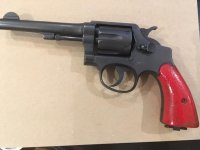
Victory with Painted RED Grips

Picked up a Victory V700,000 series with bright RED painted smooth grips. Before I strip the grips, anyone know if there is some historical value to the red painted grips or did some someone just decide to mess with a fine piece of history?

All of the number match. Also, trying to learn more about this piece of history. What does the "CTG" on the barrel represent?

Sending in a letter to S&W Foundation for info as well.

Thanks for any input.
 
Picked up a Victory V700,000 series with bright RED painted smooth grips. Before I strip the grips, anyone know if there is some historical value to the red painted grips or did some someone just decide to mess with a fine piece of history?

All of the number match. Also, trying to learn more about this piece of history. What does the "CTG" on the barrel represent?

Sending in a letter to S&W Foundation for info as well.

Thanks for any input.

Welcome! The factory did not paint the stocks red; sometimes this was done to mark a gun for training purposes or something similar.

CTG is the abbreviation for "cartridge", a common question. Hope this is helpful.
 
Welcome! The factory did not paint the stocks red; sometimes this was done to mark a gun for training purposes or something similar.

CTG is the abbreviation for "cartridge", a common question. Hope this is helpful.

Thanks for the reply! Very helpful.
 
Red Grips, could it have belonged to a pilot from RED TAIL SQUADRON?

Thinking about this, if this revolver was used for training...ya but the firing pin is in place. huh...What kind of training would someone do with a functioning firearm??

Because these Victory revolvers were issued to pilots, could this have belonged to one of the famous RED TAIL SQUADRON pilots? The Tuskegee Airmen? That would be pretty cool!
 
..
Because these Victory revolvers were issued to pilots, could this have belonged to one of the famous RED TAIL SQUADRON pilots? The Tuskegee Airmen? That would be pretty cool!

Seems a bit of a stretch, although nothing is impossible. The Victorys mostly went to arm Navy and Marine pilots, less so the AAF.

You also haven’t provided enough basic info to identify the gun yet, to determine whether it’s a US or British version, and if US, whether it was indeed military-shipped. What is the exact caliber and barrel length, and is there a US property stamp on the topstrap?
 
Seems a bit of a stretch, although nothing is impossible. The Victorys mostly went to arm Navy and Marine pilots, less so the AAF.

You also haven’t provided enough basic info to identify the gun yet, to determine whether it’s a US or British version, and if US, whether it was indeed military-shipped. What is the exact caliber and barrel length, and is there a US property stamp on the topstrap?

Thanks Absalom!

I can use the help on this one. 5" barrel, still a .38 S&W (not Special. .38 Special will not slide all the way in the cylinder).

Top stamp "US PROPERTY G.H.D." There appears to be a small "8" before the "US PROPERTY G.H.D." which I've read could be a proof mark of some kind.

On the frame, on left side, at top, is a small "P' stamped. Also that "P" appears after the serial number on the bottom of the barrel.

What do you think?
 
5” .38 S & W Victory Models were almost exclusively sent to Britain and Commonwealth countries; a few may have stayed (or were reimported) for defense related industries for guards. Proper ammo for them would have been hard to find here during the war.

The P is the standard proof stamp of the era, and I would guess the “8” you see may be the Ordnance “flaming bomb” stamp.
 
... 5" barrel, still a .38 S&W (not Special. .38 Special will not slide all the way in the cylinder).

Top stamp "US PROPERTY G.H.D." There appears to be a small "8" before the "US PROPERTY G.H.D." which I've read could be a proof mark of some kind.

On the frame, on left side, at top, is a small "P' stamped. Also that "P" appears after the serial number on the bottom of the barrel.

Yep, that's what we needed to know.

We can scratch the Red Tail Squadron. It is indeed a fairly late (fall 1944) British Service model.

As Alan has explained, these were not issued to US personnel despite the misleading US property stamp. The marking denotes a Lend-lease gun shipped to the Allies, which technically remained indeed US property. Your letter will almost certainly show it shipped to Hartford Ordnance Depot.

Since it does not chamber .38 Special, and all stampings are standard and present, it seems unconverted and unmolested except for the mysteriously red grip panels. You said all numbers match; does that include the right grip panel? If so, I'd try to strip and refinish the grips; if not, a replacement pair of originals is easily found.
 
Last edited:
Yep, that's what we needed to know.

We can scratch the Red Tail Squadron. It is indeed a fairly late (fall 1944) British Service model.

As Alan has explained, these were not issued to US personnel despite the misleading US property stamp. The marking denotes a Lend-lease gun shipped to the Allies, which technically remained indeed US property. Your letter will almost certainly show it shipped to Hartford Ordnance Depot.

Since it does not chamber .38 Special, and all stampings are standard and present, it seems unconverted and unmolested except for the mysteriously red grip panels. You said all numbers match; does that include the right grip panel? If so, I'd try to strip and refinish the grips; if not, a replacement pair of originals is easily found.

You guys are good! Thanks

Numbers all match!

Any way to know where this was sent overseas?

Here's the Victory with RED Grips:
 

Attachments

  • IMG_4593.jpg
    IMG_4593.jpg
    56.9 KB
You guys are good! Thanks

Numbers all match!

Any way to know where this was sent overseas?

Here's the Victory with RED Grips:

BTW - Just is Case...just ordered some additional original grips from ebay. Will store the red grips away just in case :)

Best to all!
 
5” .38 S & W Victory Models were almost exclusively sent to Britain and Commonwealth countries; a few may have stayed (or were reimported) for defense related industries for guards. Proper ammo for them would have been hard to find here during the war.

The P is the standard proof stamp of the era, and I would guess the “8” you see may be the Ordnance “flaming bomb” stamp.

OK, but what exactly does the "P" stand for other then the era AND what does the "flaming bomb" mean? Manufactured at a certain plant???
 
Ouch. That isn’t just red, it’s ugly red :D

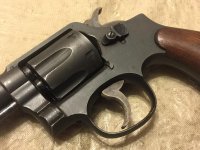
The finish overall looks original for that vintage, however, what gives me pause are the hammer and trigger, which should be case-colored, but are quite clearly finished in the same dull utility finish as the rest of the gun. See attached for an original 1944 gun, a bit earlier than yours.

OK, but what exactly does the "P" stand for other then the era AND what does the "flaming bomb" mean? Manufactured at a certain plant???

The P proofs were applied to ALL S&W revolvers produced for the military during the war and proofed/inspected by contract inspectors for the Ordnance District who were stationed at the S&W factory. The location moved from the butt to the other spots in mid-war, but otherwise, they offer no additional insights. Same with the flaming bomb, which moved from butt to topstrap.
 

Attachments

  • 99D30461-5A83-4AF2-9DD0-99E803CFB46F.jpg
    99D30461-5A83-4AF2-9DD0-99E803CFB46F.jpg
    70.6 KB
Last edited:
Ouch. That isn’t just red, it’s ugly red :D

The finish overall looks original for that vintage, however, what gives me pause are the hammer and trigger, which should be case-colored, but are quite clearly finished in the same dull utility finish as the rest of the gun. See attached for an original 1944 gun, a bit earlier than yours.


The P proofs were applied to ALL S&W revolvers produced for the military during the war and proofed/inspected by contract inspectors for the Ordnance District who were stationed at the S&W factory. The location moved from the butt to the other spots in mid-war, but otherwise, they offer no additional insights. Same with the flaming bomb, which moved from butt to topstrap.

yup, I see the case hardened hammer and tigger of your Victory. Mine are same finished as the frame. Doesn't appear to have been refinished. Maybe originally finished this way???
 
yup, I see the case hardened hammer and tigger of your Victory. Mine are same finished as the frame. Doesn't appear to have been refinished. Maybe originally finished this way???

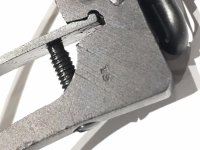
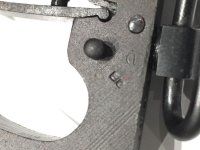
Pulled the grips off. Can you help ID these markings?
 

Attachments

  • left side.jpg
    left side.jpg
    79.7 KB
  • right side.jpg
    right side.jpg
    72.6 KB
I don't think it really was a gun that "went to the front" much. It was more widely used in the Navy with aviators.

Are you implying that WWII USN/USMC/USCG aviators, enlisted pilots and enlisted aircrewmen were non-combatants because they were issued S&W Victory or Colt Commando revolvers?
 
... Mine are same finished as the frame. Doesn't appear to have been refinished. Maybe originally finished this way???

That’s not a possibility. The factory simply didn’t install anything but case-colored triggers and hammers. That how we actually identify many refinishes at first sight. But from all your pictures, the finish of the gun itself does look like the original; I don’t have an answer.

Pulled the grips off. Can you help ID these markings?

Nope. Fitters’ marks of some type. Most marks under the grip panels of S&W revolvers fall into that category and are meaningless to us.
 
Are you implying that WWII USN/USMC/USCG aviators, enlisted pilots and enlisted aircrewmen were non-combatants because they were issued S&W Victory or Colt Commando revolvers?

I think a much better way to phrase it would be to say that Victory and Commando revolvers were generally issued to service members whose PRIMARY duty did not generally include shooting personal sidearms at the enemy :)

The British Service version of the Victory was the only American revolver to see combat as a standard-issue infantry sidearm at the front.
 
Are you implying that WWII USN/USMC/USCG aviators, enlisted pilots and enlisted aircrewmen were non-combatants because they were issued S&W Victory or Colt Commando revolvers?

Your question made me go back and reread the Original post and question and my answer probably doesn't make a whole lot of sense. I apologize. What I was implying was that typically the front line Army and Marines were more likely to have a 1911 or 1917. And even the 17's weren't as common as the 1911's. But I guess the OP's question was all about how they were marked, and if they were marked differently if they went to different places. Not about numbers....

But no, I'm not implying that anyone that carried a .38 revolver was a non combatant. But like the other gentleman said, the .45's were probably more typically used, just from sheer numbers alone and who carried them.

More than likely everybody in this thread already knows that, and I probably just stated the obvious. So I get the captain obvious award this time. LOL.
 
Last edited:
Back
Top