Whats the difference?

GSP Fan

Member
Joined
May 22, 2021
Messages
1,277
Reaction score
2,511
City & State/Province
Michigan
I have a newbie question. What's the difference between the models 14 and 15? I see them advertised as Target Masterpiece and Combat Masterpiece for the M14 and Combat Masterpiece for the M15. Both are 38 special and appear just alike.
 
2” of barrel length. M14, 6”….M15, 4”. That would be the simple answer, as there’s exceptions to every rule of S&W’s
 
Generally speaking the 15 was 4" 14 was 6". There are some variations on this but thats the simplest answer.
 
Barrel length mostly.

The model 14 is 6" or 8 3/8". The 15 is 2" or 4". In addition the barrel profile is different. The 14 is a straight "heavy" barrel and the 15 is tapered. Well the 4" Model 15 is tapered the 2" Model 15 is straight I believe.

There are some uncommon exceptions. Like a 4" Model 14. And a heavy barrel Model 15. Those two would be essentially the same except for markings and maybe sights. As always with S&W there are a bunch of exceptions to every rule.

But for the vast bulk of the production the 14 is a 6" and the 15 a 4". Plus the differences in barrel profile.
 
Lots of good answers here. I'll just add some detail.

First, some nomenclature clarification. The Model 14 continued the line of the K-38 Masterpiece, which started in 1947. "Target" was never part of its name. The 4" version, introduced in 1949, was the .38 Combat Masterpiece (not K-38 Combat Masterpiece), later it was given the Model 15 designation.

As mentioned, the tapered barrel on the K-38 Masterpiece was dropped in favor of the K-38 Heavy Masterpiece in about 1952. The Combat Masterpiece continued to have the tapered barrel until the mid-1980s.

Let's set the cutoff for this discussion at 1982. After that, a lot of things changed in the K Target line. The K-38 Masterpiece was discontinued for nine years, and the .38 Combat Masterpiece more or less replaced it when, in 1986, the 6" and 8 3/8" barrels were added to the Model 15 line.

Until 1964, the .38 Combat Masterpiece had a 4" barrel, notwithstanding some special orders. In 1964, during the Model 15-2 run, a 2" version was added.

Until 1959, the K-38 Masterpiece had a 6" barrel. In 1959, the 8 3/8" barrel was added. Again, there were special order exceptions.

Especially in the early years (before model numbers) there were some exceptions to the sight arrangements. But generally speaking, the K-38 Masterpiece came with a Patridge front sight and the .38 Combat Masterpiece came with a Baughman ramp front sight.

The original postwar plan was to separate the K frame target sight guns from the fixed sight K frame in all three chamberings, .22, .32 and .38. Prior to the war, target versions were just that, target versions of the Military & Police revolver, except for the .22, of course. So, a K-22, K-32 and K-38 were offered in the Masterpiece line with 6" barrels. Then, 4" versions were to be released, and these would be called the Combat Masterpiece. Marketwise, it didn't work out for the .32 Long, so very few of those were made. But the .22 Combat Masterpiece and the .38 Combat Masterpiece were both a huge success.
 
Speaking of exceptions, here are two photos of a .38 Combat Masterpiece with a special order 5" barrel. 365 of these were made for the Missouri State Highway Patrol, in 1952-53. They left Springfield in four shipments, three in 1952 and one in 1953.

I purchased this one a few years back from the son of the Trooper (then deceased) who carried it on duty.
jp-ak-albums-k-frame-target-revolvers-picture11787-mshp-left-2-800x565.jpg

jp-ak-albums-k-frame-target-revolvers-picture11786-mshp-left-1-800x600.jpg
 
Speaking of exceptions, here are two photos of a .38 Combat Masterpiece with a special order 5" barrel. 365 of these were made for the Missouri State Highway Patrol, in 1952-53. They left Springfield in four shipments, three in 1952 and one in 1953.

I purchased this one a few years back from the son of the Trooper (then deceased) who carried it on duty.
jp-ak-albums-k-frame-target-revolvers-picture11787-mshp-left-2-800x565.jpg

jp-ak-albums-k-frame-target-revolvers-picture11786-mshp-left-1-800x600.jpg

What the story on the upswept hammer? Factory or mod?
 
I'm drooling over a pre M14. Just to add to the lust it's a birth year gun as well 1952.
 
And just to perhaps confuse things a bit (or better yet to learn something), there's the matter of what I'll call the Special Tuning applied to target guns. We start this off with S&W's words from their mid 1920's catalog---goes like this: "--------a special type of trigger pull is desirable-----not by any means simply a very light pull, but one having the peculiar quality termed "short and crisp" by shooters. This not only requires a special type of notch and trigger point, but requires a different adjustment of the working parts of the action." The clearly objective result of this is a single action trigger pull of 3-5 lbs on target guns, and 5-7 lbs. on fixed sight guns; but as noted, there's more to it than that. So, under the heading of things to learn, when did this start---and when did it stop (IF it stopped); and while fixed sights or adjustable sights defined the visible difference between target and non-target or service weapons in the pre-war era, there are clearly target grade guns (those with adjustable sights) in the post-war era which are just as clearly not intended nor deemed to be target guns. If this practice continues, what's the dividing line? Here, for instance, we have a K-38 Masterpiece; clearly intended as a target gun----and a Combat Masterpiece just as clearly intended as a service gun---albeit with adjustable sights.

Inquiring minds want to know.

Ralph Tremaine
 
As you can see from all these excellent replies the answer to any question about Smith & Wessons gets complicated. Mostly because these designs have endured for a long period of time. The factory tended to accomadate anybody willing to buy enough units. This created a lot of variations from the standard catalog items.
 
To confuse and confound even more, those who have the Standard Catalog of Smith & Wesson, 1st - 2nd - 3rd Editions, the book clearly states K-38 Target Masterpiece and Model 14 K-38 Target Masterpiece. It was finally corrected in the 4th Edition.
 
It was finally corrected in the 4th Edition.
Yes, sort of. Jim corrected it in the headings, but not in the fine print. For example, see p. 211, at the top of the discussion on "Engineering and production changes."

Then there is that WEIRD reference to the D prefix under the 14-3 variations. What?

Also, the Standard Catalog persists in calling the Model 15 a K-38 and the Model 18 a K-22. :(

To be clear: Jim and Richard have done the collecting fraternity a HUGE good deed by compiling that excellent catalog. The surprising thing is how few errors there actually are, considering the gigantic volume of information it contains. We are in their debt.

And if you want to see what big improvements they have made over the years, just sit down with the First Edition, browse through it and compare it with the Fourth. Wow. Night and day. My First Edition is a keepsake. It does not get used. My Third Edition was falling apart by the time the Fourth came out. :)
 
Yes, sort of. Jim corrected it in the headings, but not in the fine print. For example, see p. 211, at the top of the discussion on "Engineering and production changes." . . .

They did not get them all until 4th Edition. Check page 144 heading in the 3rd Edition and it is the same for all prior editions. Absolutely agree that the Nahas and Supica work is the best available reference to all Smith & Wessons out there, from the very first lever action pistols to all the stainless revolver and black plastic pistol models ever made.
 
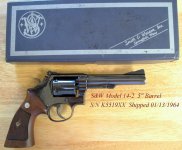
And here is a Model 14-2 K-38 Masterpiece with a 5" barrel. Note that while it has the Baughman Ramp front sight like a Model 15 .38 Combat Masterpiece, it retains the wide rib and heavy barrel contour of the Model 14 since it was just a special order factory cut barrel.
 

Attachments

  • Model 14-2 With Box.jpg
    Model 14-2 With Box.jpg
    91.9 KB
They did not get them all until 4th Edition. Check page 144 heading in the 3rd Edition and it is the same for all prior editions.
Hi Gary

The point I was making is that the headings were changed in the 4th, but there are residual references in the fine print that did not get removed. My p. 211 note, for example, is from the 4th.
 
Got it, I had missed that you were referring to the 4th Edition, not the 3rd. Also missed that reference in the latest edition. Now there is a new thread stating that the OP has a "Old Target Masterpiece".
 
Back
Top