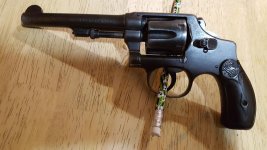
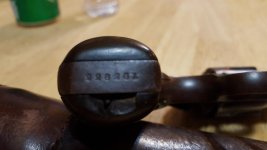
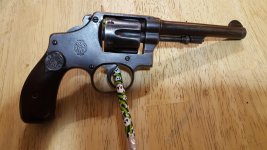
Yet another ID thread, please.

cold1

Member
Joined
Dec 25, 2016
Messages
5
Reaction score
3
Well after a day or so of digging around here, I am more confused. There is just too much info (not a bad thing).

I recently acquired my first S&W pistol, a Hand ejector. I have narrowed it down to a 5 screw (6 screw including the strain screw) I am unsure of what "change" series it is. I did figure out it wasnt an Improved model :D

It needed some TLC and it needs a cylinder stop. The hammer looks to be bobbed about as long as the pistol has been around, the patina matches the rest of the gun, but I pretty sure its not a factory job. Bubba probably.

As I mentioned earlier, it needs a cylinder stop. She has some wear on the ball on this one. If I did my homework correctly, a J frame stop with the hole filled in should work. Power customs may have one without the hole. Is all of that correct or did i read the wrong stuff?

On to the pics.

PS. Can I get a year of production please
 

Attachments
  • 20161226_212158.jpg
    20161226_212158.jpg
    92.5 KB
  • 20161226_212222.jpg
    20161226_212222.jpg
    85.8 KB
  • 20161226_212337_001.jpg
    20161226_212337_001.jpg
    39.7 KB
Last edited:
Would you be able to tell me if the parts interchange between this model and the J frames?
 
From the catalog, .32 HE Model 1903, 5th Change. Range is 102501-263000 and dates for those serial #'s, 1910-1917. I don't know what if anything would interchange with a J frame.

Stu
 
Would you be able to tell me if the parts interchange between this model and the J frames?

A few parts might interchange-trigger, bolt (maybe), grips, more or less. These pre WW II revolvers have a slightly different action, called the long action. The good news is that a ton of these I frame revolvers were built and used parts are available.
 
Welcome. Let's try to narrow this down a little. During WWI, the factory stopped placing logos on all their models, from 1916 into 1919. The Model 1903 ship dates are scattered all over the place in the SWCA database, so the company must have had a large inventory of these guns available. They would simply grab guns from inventory and ship regardless of serial number. Looks like your gun should have shipped prior to 1916 and probably as early as 1913. A factory letter would give you the exact date if you want to get one.

The hammer is a hacksaw job and eliminates any ability of shooting in single action mode. Numrich Gun Parts have hammers for a Model 1903, but you would have to take the sideplate off your revolver and match features with the images shown to find what would fit your gun. My guess is that there were at least three designs of hammer made before WWII. The bad news is that there was no serial number stamped on the hammer, so you might want to make sure you can return if it is not correct. Also, keep checking ebay for parts as well.

Check the same sites for the cylinder stop and you will need to have it in hand to match with any parts available. Good luck.
 
Unless your primary interest in this revolver is simply as an educational hobby project, you would probably be better off spending your money on something that is already fully functional.
 
Thank you all for the info.

I am a "tinkerer" of most all things mechanical. I really love bring old and unused stuff back to life. I got a heck of a deal on this pistol. It is old and loose and in a caliber that not too many people want. It was shaving lead when fired. I tightened it up by stretching the yoke and it stopped shaving lead. It shoots good and is a fun project.

Since there is no real collectors values to this pistol, I plan on having fun with it and learn some stuff along the way. I would like to get it fully functional and try my hand at restoring it and maybe even custom stocks on it.
 
Welcome to the forum.

There was a thread recently where someone explained how to repair these old black hard rubber stocks. Using two part epoxy and black paint they practiced making up some material until they had a formula that worked.

Once that is accomplished, they laid the broken stock panel on a flat surface covered with plastic wrap and added material until they had more than was needed. The stock was then gently sanded until the correct shape was obtained and then buffed smooth.

The stock panels are easily broken by folks attempting to remove them by the prying method without realizing that there is an alignment pin at the bottom. Pressure against this pin causes the panel to crack and break.

There are also reproductions available if one is not concerned with collector value as you said you weren't.

Good luck with your project. Bringing one of these old shootin irons back from the brink can be a lot of fun and since the cost is small, so is the risk if it doesn't go as planned.
 
That's just about all there is to repairing those stocks. I might just add that the reason you need to experiment with the oil based black paint is that if you use too much the epoxy will cure to only a rubber consistency. It takes a very small amount of paint to color the epoxy.

I might add that if you are going to tackle the project, please take pictures before and as you disassemble revolver. They will be invaluable in reassembly and will help you avoid having some parts left over in the end.
 
Welcome to the forum!

From my serial # and shipping date database, it likely shipped in the 1st half of 1915.

HAMMER:

The hammer was most likely broken off from being dropped and then dressed down smooth. The broken grips are additional evidence; these are the two most common results of a dropped gun.

The good news is, the vintage of your hammer was the last version and therefore used all the way up to WW II.

In a pinch, even a post WW II I or J frame hammer up to the Model of 1953 will work. The I frames did not switch from a long action to a short action hammer after the war like the K and N frames.

CYL BOLT:

I presume that the reason you want to replace it is because it's jumping out of the notch.

It's highly unlikely you need a new cyl stop. A new one will need fitting, it's not a drop in part. You said the existing one is rounded. It's much less fitting work to just slightly remove the roundness and square it up.

Also peen the edges of the cyl slots flat if they are burred over.

OPERATIONAL/SAFETY TESTS:

Simply put, the only usual issue with these marvels of yesteryear is they are gummed up and dirty. Old oils of its time do not match the quality of these old guns nor the science of today, and actually dry up and harden to the point of impeding operation and accelerating wear. The simple solution does not need a gunsmith or removal of the side plate. Just one of many premium modern gun care products from any sporting goods, gun store or hardware store.

Most are both cleaning and preserving agents; Breakfree, Kroil & M-Pro7 are some of the best, but not WD-40, and there are others. Disassembly is not necessary. With grips removed and a spray can version of the product, flood and flush the revolver thru every opening and crevice until the black gunk stops flowing out, let it drain for an hour and wipe it down thoroughly with the same product.

Scrub barrel bore and cylinder chambers with a simple cleaning rod kit found at the same places as the cleaning agents above; patches cut from rags is all you really need. And scrub any observed exterior and crevice crud with an old toothbrush with bristles cut off short for stiffness.

Once cleaned and lubricated, with a few simple checks you can determine if it’s safe to use. Open the cylinder and verify the barrel is unobstructed. Cock the hammer in single action mode. Gently push on the hammer to confirm that it will not drop w/o pulling the trigger. Cock the hammer slowly and confirm the cylinder locks in position for each of the 6 chambers about the same time the hammer cocks. If satisfactory, now operate the gun in DA pulling the trigger slowly; again confirm the cyl locks before the hammer drops. After each cycling of the action, confirm that the cyl is still locked in position.

Cylinders can have fore and aft movement and rotational movement. Check rotational movement with the hammer cocked. That's all that is really important from a safety concern.

Enjoy and let us now how it turns out,
 
Last edited:
Thanks for the detailed info!

The first thing I did was a total disassembly and cleaning. It wasnt really gunked up but there was a lot of residue in there. Hoppes #9 and a bronze brush made short work of it. The hammer engages in SA well and doesnt budge with pressure applied. There was a lot of endshake, I stretched the yoke a few thousands and got rid of it. The head space is within spec. The BC gap is huge, about 25 thousandths. Its not effecting the accuracy so I probably will not attempt to set the barrel back.

As for the cylinder bolt, I am having rotational looseness of the cylinder. The bolt itself has severe wear on the right side. Not only can you see the line of wear,but you can feel it. I am guessing about 2 thou, I havent put a micrometer on it yet.

Even with these few problems, I am having a blast with it. I loaded up 100 rounds of powdered coated 93gr cast round nose over 1.8gr of red dot. The sights are hard to see but its doing good. I havent really sat down and tried to see how accurate it is, but its keeping all the shots in the middle of the pie plate from 20 yards.
 
Back
Top