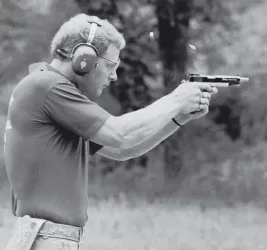
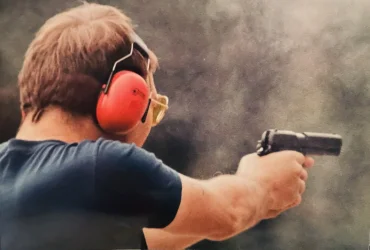
1. The Weaver stance requires the shooter to "blade" or turn their body sideways. This exposes the vulnerable, unarmored armpit area of a ballistic vest to a direct threat. The Iso stance squares the officer’s torso to the target, placing the thickest part of the body armor directly in the line of fire
2. Post-shooting studies (such as those analyzed by
National Criminal Justice Reference Service) show that officers under high stress naturally abandon complex "bladed" stances and square up to the threat. The Isosceles relies on this natural, "gross motor skill" reaction
3. Moving dynamically in a bladed Weaver stance is awkward. The squared Isosceles platform allows for faster and more balanced movement in all directions, making it superior for navigating real-world scenarios
4. While the Weaver uses push-pull muscular tension to control recoil, modern training favors the skeletal locked structure of the Isosceles triangle, which efficiently directs recoil straight through the arms and into the core.
Top competitive shooters primarily abandoned the Weaver stance in the
1980s, following the rise of the Modern Isosceles stance popularized by action-shooting legends Brian Enos and Rob Leatham in the International Practical Shooting Confederation (IPSC) The transition occurred because the Weaver stance—which relies on a "push-pull" isometric tension with bent elbows—began failing under the demands of modern competition and high-stress scenarios
Faster Recoil Recovery: Fully extending and locking out the arms in an isosceles position forms a mechanical skeletal structure that returns the gun to the exact same point of aim after every shot. This allows for faster split times.
Rapid Target Transitions: Blading your body (a core tenet of the Weaver) severely limits your range of motion. A squared-off, aggressive isosceles stance allows shooters to pivot seamlessly between multiple targets on a stage
Under-Stress Performance: Isosceles relies on gross motor skills. Studies have shown that even shooters heavily trained in Weaver revert to a natural, square-to-the-threat isosceles position when subjected to high-stress, real-world scenarios
I never bought into Weaver stance even as I was trained in it for several reasons but one above in particular. Weavers limited range of motion compared to Iso. I want the gun at my nose index, both eyes open and making use of our mechanical skeletal structure. With ISO shooting right handed, I can turret to either side where Weaver becomes a problem when trying to turret the upper body to the extent Iso range of motion gives me.
Thoughts from the members?


 . Remember, nothing ever happens-until it does !