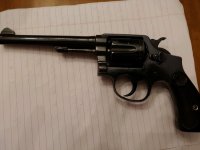
Gary, and others
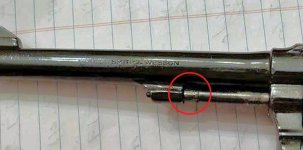
If the barrel was really replaced, with one having a shoulder, then someone would have had to turn down and rethread the barrel itself. I've seen this movie before, and that is what has to be done. The shoulder on the barrel is, at least, the first change to the barrel, to accommodate the larger threaded diameter of 0.540, whereas the 1902, like the 1899, has a barrel thread diameter of 0.500 .
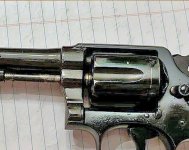
That serial number of 30301 should have been a 1902 no-change. As you noted, the barrel seems to have no notch for the ejector rod nob, so that same someone had to do something about that, to get the cylinder to close. Looks like they made up a new cap for the ejector rod. The gun does have the early lockwork, and it is a round butt.
All of this is too bad, because an original 1902 is a rare bird. If this were my gun, I'd take several steps, to confirm how much damage actually has been done. I'd swing the cylinder open, and measure the OD of the barrel where it projects into the cylinder window. If its anything less that 0.500, then its probably been rethreaded, as I suspect. If that is the case, then I'd remove the barrel to confirm the barrel OD.
If it's 0.500, then I'd remove the barrel, and set about finding a correct 1902 barrel, and also finding a proper nob. If I couldn't find one, I'd have one made. Not too difficult. I'd also try to remove that cap on the end of the extractor rod, to see if the upper half could be salvaged. If not, set about finding another one, or have one made.
Once I'd lined up all the necessary parts, I'd disassemble the gun, and soak the hammer and trigger in Naval Jelly, or something siimilar, to get the blue off.
When its all put back together, it'd be a decent example of a 1902.
Regards, Mike Priwer