That's a good deal! I would have grabbed it.
It's nicer than 90% of those still out there. I never liked them but once I satisfied my higher priority acquisitions, I got one then another once I realized how unique and different they are from all subsequent models.
That made it desirable to me but I like to discover and study them, so that may not make them appeal to others, However they're all good shotters and that one is even missing the extractor rod knob like so many are!
A little massaging with Mother's Mag Wheel polish, SemiChrome or Flitz while watching the news, and it'll look like new.
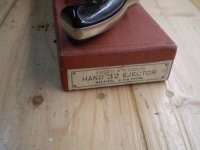
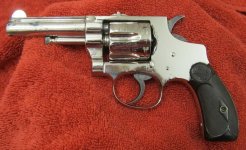
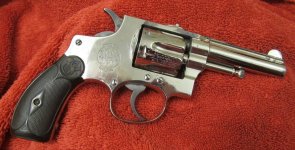
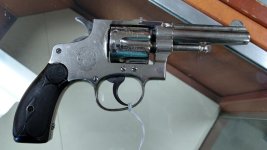
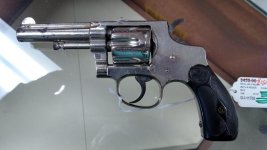
THE MODEL OF 1896 .32 HAND EJECTOR
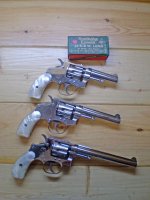
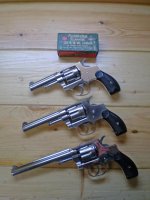
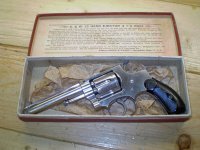
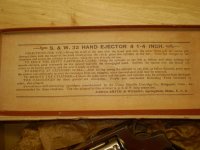
This is the very first Hand Ejector produced by S&W. You'll notice they have no cartridge marking.
These were produced and shipped way out of serial # order over a period of 8 years. Shipping dates could be any time in that period, only an Historical letter will indicate the actual date. A lot of lower numbered guns shipped very late.
Three features that vary during production are the length of the hammer, # of side plate screws, and extractor rod knob: there are long and short hammer spurs and 3 or 4 side plate screws.
Standard barrel lengths were 3 1/4", 4 1/4", and 6".
There are also target models which are rare.
Enjoy and don't be afraid to shoot it with any standard velocity off-the-shelf ammo. Ammo won't be found everywhere but it's still produced. You'll love it's accuracy.
Also, 1st Models are all antiques. Frames were manufactured and serial numbered before 1899. This is one S&W model does not have a antique serial number cut-off based on ship date. Gary (glowe)
DIFFERENCES IN THE 1896 vs. ALL LATER .32 I FRAMES:
Hand Ejector 1896, First Model - Fresh Gun Porn 4 U
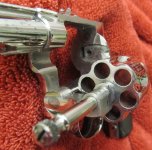
There are six unusual features that are present in the First Model. The first is that the cylinder stop is located on the top strap and engages the cylinder from the top. The stop is hammer-actuated -- when the hammer moves back the stop lifts up. S&W never used a top-mounted cylinder stop again. The last time they had was in the old Model No. 2 (.32 caliber).
Photo credit: davidj
Photo credit: davidj
The second unusual feature is the use of hardened steel shims to reinforce the cylinder stop notches. According to Jinks' A History of Smith & Wesson, S&W installed hardened steel shims from 1896 until 1908. The practice stopped in 1908 because S&W began using an improved steel for cylinders.
Photos by daivedj
The third unusual feature is the 1st style ‘action lockout’ on the rear of the yoke shaft which locks out the trigger/action when cyl is opened. This model did not have a cyl release thumb piece or rear cyl lock bolt.
All later hand ejector models, replaced it with the thumb piece and bolt (with a spring and plunger) that pushes the rear bolt forward to lockout the hammer/action from functioning with the cyl open, by interfering with the hook on the back of the hammer.
The fourth unusual feature is the cyl detent to hold open the cyl which was deleted after the Model of 1903, 2nd Model but contimued on K and N frames intermittently until WWII.
Plunger shown here in bottom of yoke and has a spring underneath it:
The fifth unusual feature is the cyl release:
The cylinder is kept in place and cases ejected the same way as a modern Hand Ejector via the cylinder pin. The difference is a “pull push” action instead of pushing the cylinder pin out of engagement with the thumb latch, you pull it out of engagement by pulling forward on the ejector rod. The barrel lug wasn't added to Hand Ejectors until the M1902. The "pull forward" latch was also used on the 2nd and 3rd Model Ladysmiths.
The sixth is a barrel set screw instead of a cross pin:
Photo credit: glowe
http://smith-wessonforum.com/s-w-ha...and-ejector-knowledge-test.html#post140281065
Photo credit: glowe
Photo credit: glowe






 Not anymore!