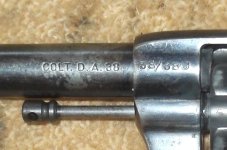
.38/380 ?

GypsmJim

Member
Joined
Oct 16, 2009
Messages
4,512
Reaction score
8,102
I have a British marked victory which is labeled .38 S&W on the barrel. It was reamed out for .38 Spl. Probably an early 1950's import. It is not import marked. The barrel was also cut down to 4". It also has the usual "US property" stamp.

I always thought the 38 S&W were the British 38/200 designation. The 38/380 is what has me confused.

Any insight?
 
Last edited:
The British designation for the .38 S & W round during WW II was .380 Inch Revolver Mk IIz. Does it have the usual 1950s commercial proof marks from over there?
 
It has numerous British proof marks on the left side of the barrel, plus the statement "Not British Made" on the frame. I don't know what commercial proof marks look like.

All the parts are matching.
 
It has numerous British proof marks on the left side of the barrel, plus the statement "Not British Made" on the frame. .

“Not British Make” with a ‘k” is for export.

Are you sure it says “British”?

NOT ENGLISH MAKE is part of the British commercial proofs required for foreign guns imported into Britain under the “Rule of 1925”; it went away with the new “Rule of 1955”. The nitro proofs also looked different for foreign-made vs. domestic guns.
 
I always thought the 38 S&W were the British 38/200 designation. The 38/380 is what has me confused.

As far as I’ve been able to determine, the .38/200 was never a British designation; it was an American designation for the British .38 caliber.

As far as the 38/380 stamping is concerned, the story is murky. Supposedly, according to Pate who has the only attempt at explaining this, it was supposed to be stamped ONLY on .38 Special revolvers that were converted to .38 S&W early in the war, .380 being the British designation for their .38 cal (pg. 111).

However, I’ve seen it applied to quite a few (though not a lot) S&W revolvers that were already originally .38 S&W British Service models, like your gun apparently, so that explanation does not match observed reality. But it is definitely an early-war mark that has nothing to do with any of the post-war commercial proofs.

And for additional inconsistency, while .380 was the official British name for the caliber, the two officially British revolvers, Enfield and Webley, are just stamped .38 :rolleyes:
 
Remember too that the Colt Official Police revolvers made under the British Purchasing Commission order of 18,250 units had .38/200, factory stamped on their barrel.

The use of the term .38/200 on revolvers when the 178 grain bullet had been adopted years before, still awaits a conclusive explanation.

Regards

AlanD
 
Can be found on other revolvers, and is supposed to signify that it WILL accept the service cartridge.
Seems to have been over-enthusiastically applied to some guns that didn't really need it.
 

Attachments

  • Colt 38 DA 006a.jpg
    Colt 38 DA 006a.jpg
    214.6 KB
It has numerous British proof marks on the left side of the barrel, plus the statement "Not British Made" on the frame. I don't know what commercial proof marks look like.

All the parts are matching.

In theory all imported firearms to England were supposed to be proof tested before use. The little overseas conflict in 1939 stopped enforcement of that rule, so virtually any extra stampings such as .38/380, BNP, 0.767", 5 TONS, etc. are commercial marks applied after the revolvers became surplus and before their sale.
 
The .38/380 marking in MkVII's post is a British military marking not commercial. Its to show that it can fire standard British service ammunition, as opposed to non-standard ammunition.

regards

AlanD
 
Are you sure it says “British”?

is part of the British commercial proofs required for foreign guns imported into Britain under the “Rule of 1925”; it went away with the new “Rule of 1955”. The nitro proofs also looked different for foreign-made vs. domestic guns.

My mistake. It is NOT ENGLISH MAKE.
 
My mistake. It is NOT ENGLISH MAKE.

My mistake as well. I wrote it from memory.

As far as the conversion, it was definitely a .38 S&W reamed out to Special. The start of the ream coincides exactly with the length of a S&W cartridge. Special cases also bulge, S&Ws do not.
 
The 38 S&W loaded with a 200 grain bullet was named the 38 Super Police load here in the U.S. Way back when.
 

Latest posts

Back
Top