38/44 round???

BigBill

Absent Comrade
Joined
Jan 29, 2011
Messages
13,869
Reaction score
13,363
City & State/Province
Planet earth
Was the 38/44 offered as a new round?

How many mixed up this over charged 38 special round they called the 38/44 in there 38 specials?
 
Last edited:
Bill, I think what's confusing is that the 38/44 is a revolver, not a cartridge. aka as the Model 23 and the Pre-23, the Outdoorsman and the Heavy Duty. The "38" referring to the caliber chambering in the .44 cal. N Frame. A few ammo. makers did label their high velocity .38 Specials as .38-44s to match the S&W nomenclature for the revolver. To real collectors, the only true .38/44 is the old black powder target round in the S&W No. 3 New Model Targets chambered in that caliber. It was a straight case round with the bullet seated flush with the case mouth. Ed.
 
Last edited:
I just realized the 38/44 means a 38caliber in the 44 n frame. The 44 has nothing to do with the case. This 38/44 round was more powerful than the 38 special. I'm not sure if it's equal to the 38 special +p of today.
 
I would answer - "Kind of 'Yes'"

Bill:

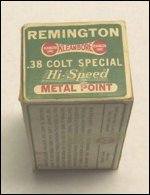
Although the round that was fired by the 38/44 Outdoorsman's and the Heavy Duty's was just a souped up 38 special, there was at least one manufacturer (Remington) that labeled some of its ammo for the Outdoorsmans and Heavy Duty's as "38-44" as noted in the photos below (I have a couple of boxes of this ammo):

Box Top:


Side:


Bottom:


Side Warning:


End Flap:


I could not get a good photo of the head stamp on the cartridge with my iPhone, but it says "REM-UMC 38-44 SPL". If I recall correctly, I have a couple of other ammo boxes that are labeled something like "Heavy Duty" or "High Velocity" 38 Special and then they have a warning that the ammo is only to be used in the S&W Outdoorsman's and Heavy Duty revolvers...
 
Last edited:
Bill, I think what's confusing is that the 38/44 is a revolver, not a cartridge. aka as the Model 23 and the Pre-23, the Outdoorsman and the Heavy Duty. The "38" referring to the caliber chambering in the .44 cal. N Frame. The only true .38/44 is the old black powder target round in the S&W No. 3 New Model Targets chambered in that caliber. It was a straight case round with the bullet seated flush with the case mouth. Ed.

As pointed out by another poster, you are wrong! While there was the .38-44 Target load for the New Model #3 top break dating to the 1880s, the ".38 Spl. Hi-Speed", "Super-X", and some other designations, was indeed a second cartridge referred to as the .38-44. Remington did issue ammunition headstamped "REM-UMC .38-44 SPL".

Yes, the cartridge was intended for the .38-44 "Heavy Duty" and "Outdoorsman's Revolver". And, yes, they were simply marked as ".38 S&W Special".

To directly answer OPs question, which I don't see anyone has done yet:D, various sources identify the date of introduction of the .38-44 cartridge and the .38-44 Heavy Duty revolver as 1929, and the Outdoorsman's target sighted version in 1931. There are some contradictory dates out, but regardless it was somewhere in the 1929-1931 time frame.

Factory .38-44 ammunition was advertised as giving a velocity of from 1115-1150 FPS in revolvers, not test barrels. The vast majority of factory .38 Spl +P 158 grain ammunition does well to reach 1000 FPS in a 6" revolver. Contrary to the belief of many who have never done the research .38-44 ammunition significantly exceeds the performance of modern +P ammunition. The SAAMI pressure standard for .38 Spl +P is 20,000 PSI. It is generally accepted that original .38-44 ammunition (pre SAAMI!) developed somewhere in the 25,000 PSI by the crusher method then in use, now usually referred to as CUP. Some .38-44 ammunition is believed to have actually developed as much as 35,000 PSI Crusher.
 
The 38/44 load was MUCH more powerful than current +P. Not even a close comparison. The 38/44 used a 158 bullet at 1,100-1,150 FPS. Mainstream +P is a 125 at 925 FPS. The +P is a true pipsqueak next to the 38/44.

But the 38/44 was just a 38 Special loaded to higher pressure and velocity. A 38/44 round will chamber in any 38 Special revolver and the 38/44 gun can be loaded with any 38 Special ammo.
 
Last edited:
Sorry for the drift

As per Big Bills original post, I have always wondered about
the 44-40.

Seem like a very slight bottleneck to what functional purpose?

This led to me wondering if there was a similar 44-38, which
makes more sense to me as a high velocity handgun rnd.


For the official hall monitors.....the original question has been fully answered and understood :cool:
 
AND-----in an early post-war brochure, S&W notes the M&P Target is suited to "38 Special Super Police" ammunition. That said, I don't know what that is; but as is often the case, my blissful ignorance and I would be happy to bet money it's some variant of the 38/44 round.

As a point of order (or some such), the 20th century 38/44 round is expressed thus: 38/44. The nineteenth century round with the similar name is expressed 38-44. That's another thing I don't know the why of----other than the need to note they're different.

Ralph Tremaine
 
As per Big Bills original post, I have always wondered about
the 44-40.

Seem like a very slight bottleneck to what functional purpose?

This led to me wondering if there was a similar 44-38, which
makes more sense to me as a high velocity handgun rnd.


For the official hall monitors.....the original question has been fully answered and understood :cool:

There is no comparison between the .38-44 and .44-40. While looking similar (the nomenclature) they mean two entirely different things.

In the case of the .38-44 it is a high velocity of a standard .38 Special cartridge intended for S&W "Heavy Frame" (N Frame, .44 size) revolvers. The .38 Special was from the beginning, and always has basically been a revolver cartridge.

The .44-40, nominally .44 Cal. bullet and 40 grains of Black Powder, was designed as, and always has been, a rifle cartridge for which several handguns were later adapted to use this cartridge. The .44-40 (.44 W.C.F.) was originally designed for the Winchester Model 1873. The cartridge (and the later .38-40) were designed originally as a straight taper, not bottleneck, case to facilitate feeding in the 1873 action. The cartridge case was a straight taper, the chamber was bottlenecked. The same situation applied to the .38-40 and .32-20. All three cartridges were originally for the Model 1873. It wasn't until sometime after smokeless powder came to be commonly loaded in the 1873 series of cartridges that the cartridge began to be formed as a bottleneck.

It is an entirely different subject to explain why a .423" to .431" diameter bullet is called a .44. Likewise why a .38 Cal. uses a .357 bullet. And on, and on, and on..........
 
Now I wonder how many of the owners of the standard s&w revolvers in 38 special tried to shoot the 38/44 cartridge? Maybe thinking they could upgrade and got kaboom?

I want to thank everyone for there input to my questions. You guys are awesome. I was searching for new 38/44 ammo with none to be found.
I guess everyone rolls there own? I really wanted some info before I purchase one.

The riflemans lever action rifle was in 44-40 & I believe it was a 1873 Winchester.
 
Last edited:
There is no comparison between the .38-44 and .44-40. While looking similar (the nomenclature) they mean two entirely different things.

In the case of the .38-44 it is a high velocity of a standard .38 Special cartridge intended for S&W "Heavy Frame" (N Frame, .44 size) revolvers. The .38 Special was from the beginning, and always has basically been a revolver cartridge.

The .44-40, nominally .44 Cal. bullet and 40 grains of Black Powder, was designed as, and always has been, a rifle cartridge for which several handguns were later adapted to use this cartridge. The .44-40 (.44 W.C.F.) was originally designed for the Winchester Model 1873. The cartridge (and the later .38-40) were designed originally as a straight taper, not bottleneck, case to facilitate feeding in the 1873 action. The cartridge case was a straight taper, the chamber was bottlenecked. The same situation applied to the .38-40 and .32-20. All three cartridges were originally for the Model 1873. It wasn't until sometime after smokeless powder came to be commonly loaded in the 1873 series of cartridges that the cartridge began to be formed as a bottleneck.

It is an entirely different subject to explain why a .423" to .431" diameter bullet is called a .44. Likewise why a .38 Cal. uses a .357 bullet. And on, and on, and on..........

The s&w 38 is a different diameter than the 38 special / 357 mag.
I was thinking of getting a snubnose for my misses in 38 special and let her shoot the milder s&w 38 but it won't fit. The colt 38 will fit. Now I figure to get her a 44 special and let her shoot 44 Russians out of it. I want to go slow with her. She's getting her ccw license and I want her to carry when she walks the dog.
She surprised me when I purchased her own Taurus 94 with a 6" barrel in 22lr. She shoots double action all the time. She's accurate too. She got scared when she heard the louder bang of my 58/41mag. The range was quiet with most shooting the 9mm autos. I woke everyone up with the 41.
 
Last edited:
Now I wonder how many of the owners of the standard s&w revolvers in 38 special tried to shoot the 38/44 cartridge? Maybe thinking they could upgrade and got kaboom?

I want to thank everyone for there input to my questions. You guys are awesome. I was searching for new 38/44 ammo with none to be found.
I guess everyone rolls there own? I really wanted some info before I purchase one.

The riflemans lever action rifle was in 44-40 & I believe it was a 1873 Winchester.

Some of the 38-44 ammo was marked as such but some of it was not. They relied on the box markings, I guess. Also, if you see a 38 Special round with a large primer, it probably is a 38-44 or was one. They had to use a rifle primer at first to get the slower powder to burn. There really was no suitable powder for the 38-44 until 2400 came out.

There is a lot of info out there on the 38-44. It was designed to compete with the Colt 38 Super. The standard loads for the 38 Special did not do well against auto bodies. Bounced off. The 38-44 cured that problem.

Elmer Keith designed his 173 grain SWC for the 38-44 revolver. It has a long nose and wont fit the 357 N frame revolver cylinder. He designed another one for the N frames with a shorter nose. IMHO the 173 is about the best for the 38 Special.

There probably were some guns damaged by using this ammo in smaller framed guns. I dont think they would blow up but they would probably wear out quickly. If you handload, you can easily duplicate the 38-44. Just make sure they dont get used in smaller framed guns.

The Rifleman used Model 1892 Winchesters in the series. Some were the knockoff El Tigre rifles. 44-40 was designed to be tapered a bit for the 1873 Winchester rifle. This action jams the cartridge straight into the chamber and the slight taper helped. Winchester called it the 44 Winchester Centerfire, or 44 WCF. Other makers changed it to 44-40 to avoid the Winchester name on their rifles.
 
Ah the tower of Babble that is cartridge nomenclature! We could go on for weeks trying to explain ever nuance such as .22- Swift, .221 Fireball, .222 Remington, .223 Remington, 5.56 NATO, .224 Weatherby Magnum all using .224" diameter bullets. Or delving into .30-30 WCF, .300 Savage, .30-06, and .308 Winchester and 7.62X51R all using .308" bullets.

ANYHOW-

I am the extremely lucky owner of a S&W .38-44 Outdoorsman Revolver and can tell you first hand that any 158 grain .38 Special load from the standard "widowmaker" 158 LRN up to P+P Law enforcement loads shoot near point of aim in these classic, heavy duty revolvers. No need to load a special ".38-44" load for them.
Standard 158 grain plated bullet load at near plus P shot these targets with my .38-44 Outdoorsman.
38-44rangeBweb_zps16430696.jpg
 
One other nuance about the Winchester 38-40 (38 WCF):

It's actually a .401 cal. bullet originally loaded with 38 grs of black powder and is a .40-38. But Winchester decided they wanted to market it as a medium bored rifle/cartridge combination, plus 38-40 rolls off the tongue much easier.
 
There have been a great many postings here concerning the .38-44 revolvers and cartridges, so searching through them will turn up a lot of information. Additionaly, there is probably a great deal more information to be found on other internet sites. In the early days, most bullets used for the .38-44 were 150 or 158 grain, either solid lead or metal capped lead, leaving the bore bearing surface as lead. There were also metal-piercing bullet loads available, the intent being for law enforcement use against automobile bodies. Actually, .38-44 ammunition could be used in about any .38 Special revolver, but fired in revolvers having frames lighter than the S&W N-frame, excessive recoil was objectionable, resulting in increased recovery time between shots. I have no idea as to what the peak chamber pressure was for the pre-WWII .38-44 loads (by whatever name they went by), as I have never seen such data. You might find some information concerning the peak chamber pressures arrived at from using the old copper crusher pressure measurement methods, but those are not translatable into pressures derived from using modern electronic piezo gauge measurement methods. About the only thing that can be reliably said of the CUP (copper units of pressure) data is that it dramatically understates the true peak chamber pressure, perhaps by as much as 30%. While the CUP method is still "Legal" under SAAMI protocols, you would be hard-pressed to find an ammunition factory anywhere in the world using anything other than modern piezo pressure gauges in their ballistic laboratories today. The best thing to do is to consider any CUP measurements you might find as relics of the pre-electronic era, prior to about 1970. My first experience with piezo gauge measurements was in the late 1960s, and it was really new technology at that time. In fact, I was hooking up piezo gauges to a huge oscilloscope, and taking Polaroid pictures of the CRT screen to make pressure and duration measurements from the time vs. pressure trace photos. Everything is far more automated today, and such data is fed directly into a computer for analysis instantly.
 
Last edited:
I have a 1930 Remington Ammo Catalog and in it is an advertisement of the 38-44 S&W SPL Dogbone box, so when it hit the shelves is anyones guess but they did as evidenced above that it should only be shot in N frame revolvers. I bet S&W blew a few M&Ps up before they decided to go with the N frame!
Bill
 
Colt got into the act as well. The normal 38 Special was called 38 S&W Special by S&W and 38 Colt Special by Colt. Colt got into the same marketing for a short period with the 38/44 Special or 38 Special High Speed.

As to the issue of "kabooms," I have my doubts. Colt certified its Police Positive and Detective Special for the 38/44 round, and S&W said the round could be used in the M&P 2 inch when it was introduced prior to WWII. Accelerated wear, yes. Blown cylinders or kabooms, not so much.

As to the issue of Colts and the 38/44 round, it should be noted that when the FBI decided, in 1933 or so, what handgun to use, the Colt Police Positive with 4 inch barrel was chosen on the condition that it could use the 38/44 round. The report of the weapons committee listed the ballistics of the 38 Special round used by the FBI as 158 grain Keith (a semi-wadcutter) at 1,125 fps. The report incorrectly uses "grams" instead of "grains," but that does not change the fact that this round is why the FBI weapons committee felt the Police Positive was better than the .45 ACP load in the 1911. The report is, perhaps, naive by modern ballistics research standards, as the evaluation focused on muzzle energy and penetration of pine boards, both common methods of evaluating ammo at the time. Note that the report referred to the ammo by the "Colt" marketing name. Further information about early FBI use of firearms is available at the Historical G-Men web site:

Home - Dusty Roads Of An FBI Era
 

Attachments

Last edited:
Just for fun, the production date of the Remington .38-44 ammunition in the dogbone box in posting #4 is May 12, 1936. And it is probably very near the end of the dogbone-style box period.

The only difference between .38 Colt Special and .38 S&W Special cartridges was that the former had a flat point.
 
Last edited:
BigBill- Colt and S&W used to advertise that their medium frame revolvers could handle 38/44 ammo but it's probably not a good idea. However, Elmer Keith wrote of shooting 38/44 loads in an alloy Chief's Special in 1955 and nothing happened to the gun. A member here posted that in the late 1950s he fired 1,000 rounds of 38/44s through his police issue Model 10 with no visible effect to the gun.

I have loaded some 38/44 equivalent loads and shot them in my Heavy Duty and a Colt Official Police. They are stout for sure. I doubt anything much would happen to a Model 10 except maybe some increased wear. One guy already did it, like I said.
 
Last edited:
I have a 1930 Remington Ammo Catalog and in it is an advertisement of the 38-44 S&W SPL Dogbone box, so when it hit the shelves is anyones guess but they did as evidenced above that it should only be shot in N frame revolvers. I bet S&W blew a few M&Ps up before they decided to go with the N frame!
Bill

The Remington ammunition annual wholesale price lists of January 1929, January 1930, and January 1931 do not list anything other than normal .38 Special ammunition. The January 1932 Remington price list shows two loadings for .38-44 (Lead and metal capped bullets). Therefore, it seems evident that the .38-44 cartridge must have made its Remington debut sometime in 1931. The Western wholesale price list of April 1930 does not show anything other than standard .38 Special ammunition. I don't have any corresponding Western price lists for 1931 or 1932.

Later 1930s Remington ammunition catalogs DO NOT provide any cautions about not shooting .38-44 cartridges in revolvers other than heavy N-frames. The only caution given warns of greatly increased recoil if used in lighter-weight revolvers. As previously noted, it appears to have been considered safe at the time to fire .38-44 ammo in any .38 Special revolver. That does not necessarily mean that it is a good idea to do so.
 
Last edited:
Just for fun, the production date of the Remington .38-44 ammunition in the dogbone box in posting #4 is May 12, 1936. And it is probably very near the end of the dogbone-style box period.

The only difference between .38 Colt Special and .38 S&W Special cartridges was that the former had a flat point.

Can You please tell us how You dated the Box?
 
Can You please tell us how You dated the Box?

There is a Remington lot dating code which involves a letter for the year, a number for the day and a letter for the month. Each year has two letters - first half, and second half. These repeat every 11 years. N indicates first half of 1936, 12 means the 12th day, and E indicates (probably) May. Regarding the final letter, apparently Remington changed the month code from time to time, which is why I say "probably" May. There may also be additional information within the lot code indicating what loading line it came from, if the same caliber was being loaded on several loading lines.
 
Again I want to thank everyone for your input I find the history of this 38/44 round very interesting. I did a search for 38/44 and even wiki showed no info on it the 38 special kept on coming up.

Was the 38/44 one of the first handgun hunting calibers, was it promoted by Elmer Keith and Bill Jordan or someone else? I read where law enforcement wanted a handgun caliber to go through the thicker metal on cars, the plexiglass windows and the bullet proof vests. The 38/44 met these requirements at the time.
 
I doubt it was promoted by Elmer Keith. He called the 357 Magnum "puny".

Both Keith and Jordon were in on the 41 Magnum. It was supposed to be the perfect load for the police. Didnt work out that way. IIRC, they wanted a 40 cal with 200 gr SWC at 1000 fps in a lighter revolver than an N frame. So, the L frame in a 40 would of been about right.
 
Last edited:
I remember an old article by Willey Clapp that said more or less like this:

“The cartridge should not be confused whit an earlier target load called the .38-44 S&W.
The 1930s .38/44 designation stood for the .38 special cartridge intended to be fire in .44 frames guns only.”


The .38-44 S&W target load was a black powder round for model 3 Target revolvers. I read that 32-44 S&W and .38-44 cartidges were created for somebody called Ira Paine.
 
Last edited:
I have loaded some 38/44 equivalent loads and shot them in my Heavy Duty and a Colt Official Police. They are stout for sure. I doubt anything much would happen to a Model 10 except maybe some increased wear. One guy already did it, like I said.


I am interesting in this information: How it would it be the recipe to equal the .38/44 loads of 1930s?

My friend Calmex has shared some of his intents of duplicate the load in this forum, but I think my friends´ load is rater hot. 1200 fps. or something from a 6 inches barrel. I´m interesting in duplicate the 1110 fps load.

Forgive my bad English.
 

Latest posts

Back
Top