
.38 Perfected

James K

Member
Joined
Jun 12, 2020
Messages
456
Reaction score
1,779
City & State/Province
Costa Mesa, CA
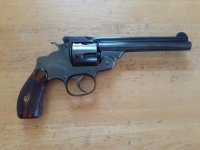
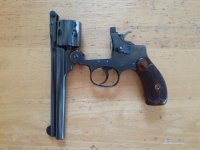
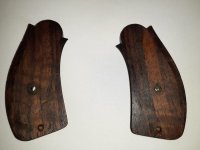
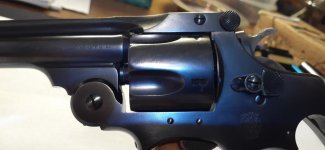
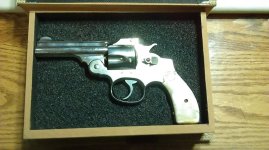
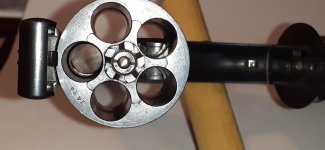
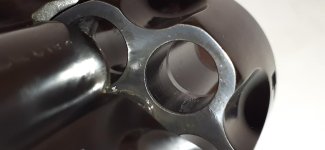
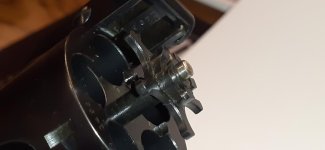
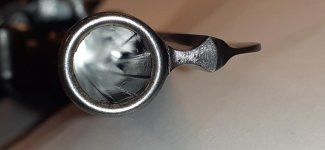
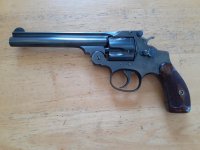
Just bought this guy at auction. Supposedly a factory refurbishment. Sure looks like new! Bore is shiny and no visible imperfections in the finish. Grips obviously not original but very nice.
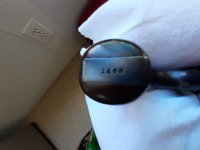
My question is, I see the 2 serial numbers marked 1496 on the butt and inside the frame near the latch, however cannot see the registered serial #54027. I assume it may be under the frame plate but the grips are on so tight and perfect I'm reluctant to attempt removing them at this time.
Anyway, really nice little revolver and looks like it was made 2 weeks ago. Even picked up some original Western 38 S&W ammo to try out. Can't wait.
 

Attachments

  • 20200612_132902.jpg
    20200612_132902.jpg
    85.9 KB
  • 20200612_132917.jpg
    20200612_132917.jpg
    78.3 KB
  • 20200612_132934.jpg
    20200612_132934.jpg
    80.3 KB
  • 20200612_133323.jpg
    20200612_133323.jpg
    46.9 KB
A dream gun for me, in just the configuration I'd want. Congratulations!
 
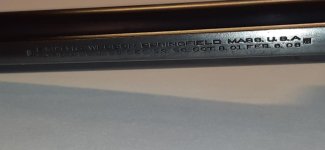
Welcome to the Forum. Your serial number represents a very early example of the 38 Perfected. It would undoubtedly have been manufactured in 1909, the first year of production. 59,400 in total were made with production ending in 1920. The barrel should have a 1906 patent date as the last one listed on the rib.

How do you know it was returned to the factory? Those guns usually have a star near the serial number on the butt and a numbered month and year of return stamped on the butt frame under the left stock??

Not sure what you are referring to with the "regstered serial number #54027, but the butt is the only place to look for the factory serial number. If someone as listed the gun with that serial number, they were wrong.

The 38 Perfected was normally offered with hard rubber or extended walnut target stocks, I am curious about the set on your revolver? I cannot tell for sure from the images, so let me know if the top round is concave (sunken in)?
 
Last edited:
Looks like another typical auction house screw up in identifying the gun, if that's where the 54027 came from. As Gary said, It's serial number is on the butt. If you received the gun through an FFL dealer transfer from the auction house and they did not use the correct serial number, then you need to get that straightened out ASAP. If the factory had anything to do with the refinish, is should have the "*" symbol stamped on the butt and under the stocks on the left side will be a month & year code saying when the gun was at the factory for rework/refinishing. For example " 5. 33" would indicate May 1933. Ed.
 
This is the description in the catalog. I also attached the link if it works.
It was verbally described as a factory resto but maybe it wasn't. Doesn't matter to me because I've never seen another in this condition.
After further review, the auction house did list the four digit number as the serial # on the paperwork but the other 5 digit number in the description lead to the confusion. Again, doesn't matter to me.
I'm also aware that these are not the original grips however I find them much nicer than the original style.
I paid $400 plus auction fees, etc, etc.....

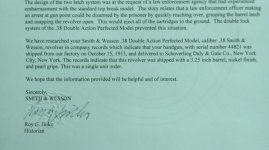
Smith & Wesson Perfected Model DA revolver, #1496, .38 S&W cal., 5” barrel, blue finish, checkered walnut grips, #54027 (all matching visible serial numbers). This gun is in overall excellent condition as restored showing approx. 98% of a professionally applied refinish with just slight edge wear and slight wear to backstrap; fine bore, crisp action, good markings, fine beautifully checkered wood grips; vivid case colors on hammer and trigger. A really nice Perfected Model of which only 59,400 were manufactured and the only S&W that utilized a top strap and a side thumb release.

Link to auction result: 20CN-192 PERFECTED .38 D.A. |


Firearms & Military Artifacts

Firearms

Pistols

Revolvers

| Auctions Online | Proxibid
 
One More Thing

The gun was not clean when I picked it up and you can tell from the auction pictures- looked like lots of accumulated leather dust . The Bore and cylinders were also dirty from not being cleaned after last shots. Hard to believe! But, it easily cleaned up beautifully, the bore is shiny new and not a mark on the barrel or frame. Looks like it was made last week.
 
The barrel should have a 1906 patent date as the last one listed on the rib.

Yes- Feb 6, 06

The wood grips are not concave.
 
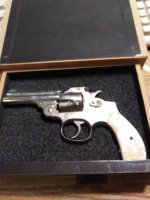
I cannot see medallions in those stock circles and so are not likely factory installed. The company was very protective of their high quality factory pearls, and wholesalers were offering very poor quality stocks by comparison, so S&W added medallions to authenticate their offerings. By the late 1920s, the factory could not obtain quality MOP so stopped manufacturing them.

The wood stocks are interesting and from the auction pictures, they look like the have recessed top rounds that were standard for the period on other models. I would also venture a guess that they are factory stocks, but have never seen a set on a 38 Perfected, so maybe from an early J frame??

I would remove them to find out if there is a factory return date and if the stocks have any serial number written of stamped on the inside of the right stock? Not difficult, just start the screw out and tap on the head while holding the top of the other stock until the stock lifts from the lower pin. Remove the other one by using a small wood dowel and tap the bottom until it comes loose from the frame. Just watch to make sure the escutcheons remain tight in the stock.

Second, the finish looks great and screws look un-turned. Perhaps the auction house did not think revolvers that old could have near perfect finished, so made the guess. The pictures show not any evidence of buffing and all edges remain perfect. The only thing I notice is that the color looks lighter than what was done in the period, but that could be lighting. I have a near mint four digit Perfected that shows very dark bluing by comparison.
 
Removed the panels and there were no markings. I took a few more pix, wish my phone camera was better but it will do.
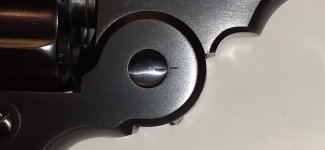
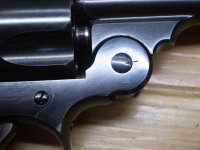
I like the alignment marking on the hinge. The tension screw for the hammer spring is blue. Incredible how clean everything is inside the grip frame. Not a speck of corrosion anywhere on the gun.
 

Attachments

  • 20200613_105535.jpg
    20200613_105535.jpg
    69.3 KB
  • 20200613_110711.jpg
    20200613_110711.jpg
    38.9 KB
  • 20200613_110749.jpg
    20200613_110749.jpg
    31.5 KB
  • 20200613_111305.jpg
    20200613_111305.jpg
    44.4 KB
Thanks for the pictures. I think those images answer a few questions.

The stocks might be a set of J frames, fitted to the I frame butt. There is no star and no numbers to signify a factory return, so most likely it did not get a factory refinish. A few have been reported as being returned to the factory here on the Forum with no marks, but it is high odds that most unmarked refinishes did not go back.

I now believe it was refinished. You can see a very slight roughened metal surface of the frame, but the pins and screws are smooth high gloss blued. The finish on a gun leaving the factory would be the same for every part, including screws and pins. The best condition Perfected I have has a dark blue and is quite glossy. A closeup of the surface shows very nicely polished metal. I think the reason why the edges are very sharp may be because the gun was simply re-blued with no polishing or buffing, leaving stampings and edges as sharp as factory finished.

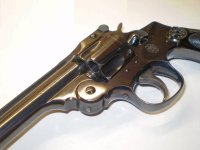
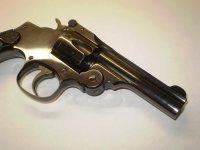
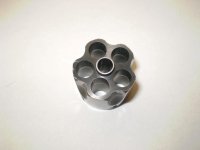
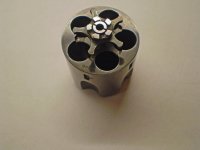
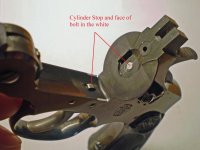
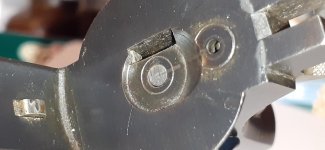
The attached images are things to look at with respect to your gun. There are ways to identify an unused gun, a slightly used gun, and a refinished gun. First and second images show the dark bluing and near mirror finish, which is appropriate for guns of this era. Third a fourth pictures show the cylinder from front and back. The front image shows that the chambers are deep blue and the face is perfect with no powder burn rings, so this gun was just not used. The rear image shows what an original extractor star looked like. The last image shows the recoil shield with just a very light drag mark from the cylinder locking pin and the thumb-latch and cylinder stop polished and in-the-white. Hope this helps.
 

Attachments

  • P1010015.jpg
    P1010015.jpg
    91.9 KB
  • P1010017.jpg
    P1010017.jpg
    59.3 KB
  • P1010018.jpg
    P1010018.jpg
    34.5 KB
  • P1010023.jpg
    P1010023.jpg
    56.2 KB
  • P1010032.jpg
    P1010032.jpg
    69.2 KB
Last edited:
Thanks for the insights glowe. I attached some more detail pix. Just learning to use this magnifying app on my phone camera but the focus is pretty good.
 

Attachments

  • 20200613_143851.jpg
    20200613_143851.jpg
    50.3 KB
  • 20200613_144114.jpg
    20200613_144114.jpg
    50.4 KB
  • 20200613_144151.jpg
    20200613_144151.jpg
    32.4 KB
  • 20200613_144445.jpg
    20200613_144445.jpg
    27.5 KB
  • 20200613_145841.jpg
    20200613_145841.jpg
    34.7 KB
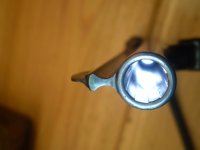
A couple more comparisons. I have an image of the muzzle of my Perfected and it shows a mirror polish and also a blued bore without any loss of finish. Not sure how long many shots it would take to remove the bluing, but I am guessing not many Your bore shows what looks like pitting. Also, the end of the rib shows the same roughness as the frame on your revolver compared to my example. I also attached an image of what the finish would have looked like straight from the factory. If you look close one can even see the direction the worker polished the metal.

The very good news is that I think your revolver is definitely worth more than you paid for it and you made a great purchase to get a nice specimen of an uncommon model.
 

Attachments

  • P1010008.jpg
    P1010008.jpg
    38.7 KB
  • P1010010.jpg
    P1010010.jpg
    75.4 KB
I wonder where the "#54027" came from? Number 1496 appears to be on the frame, cylinder and latch and I'll presume that number is also on the barrel. Could the 54027 be from the grips?
 
I wonder where the "#54027" came from? Number 1496 appears to be on the frame, cylinder and latch and I'll presume that number is also on the barrel. Could the 54027 be from the grips?

Yes, that's the question I can't answer. The 54027 was in the auction description but I can't find it anywhere on the gun. I did remove the grips and there are no pencil markings. Could be just bad info in the description. It is registered under 1496 and I found that # in 3 places- butt, cylinder, frame.
 
My guess about the seemingly extraneous #54027 is that the auction house was using a boilerplate and that number wasn't deleted from an old description when the new material was added.

The barrel serial number is very small and located 'between the ears' at the latch. Raise and hold the latch, clean between the ears with a Q-tip in order to view the number. A magnifying glass may help.
 
My guess about the seemingly extraneous #54027 is that the auction house was using a boilerplate and that number wasn't deleted from an old description when the new material was added.

The barrel serial number is very small and located 'between the ears' at the latch. Raise and hold the latch, clean between the ears with a Q-tip in order to view the number. A magnifying glass may help.

Yes, that's the one I meant by 'frame'. It is where you stated and quite clear. And I agree the auction house just missed the typo.
 
Yeah, I thought it was a good deal. After auction fees, tax, and DROS, it adds up but still worth it.
 
I only have one top break, plus a multitude of hand ejectors. I may have to rethink my priorities. Given the roadside hijack price given for the gun, acknowledging the possibly not original but still beautiful stocks, and the probable refinish, I'm guessing that the market for these old-time actions is diminishing. Who wants a gun that looks like it was made in the 1800's? Answer: me :)
 
The claims of the death or S&W antiques are greatly exaggerated!!:D

I do not think that antique S&W guns are losing value. You have to look at all the circumstances before making that claim. First, where else can you find a fully functional revolver for sale without having to deal with shipping between FFLs and that are exempt from BATF regulations in almost all states? There remains a strong attraction by collectors to own antique Smiths and Colts but may be declining other brands. You also have to look closely at what is being sold on the market today. Many are well used, beat-up, mixed parts, no finish, or non-functional. Sellers are asking high prices for poor rated antique S&Ws but they are not selling. Look at high finish antique S&Ws and I believe the priced are holding steady and maybe gaining some. Will there be any major rise in values for this class of gun? - probably not, but who knows for sure? A new generation of potential collectors occur every 20 years or so and who knows what their interests may be?

I also wanted to offer one piece of advise and caution about the 38 Perfected. Having owned antique top-breaks for decades, I am very familiar with how to open the action for loading or ejection of empties. Simply lift the top latch and with some force, put pressure on the barrel in a downward motion. That is fine with all but the Perfected revolvers and I believe many of this model, through the years, have had problems because people forgot to also open the thumb latch.

The gun I am showing in this thread was purchased just a few years ago online with a title: 38 S&W Revolver - Parts Only Gun. I put in a minimum bid of $130, knowing what the gun was and was the only bid, and when it arrived, it was indeed inoperable. The problem turned out to be what I thought for an almost unused gun and it was a bent center pin (quill). If you forget the second thumb latch on this top break, you can bend the quill while trying to open the gun. It can be repaired, but realigning the quill is a tedious trial and error process and if not careful one can break the "conduit thin" quill.

James, give us a range report when you go out to shoot your gun.
 
Gary- will do on the range report. Probably several weeks out at this point but I'm itching to give it a try. And thanks for mentioning the importance of opening it properly. Fortunately I haven't had any miss-haps in the process and it works so beautifully.
 
About the grips, I was looking at photo #6 in the auction listing and the escutcheon looks to be brass, as seen in most import grips. I believe all the early S&W escutcheons were nickel/silver, is that correct.
 

Latest posts

Back
Top