38 Special Cannelure

Beemer-mark

Member
Joined
May 12, 2009
Messages
1,084
Reaction score
755
City & State/Province
Wilmington, NC
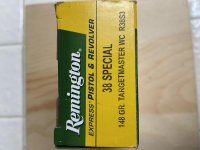
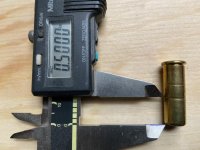
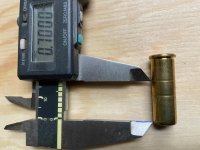
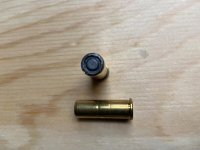
Sorting and cleaning some range brass and noticed something strange, or at least I never saw it before. The cannelure is usually about .20" from the top. I picked up some Remington brass and it has two cannelures. One is ~.50" from the top and second one is almost at the bottom ~.70" from the top of the case. What would they have been used for.
 
Cartridge case cannelures are usually used by the factory to designate the specific load the cartridge contains. Different placement or spacing, or use of knurling allows variations to indicate various loadings, either the propellant being used or bullet weight when different weight bullets which have the same appearance once loaded in the case. Anywhere from one to three cannelures may be used.They only are intended to have meaning to the manufacturer.

STORMINORMAN: "Don't know if this is really a cannelure."

look up the definition of "cannelure" in a real dictionary, not on-line. A cannelure is any circumferential groove on the exterior of a cylindrical object. It also includes extractor grooves.

For your last question, re-read the underlined item above, or follow this link for several additional definitions: Cannelure Definition & Meaning - Merriam-Webster
 
Last edited:
Don't know if this is really a cannelure, as I associate the term with a recessed area on a bullet to facilitate crimping. But I have some cases like that, typically from older 158gr LRN factory ammo in both brass and nickeled cases. They don't resize differently from other cases in my experience, though...

Cheers!

P.S. Had no inkling that it was for identification purposes: does anyone know how to decode them?
 
Last edited:
That's why I truly value this forum: I can learn something new almost every day (if I'm lucky and pay attention?)!

Cheers!
 
As a loader, you might also put the brakes on when crimping, if
things don't feel right............

Over the years I have had "Can's" on some JHP etc type bullets with the
location higher or lower, that what it should be, that caused the crimp to not happen.

Though, rare, it can happen.

This is not a problem with a soft lead bullets, though.


I wish I would have saved those bullets for pictures but I just
adjusted them, so that I could shoot them.......... bummer.
 
Last edited:
2 Cannelures = Wadcutter Brass?

carelesslove, here!

Recently, I read in a post, here, that the two cannelures - like the last case in the picture (above) were "special".

I sized, de-primed, cleaned the primer pockets, and polished 400, all-matching pieces of W-W brass, with the intent of loading them with 148 gr. HBWC's for my old, trusty K38.

Then, I remembered, from many (many) years ago, that my K38 actually liked 158 gr. SWC's better !

I guess 400 more empty cases ain't gonna kill me.

Tom "carelesslove" Love
 
Any case, any cartridge, the cannelure inside the case will be gone the first time you fire the new cartridge. I always ignore it just saw the difference this time. You can still see the cannelure on the outside but not the inside. And bullet seating depth and/or crimp has nothing to do where the factory put the cannelure. I always believed they put it on to prevent the bullet from being pushed back on recoil. And I can't believe the factory uses the cannelure to determine the powder level since the powder is dispensed automatically by machine and it would be tough to see even by a people checker where the powder and cannelure meet inside the case.
 
Last edited:
I posted this picture once before.

It will give you an idea of what some companies cases look like.


Yes, never paid that much attention to it. For the cases you have labeled 148 & 158 gn it would have to be a very long bullet -:) I'm loading 160 gn bullets out a Lyman mold and it's seated closer to
 
Now we know the cannelure on the 130gr Federal HST Micro JHPWC bullet is there to help hold the jacket to the core upon expansion: I don't recall ever seeing any evidence of it on the exterior of the factory cases...?

Cheers!

P.S. The 1st definition I find in the online Merriam-Webster for a cannelure says ": a groove running LENGTHWISE on the surface of a cylinder or column", by the way...
 
The far right cartridge in the picture is wadcutter brass. Federal has a single cannelure about 1/2 way down. I have seen hornaday wadcutters loaded but don't recall their markings.
I believe wc brass has a different internal dimension than standard though only slightly. I think the markings are to distinguish that. IIRC the thinner walls aid in the release of a bullet often lubed with a very soft coating on a soft lead, swedged projectile.
 
Now we know the cannelure on the 130gr Federal HST Micro JHPWC bullet is there to help hold the jacket to the core upon expansion: I don't recall ever seeing any evidence of it on the exterior of the factory cases...?

Cheers!

P.S. The 1st definition I find in the online Merriam-Webster for a cannelure says ": a groove running LENGTHWISE on the surface of a cylinder or column", by the way...


I am "using" this picture from another forum member to show you
that there can be mistakes made in making bullets.

No big thing but it might mess things up, if you don't catch it.

As stated earlier, this in not for a "Crimp" , but to hold the lead
from moving under firing, in a "Bonding" form.


However, with this bullet, they will both work..........
since this bullet is seated like a 148 HBWC, all the way into the 38 special case
and only the final OAL has to be adjused for the final step, in loading.

A Crimp is not needed, with ALL of the Friction put on the case by the bullet, just enough, to remove the belling for ease of loading......

if you load this bullet.
 
Last edited:
I picked up some Remington brass and it has two cannelures.
One is ~.50" from the top and second one is almost at the bottom ~.70" from the top of the case.
What would they have been used for.

I believe wc brass has a different internal dimension than standard though only slightly.
.

From my post in a related thread on the subject:

Wadcutter brass can be distinguished from regular brass by the double crimp, as seen in the nitro-express photo, on the right.

Wadcutter brass has a longer straight untapered inner case wall than the standard case. This allows the deep seated wadcutter bullet to not hit the thicker wall of the case toward the case head. This can cause the loaded case to bulge and the bullet to be damaged. This also gives an even case tension on the entire length of the bullets.

Don't use wadcutter brass for higher pressure loads.

Did a quick check comparing the 38 Spcl wadcutter double cannelure brass walls to a 38 Spcl (+P)'s brass walls:

Using a .350" plug gage (the biggest that would pass by the inside ridges caused by the double cannelures), it would extend ~.725" into the wadcutter double cannelure case but only ~.460" into the (+P) case, a difference of ~.260".

That shows that the wadcutter has straighter walls & the (+P)'s thicker more tapered lower walls.

The wadcutter's walls only start getting thick just below it's lower cannelure while the (+P)'s starts getting thicker higher, where the upper cannelure would be on it, if it had one.


.

Cannelure brass in .38 special.

38/357 Brass Question

.
 
Last edited:
The main reason for the cannelure in the brass is to aid the factory in making consistent loads/oal's.

Mfg's use a die similar to the lee factory crimp die (Hence the name fcd). They make their cases and then put a cannelure in them. This cannelure is placed where the base of the bullet sits in the case. It stops the bullet from going/seating deeper into the case. Then the fcd is used size the case/marry the bullet case neck tension and crimp the bullet in at the same time.

This is why you see the cannelure on the 110gr and 125gr bullets high on the case and the 158gr bullets cannelure lower on the case.
 
Per post #4;

Now "the rest of the story"......................

Here is what goes inside of those cases with those marks on them.
Notice how deep the bullets are seated and going deeper as the weight increases.
The lead 148 HBwc is king on how deep it is seated, even though the
158 copper jacket bullet weighs more.

Enjoy.
 
Back
Top