
Ammunition Longevity

DWalt

Member
Joined
Dec 19, 2009
Messages
36,645
Reaction score
33,863
City & State/Province
South Texas & San Antonio
Not really intended as an aging test, but I’ve had three 50-round boxes of WWII steel case GI .45 ACP (ECS 43) sitting on a shelf for many years. I decided to shoot it up today. Even after 80 years, 100% fired and functioned, just like new. Which was what I expected.

Of course, it was corrosive primed so I soaked everything on my M1911 in hot water afterward to remove the corrosive residue.
 
Not quite in the same vein but I once reloaded 100 AA 12 GA shells. Put them out doors behind the barn on a 55 gal drum. Sat out there rain(lots of rain in Md)shine hot cold for 3years...boxes pretty much disintegrated when I picked ' em up. Shot 4 rounds of skeet with them...broke a 99. Missed a dad blamed high one...but every shell fired normally. It's amazing that we have such reliable ammo with the planned obsolescence of most things nowadays. I have a couple boxes of that same ammo.
 
Not really intended as an aging test, but I’ve had three 50-round boxes of WWII steel case GI .45 ACP (ECS 43) sitting on a shelf for many years. I decided to shoot it up today. Even after 80 years, 100% fired and functioned, just like new. Which was what I expected.

Of course, it was corrosive primed so I soaked everything on my M1911 in hot water afterward to remove the corrosive residue.

Any water based solution for initial cleaning should take care of the corrosive priming salts deposited in the bore. Hot water is just fine and follow up with normal cleaning solvents. I use a solution of 10% Ballistol oil and 90% water. Ballistol mixes and emulsifies with water making a milky and slightly alkaline substance that is white and takes care of the bad stuff. I call it "Moose Milk." I use this with any ammo that has corrosive priming. I shoot a lot surplus ammo in 7.62x54r in the Mosin Nagant rifle, so I have to use this cleaning protocol on the range or immediately after coming home to insure my rifles and pistols don't become a rust bucket. I follow up with a lightly oiled Ballistol soaked patch as a preservative.
 
  • Like
Reactions: Rpg
Instead of soaking the entire gun in water 7.62 Sweets would have taken care of an corrosive effects from the ammo.
 
DWalt, I don't understand why you'd shoot up that ammo in the first place. Are you hard up for 45ACP ammo? WWII vintage ammo may not be scarce (yet), but with regular, new-production ammo available, I'd be more inclined to hang onto that 75-year old ammo, rather than just shoot it for the heck of it.
But that's just me...
 
I used to fire a quantity of corrosive military rifle ammunition in bolt action rifles. After shooting, I would stick a funnel into the chamber and pour a quart of hot water through the bore, followed by normal cleaning with solvent. That worked. The older US GI bore cleaner was just an oil-water emulsion that would dissolve the corrosive primer residue. But so will hot water alone.
 
I had a fair bit of Spanish MilSurp 9mm largo that I finished firing up about 5 years ago. It was from the 1930s. I had a few misfires and hangfires. I used the old GI bore cleaner afterwards. I still have a couple of cans of it laying around, just in case.
 
I once shot a bison with an original Sharps rifle and a round of black power ammo that was loaded in the 1880's. Not knowing if it would even go off. Three plus feet of penetration and dead buffalo. I was around when 9 other bison were shot with varying modern guns and ammo, and none killed any quicker.
 
That WW2 hardball must have been high quality. My father had brown paper bag full of that stuff in his tool shed in the backyard. It got frozen, baked and had absolutely no humidity control. This was unplanned destructive testing that when on for decades. When I was 18, he told be to take it to the range and shoot it up. The ammo was about 25 years old at that point. Amazingly, every round fired and cycled a 1911.
 
Last edited:
just finish up shooting some 12 gauge federals that I bought in 1973 all went bang and I even hit some birds with it....
 
I've had ammo decades old and ammo that has been rotated in carry guns in the humid sweaty southern states for years and it all goes bang. I dont think it ever goes bad unless you go diving in a river often or have magazines falling out of your pockets damaging the casings.
 
Evansville Chrysler is your friend and the steel cases
can be reloaded twice before they start splitting, I did
that when I shot the last of it. 4 grains of Bullseye and
a 230 grain cast lead projectile after a Windex wash. I
still see them at the range once in a while.
 
Purchased a bunch of FA-18 .45ACP and various WW2 surplus (steel and brass) back in the 1970s, 5 cents per round when my department traded in the old Thompson guns. Still using much of that old brass for reloading. Learned to soak it in soapy water for a day, then two rinses in clean water after the first firing.

Also in the 1970s I came across a case of FA-35 match .30-06. That fired brass continues to serve in .30-06, .270, and .25-06.

I'm still using GI surplus bore cleaner made in the 1960s. Purchased several pint cans at a gun show for $1 each. I doubt any commercial product has benefited from the levels of R&D that the US military applied. Still works great, removes any type of primer, powder, or bullet fouling residues.
 
I had a Enfield Rife and I had some Ammo from WW-1 that except for a little hesitation to fire after pulling the trigger it worked fine.I guess those sticks of Cordite they used for the powder kind of broke down after some years. But it seems as long as the Ammo is kept dry in a sealed container it should last for a long time.
 
I had a Enfield Rife and I had some Ammo from WW-1 that except for a little hesitation to fire after pulling the trigger it worked fine.I guess those sticks of Cordite they used for the powder kind of broke down after some years. But it seems as long as the Ammo is kept dry in a sealed container it should last for a long time.

"...a little hesitation to fire..." sounds kinda' like a "little bit" of a "hang fire" to me.

I'm not so sure I would have kept shooting those rounds. Assuming there was any alternative ammo available.

I'd always be wondering when that "little hesitation" might turn into a lot more hesitation.

Maybe I'm just too cautious about such things...
 
I got to shoot a guy’s Bren gun one day. As much as I wanted to. It was pretty neat for a while but loading magazines got tiresome. We used a bunch of WWI and even earlier surplus ammo that was in 5 gallon buckets. Most of it fired. Most of it was Cordite and had an odd smell, sorta reminiscent of hot cat pee.
 
I shoot a lot of 7.62x54R in Mosin Nagant rifles. All of it is corrosive priming and I am very careful about mitigating the effects of the corrosive priming residue. At the range, I will swab the barrel with a mixture of 10% Ballistol and 90% water (I call it moose milk) to neutralize the corrosive salts. Then I follow up with standard cleaning at home with Hoppes #9 and a light coating of Ballistol or Break-Free. Most of the ammo I have is from the Cold War era (1970's Russian or Bulgarian) packed in 440 round spam cans. I would wager that a lot of similar ammo is being used in Ukraine right now.
 
I had a Enfield Rife and I had some Ammo from WW-1 that except for a little hesitation to fire after pulling the trigger it worked fine.I guess those sticks of Cordite they used for the powder kind of broke down after some years. But it seems as long as the Ammo is kept dry in a sealed container it should last for a long time.

As already said, that sounds like a hang fire. I also agree I would not continue shooting that ammo. Some hang fires can be long and possible fire after the shooter thinks it's safe to lower the rifle.

Sometimes unstable powder or Cordite can be dangerous and spike pressures. IMO it's not worth the risk to shoot that ammo anymore. (sorry)
 
I shoot old vintage ammo on a regular basis. I usually reload for my Range sessions however when my Dad passed away 14 years ago he left me a plethora of old old ammo. I inherited many factory boxes from the 1940's, 50's, 60's and 70's. I have hunted with them, used them for practice and competition and have never ever had one fail! They are accurate, reliable and give me the Fizz when they are shot.

The only ammo or shot shells I have ever had fail are 5 paper hull Browning marked 12 gauge shells that when hit did not go off. I don't know exactly how old they are, but more than likely about 100 years old. I found them in an old abandoned barn and although they look like they are in perfect shape, they were exposed to much simmer heat, moisture and extreme cold in the winter. As far as I can remember, those are the only pieces of ammunition I have had not work. I am not counting the very rare "dud" from newly loaded factory ammo or rimfire ammo of course.
 
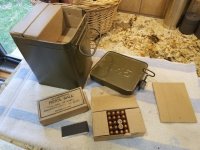
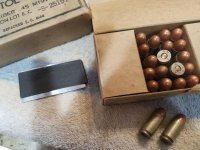
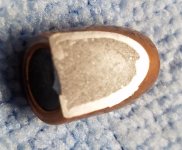
The 43 is good stuff, I opened a spam can of it 2 years ago. The bullet does have a steel core as well in addition to the steel case. The repacking was done to put the cartridges in the new spam can that was invented because the original packing in wood crates deteriorated in the island climates.
Bullets By The Billion is an excellent book on the EC cartridges.
 

Attachments

  • 20180303_170913.jpg
    20180303_170913.jpg
    121.7 KB
  • 20180303_170947.jpg
    20180303_170947.jpg
    111.4 KB
  • 20180306_123638.jpg
    20180306_123638.jpg
    90.5 KB
Last edited:
Taking a lesson from our military I have ammunition I have stored for several decades in military surplus ammo cans that look as bright and new as the day I purchased them.

Stored indoors in waterproof and air tight cans with good rubber seals will help keep the ammunition usable for years to come.
 
Last edited:
I shoot old vintage ammo on a regular basis. I usually reload for my Range sessions however when my Dad passed away 14 years ago he left me a plethora of old old ammo. I inherited many factory boxes from the 1940's, 50's, 60's and 70's. I have hunted with them, used them for practice and competition and have never ever had one fail! They are accurate, reliable and give me the Fizz when they are shot.

The only ammo or shot shells I have ever had fail are 5 paper hull Browning marked 12 gauge shells that when hit did not go off. I don't know exactly how old they are, but more than likely about 100 years old. I found them in an old abandoned barn and although they look like they are in perfect shape, they were exposed to much simmer heat, moisture and extreme cold in the winter. As far as I can remember, those are the only pieces of ammunition I have had not work. I am not counting the very rare "dud" from newly loaded factory ammo or rimfire ammo of course.

The OP said this 303 British ammo was from WWI, not post WWII. There is a big difference IMO and while most all ammo I have shot which is that old runs perfectly fine, there is always that one lot that doesn't.

A friend had some very old 7.5 French ammo and it was nice and clean but the first few rounds caused bad hang fires, up to 20 seconds, maybe more. I know because I personally saw it shot. He was firing it in a K31 and that ammo just was not safe. The next week we fired his reloads without a problem made with the brass and bullets he pulled down but with fresh powder. That was the only time I've seen old ammo hang fire.
 
I had some pre WWI 30-06...looked pretty clean Shot 10...all were hangfires but no more than a second...like shooting a flintlock....also every case neck cracked or split. All hit the target but the first barely...my fault
 
I just shot 12 rounds of some R P 38 spl through a new to me snub barrel swapped 1905 4th change m&p I’m not sure on the age probably 60s-70s it was from my grandfathers stash(sheriff starting in 63 and retired early 2000s). There were probably 25 rounds total of mixed wadcutters and targets, the 12 I shot were perfect the rest had corroded from being stored in his first gun belt and some in a leather pouch. Also about 15 years ago my dad had a box of Super Vel .357s from the late 70s early 80s and we shot all of them through a model 65 3 inch no issues at all, fireballs were huge haha.
 
Ammo has an incredible lifespan if stored in your house. No ritualistic storage procedures are needed. I wouldn't consider ammo from the '60s or '70s very old.
 
Sometimes good, sometimes bad. About 45 years ago I had the only incident with old ammunition I ever had. I had a Ruger #3 in .30-40 Krag. I picked up an old box of black powder .32 S&W ammunition from our evidence room that was probably pre 1900, and was shooting in in the garage through a .32 S&WL to .30-40 adapter I had made. I was sure that I saw a bullet hole from every shot, but the lighting wasn't the best. When I cleaned the bore I found it was ringed about 4" back of the muzzle. I don't recall having any hang-fires, just the one squib.

The rifle never did shoot for beans as a .30-40, 4"/100 yards was about the best no matter what I did, and the ring didn't hurt anything! I decided to have it re-bored to .35 caliber for a .35 Krag. The work was done by Bob West who was recommended by Fred T. Huntington (RCBS). Once re-bored the gun will now shoot under 1"/100 yds, so all-in-all the result was favorable! The dies I use are RCBS .30-40 that I converted to .35 Krag.

Fun gun to shoot, but with 250 Hdy .35 RN it sure is a kicker. I shot a scope loose on the gun and it won't hold elevation.
 

Latest posts

Back
Top