Another progressive reloader question

B's640

Member
Joined
Apr 6, 2014
Messages
43
Reaction score
9
I'm getting ready to move forward fm single stage reloading rifle ammo as needed, to gettting into loading pistol ammo now that I can't get all the free .45 I could shoot anymore. I'm looking at getting a progressive loader, and have read through the sticky here various times. I still have a few unanswered questions though.
For instance, I see that some of the nicer reloaders have both auto shell, and auto bullet feeders with variations on that theme.
The Dillon offers the option of having an auto SHELL loader with the bullets placed by hand; the RCBS offers no auto shell loader that I can see, but for the cost of the Dillon you can get the RCBS with an auto bullet feeder (not for cast bullets though). Hornady offers their unit with both.
So what is really needed on this front? I tend to think if I were to only have one or the other, that the auto shell feeder would be more convenient since inserting the brass into the holder can be a little slower than setting the bullet on top of the brass.
 
Last edited:
Unless you are reloading for an entire team or commercial, a Dillon 550B will reload enough pistol ammo in a couple of hours to keep you shooting for several range sessions. The more automatic gizmos on a reloader, the more things you have to break, get out of adjustment or otherwise slow down production (KISS principle). Once you develop a rhythm you can manually put shells in the shell plate and bullets in cases quite rapidly. However, get whatever you think you need.
 
Unless you are reloading for an entire team or commercial, a Dillon 550B will reload enough pistol ammo in a couple of hours to keep you shooting for several range sessions. The more automatic gizmos on a reloader, the more things you have to break, get out of adjustment or otherwise slow down production (KISS principle). Once you develop a rhythm you can manually put shells in the shell plate and bullets in cases quite rapidly. However, get whatever you think you need.

Exactly! A Dillon 550B is the best choice for most reloaders.
I love mine.
 
To me the Dillon 550 is the most versatile. Without either a auto shell or auto bullet feeder I can load 400-500 per hour and have time to drink my coffee, and not be in a rush. The 550 offers the versatility of loading just about any caliber you may have or ever acquire, (except the 50 BMG) and other excessively long rounds. I have set up and used the Hornady, and it is overly complex and does not lend itself well to making corrections to a given load without a lot of adjustments. The Dillon can be easily adjusted on any individual stage as simple as on any single stage loader.

Only you can determine what your individual needs are, how many rounds you need to load in what period of time.

Do a search here on the forum as there have been several threads about different loaders.
 
My friend and I just are still very new to the 550 and we reloaded 500 in 50 minutes without trying to be fast. We just were aware of the time. I am sure many could go faster but how important is speed anyway.
 
Harrison put it about as well as can be....

I have a 550b Dillon without the auto anything and it can produce all the ammo I need in a very short time...

even when taking my time I can easily run 300 rounds in less than an hour....

You will never regret getting a 550 Dillon especially with the NO BS warranty which I have used a few times and they have always sent me the replacement part the next day NO CHARGE ever.

Randy
 
Bullet feeders can be added to any progressive. You can run a Hornady or rcbs bullet feeder on a Dillon press. My op on bullet feeders, if you load a lot of one caliber, like 4-5k at a time, they are useful, otherwise the feeder just complicates things. If you change calibers often, bullet feeders are an even Bigger pita.
All progressives have quirks, but some more than others. I wouldn't own a lee if it was free, too many problems. The LNL is a Decent press, but if you want a case feeder, the 650 is a better tool for about $75 more. If ou never want a case feeder & don't care about auto indexing & you want simple reliable 400-500rds per hr, the 550b is a Great press.
As noted, bullet feeders can be added to them all, but if you load conv lubed lead, the are an even bigger pita. The more you add to the press, the more you need to tinker to keep it running right.
 
Last edited:
It's possible to add a bullet feeder to a Dillon 650, but to do that you need to eliminate one of the stations. The typical station that is deleted is the powder check but IMO that is the most important station on the press. Almost impossible to double charge (or no charge) a round unless you are deaf. I don't load massive amounts at one sitting, but I load at least 200 rounds per day to replace what I shoot. Total time in the handloading room is less than 45 minutes from turning the lights on to turning them off. (and I load at shall we say a leisurely pace :D).
 

Attachments

  • xl650 complete.JPG
    xl650 complete.JPG
    151.7 KB
Dillon non-standard parts

I replaced the arm on my Dillon 550B with a non-Dillon arm produced by a machine company whose name escapes me for the moment. It provides better leverage and makes reloading even easier and smoother on my Dillon. It was worth the investment, around $60.00 as I recall.
 
I realize you didn't mention Hornady LNL.
Got mine about 10yrs ago w/case feeder. I really like it, have had 0 issues w/it.
Added a Horady bullet feeder a while back. Rather steep learning curve to get it running right and even then it does require strict attention.
Bottom line is it's kind of nice but not really needed.
If I had it to do over would definately get the case feeder and probably skip the bullet feeder.
Good Luck, Kevin
 
I have had a Dillon 550 for 4-5 years and have produced thousands of rounds with it. I decided to add a Dillon case feeder to my setup. This allows me to keep my right hand on the lever and all I need to do is place the bullet at station 3.

This setup works well for me. One way or another I'm with others here who recommend the Dillon 550B.

LTC
 
I recently went the progressive handgun loader route and after comparing what is available, I bought a Dillon 650. I've loaded shotshells on progressive loaders for many years and found the auto-indexing feature really nice when I bought my first loader with it. Things like that are kind of like cruise control or power windows on a car - once you have them, you don't want to do without them.

Having said that, I did not buy the shell feeder and after loading several thousand rounds without one, I don't see myself buying one in the future. I primarily passed at the outset because of how high one makes the loader and that would require that I reach around it as I already have to reach around my shotshell loader in order to get things off my loading bench's shelves.

I found I like the standard operating handle better than the extra-cost one (Anyone want to buy it?) and I never move my right hand from that round knob. I just pull the loading gate back with my right thumb, reach through the loader with my left hand to place a case in the track and release my thumb. My left hand then puts a bullet in a case mouth and the handle gets pulled again. Compare the prices of the 550 and 650 and I think the auto-indexing by itself is worth the difference.

If you go with any Dillon model, go with extra Quick Change tool heads with powder measures. Dillon dies don't have lock rings with locking set screws (they could be easily swapped for ones that do, however), so not having to readjust dies and a powder measure every time you change calibers is nice. Even aside from that, they really make caliber changes quick and easy, especially if the primers size remains the same.

DSC_0868_zps7e5918ee.jpg


Obviously, I like my 650 a lot. After 40 years of loading handgun ammunition on that single-stage RCBS RockChucker IV on the far end of my bench, I can say that reloading is a LOT more fun on the 650! I still prefer the RockChucker for my rifle ammo but that represents many fewer shells.

Ed
 
Last edited:
I replaced the arm on my Dillon 550B with a non-Dillon arm produced by a machine company whose name escapes me for the moment. It provides better leverage and makes reloading even easier and smoother on my Dillon. It was worth the investment, around $60.00 as I recall.

I believe you're talking about Inline Fabrication Dillon | Inline Fabrication, I don't have their handle but I did get their lighting system.
 

Attachments

  • side light.JPG
    side light.JPG
    149.3 KB
I replaced the arm on my Dillon 550B with a non-Dillon arm produced by a machine company whose name escapes me for the moment. It provides better leverage and makes reloading even easier and smoother on my Dillon. It was worth the investment, around $60.00 as I recall.
I would be interested in this how did you find it? My aging shoulder sometimes feels rough when reloading
Thanks
 
OP, I want to fill in some factors I didn't see well-addressed in previous answers.

The Dillon 550 is a 4-hole, manual index press. Brian Enos, whose opinion most "Dillon Blues" respect, says the 550 isn't designed for auto-feeders, and it doesn't make much sense to add either one to it. FWIW, I agree. You still need to bring your left hand to the press to index, and adding a bullet feeder would take up one station. The remaining 3 would then not support both a powder check die and separating seating from crimping which many people find important.

Having said that, the 550 is fast enough for most people. See changeover comments below.

If you go Dillon 650 or Hornady LnL AP . . . these are 5 hole auto-index presses. Watch videos to see exactly how these presses are operated - they require different setup operations and different hand movements. Check out the Dillon on your own, but as for the Hornady . . .

The Hornady requires the left hand to do 2 operations (case and bullet) while the right hand stays on the handle. So the case feeder is extremely beneficial, doesn't take up a station, and is a significant time saver. Adding a bullet feeder takes up a station, but then the press operates by just cranking the handle . . . until a stoppage occurs lol.

FWIW, I have the case feeder and no bullet feeder . . . and if I were buying again would buy the same way.

Note that adding these devices considerably increases caliber changeover time. Frankly, if you are changing calibers and doing less than 2k batches, there may well be NO time savings gained by adding the devices . . . though it will be easier on your arms :)
 
Last edited:
I have a 550b and can't say enough good things about it & Dillon's no BS warranty.
 
The speed of all the auto stuff is negated by having to fill primer tubes. It makes no sense to me to fill a handful of primer tubes hen pecking your way through hundreds of primers. The more money you pour into speed the more you find you want more stuff. Dillon offers a primer tube feeder and brother it ain't cheap but then neither is a 650 or OMG the 1050. I went with Hornady and while I enjoy the case feeder it's more of a pain to switch between calibers than it's worth. If you want it just for your one main use cartridge then it might be worth it. The bullet feeder is nice but I can only keep everything running if I first use the Lyman M die and then the bullet feeder. Otherwise the bullets like to tip or fall off during rotation.

And really when it all comes down to it I still prefer to load on my Lee Classic Turret.
 
So the gist of my question was how much I really need auto feeders. Sounds like the bullet feeders are more trouble than they are worth for my application. If I use a shell feeder, than that would need tinkering with every caliber change over, and use one of the five die slots. Right now I'm looking at reloading for bulk on .45 auto, .38 sp, and .204 Ruger. I'll likely do runs of each, 1000 rnds or so, then lay off that rnd until I get low. With no auto shell feeder, I'm looking at moving my left arm twice per evolution (insert a shell, insert a bullet) of the right hand lever. With the shell loader, once with the left arm per evolution. The other consideration is using up a die space on the 5 station models. If reloading handgun ammo, what would be the standard die configuration? I would like to include a powder check die in that.
 
The speed of all the auto stuff is negated by having to fill primer tubes. It makes no sense to me to fill a handful of primer tubes hen pecking your way through hundreds of primers. The more money you pour into speed the more you find you want more stuff. Dillon offers a primer tube feeder and brother it ain't cheap but then neither is a 650 or OMG the 1050. I went with Hornady and while I enjoy the case feeder it's more of a pain to switch between calibers than it's worth. If you want it just for your one main use cartridge then it might be worth it. The bullet feeder is nice but I can only keep everything running if I first use the Lyman M die and then the bullet feeder. Otherwise the bullets like to tip or fall off during rotation.

And really when it all comes down to it I still prefer to load on my Lee Classic Turret.

This is so over stated. Buy 10 tubes, sit in front of the tv watching the news & fill them. If you are really slow, it might take you two minutes to fill a tube, big deal. From start to finish, with clean brass, I can fill tubes & load 700rds/hr on my 650. If the tubes are preloaded, I can get 800/hr without pushing hard. It's only one handle pull every 4.5 sec. Still plenty of time to visually check powder drops. I rarely load for more than an hour though. It's not something I love to do anymore.
Fwiw, auto indexing offers no speed advantage. I loaded on my 650 for 2 months w/o a case feeder. It was no faster than my 550, you have to place a bullet after it indexes or place the bullet on the 550 as you index it, same speed.
 
Last edited:
Bullet feeders can be added to any progressive. You can run a Hornady or rcbs bullet feeder on a Dillon press. My op on bullet feeders, if you load a lot of one caliber, like 4-5k at a time, they are useful, otherwise the feeder just complicates things. If you change calibers often, bullet feeders are an even Bigger pita.
All progressives have quirks, but some more than others. I wouldn't own a lee if it was free, too many problems. The LNL is a Decent press, but if you want a case feeder, the 650 is a better tool for about $75 more. If ou never want a case feeder & don't care about auto indexing & you want simple reliable 400-500rds per hr, the 550b is a Great press.
As noted, bullet feeders can be added to them all, but if you load conv lubed lead, the are an even bigger pita. The more you add to the press, the more you need to tinker to keep it running right.

I agree with this. My rank would be the 650 is the best, followed by the LNL-AP then finally the manually indexed 4-hole 550.

Time is money and with a young family I don't get a lot of time to spend on my hobbies. The Dillon 650 with case feeder is fast enough for my purposes. I had a LNL-AP for a few years and the 650 is just a better press (with the pricetag to match although.)

Chris
 
So the gist of my question was how much I really need auto feeders. Sounds like the bullet feeders are more trouble than they are worth for my application. If I use a shell feeder, than that would need tinkering with every caliber change over, and use one of the five die slots. Right now I'm looking at reloading for bulk on .45 auto, .38 sp, and .204 Ruger. I'll likely do runs of each, 1000 rnds or so, then lay off that rnd until I get low. With no auto shell feeder, I'm looking at moving my left arm twice per evolution (insert a shell, insert a bullet) of the right hand lever. With the shell loader, once with the left arm per evolution. The other consideration is using up a die space on the 5 station models. If reloading handgun ammo, what would be the standard die configuration? I would like to include a powder check die in that.

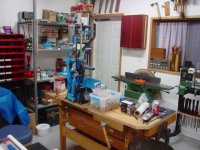
The case feeder does not take up one of the die slots, it's actually outside of the die area (the case is pushed into position one which is the decap/size die). When I got my 650 I didn't get the auto case feeder on purpose so my wife would have something to get me for birthday/Christmas (after 37 years you run out of ideas ;)). The 650 comes standard with the feeder tube for the cases, the electric sorter and feeder is optional. The difference is that with just the tube, you have to fill it with cases (around 22) and then remember to fill it up before you run out. I got pretty good but sometimes forgot (not a real problem, without a case, a primer falls into the catch tray and no powder is dropped). With the optional feeder, I just dump around 400 cases in the hopper and load away. I've attached a picture of the 650 without the electric case feeder. I have to admit that I do prefer the electric feeder though.
 

Attachments

  • Dillon 2.JPG
    Dillon 2.JPG
    155.3 KB
I can load 400/hr, .45 ACP with my Dillon 550B. With case prep (trim, chamfer and swage) that drops to about 100/hour including external time. It's no big deal to set cases and bullets by hand. That's about four trips to the range for me. If you shoot a lot, then the 1050 might be right for you. IMO, the 650 offers one extra station, which can be used for a fill failsafe, or something else.

Based on my experience in packaging, part feeders take a lot of setup and debugging time. They work great until they don't. One inverted case (or bullet), or a 9mm nested inside a .40, and you shut down until the press can be cleared and cleaned.

You develop a rhythm for manual feeding. I ALWAYS index immediately after each stroke, so if I drop a case or bullet, there's less chance of a double drop on resuming. I insert the new case with my right hand, start the bullet with my left - working from trays near the press.

If you must stop, run out all the stations and leave the press empty. On resuming after a delay of 10 minutes or more, check one or two drops before proceeding (powder tends to settle in the measure).

With the Dillon, all of the dies are set in one tool block, so their settings are locked in. For another $80 or so, a quick-change kit includes a tool head stand and a powder hopper/measure.

Hornady LNL dies are easy to change, but they are separate, not in a removable tool block. The shells are retained in the shell plate with a long spring, which can break and launch itself into a black hole. Dillon retains shells with removable pins. The only loose spring on the Dillon is the primer feed return.

The primer feed is simple and reliable. However you have to reload the drop tube every 100 rounds or so. The drop tube is reloaded using a pickup tube, which can be loaded ahead of time (spares are inexpensive). I think of it as a 5 minute break, but there is a ($$) automatic pickup tube filler, instead of one at a time from a flip plate.
 
I bought a 450 Dillion in 1984, over the years I upgraded with a non Dillion kit. As soon as Dillion came out with the auto priming and case mouth powder drop systems I jerked the un-brand stuff of my press. After 25 or so years I upgraded the frame and basically have a 550b press. I installed a case feeder. I found that a case feeder makes loading easier but not any faster, and is only for pistol cases. Make sure you have 6-10 primer tubes of each size. Fill as many as you want to load and go to town. I have the bullet tray, but a home made one will be just fine! The rack for the tools is nice but you can get by without it very easily. I have about 10 tool heads and 4 powder drops, I load cartridges in a specific order. 45 Colt then 44-40WCF, Same shell plate and with 2 different powders I don't change the measure settings. Then I go to 44 Mag then 44 Special then 44 Russian, I still haven't had to change shell plates. Then I can switch big time, but usually to 45ACP. At this point I used to go to Rifle cases like 308, 30-06, and the Mausers. Next would be Change the primer system to small and do 9mm then the 223 family ( my old shell holder was the same, I don't know if the newer ones work that way) and with 30 Mauser and I could do 30 Luger, but never had the need. Finally I would do 38's and 357's. Loading small lots of 200 or less was done on turret presses. Once in a while an additional round would be inserted into the mix (mostly 45-70 or 50 AE when on the 44-45 shell plate) but those usually were done in smaller batches. Back in the 80's I loaded a batch of 20,000-223's that took over a month and there were several 9mm Luger batches over 5000. I looked into having a bullet feed that sized a cast bullet then fed it, but it was beyond my engineering abilities. I hope this gives you some more ideas on how to best use your press.

I also own a Hornady L-N-L AP I bought used, It is not well engineered in my opinion. That is around the 4th or 5th generation of their progressive, and problems that existed in 1st (07) and 2nd generation (007) designs are still happening. RCBS has some good and bad progressive designs but discontinue them quickly, I don't know what support you get!

Have fun loading! Ivan
 
So the gist of my question was how much I really need auto feeders. In the extreme, with 550, 650, or LnL AP you really don't need them at all. With the 650 and AP you can easily add them later. With the 550 they make less sense, and with the bullet feeder you lose a station.
Sounds like the bullet feeders are more trouble than they are worth for my application. Bullet feeders are more sensitive, having somewhat the same adjustment/changeover issues as case feeders, plus your case belling has to be very good or the bullet falls off.
If I use a shell feeder, than that would need tinkering with every caliber change over, and use one of the five die slots. The "caliber changes" require parts changes for large pistol, small pistol, large rifle, small rifle - IOW, some caliber changes MAY not require changeover, or may also need smaller part changes or benefit from adjustment. Case feeders (on the 650 and LnL AP) do not take up a station.
Right now I'm looking at reloading for bulk on .45 auto, .38 sp, and .204 Ruger. I'll likely do runs of each, 1000 rnds or so, then lay off that rnd until I get low. With no auto shell feeder, I'm looking at moving my left arm twice per evolution (insert a shell, insert a bullet) of the right hand lever. With the shell loader, once with the left arm per evolution. This is correct for the Hornady, and is why the case feeder is highly beneficial. The 650 runs differently - check a video to see. I believe the right hand seats the bullet.
The other consideration is using up a die space on the 5 station models. This is much more of an issue on 4-hole presses, ie the 550.
If reloading handgun ammo, what would be the standard die configuration? I would like to include a powder check die in that.On the Hornady, 1=Deprime/size, 2=case bell/powder drop, 3=powder check die, 4=seating, 5=crimp/bell closure. Note that your seating die can also crimp, but most of us prefer to separate the two to simplify adjustments and deal with case length variations. With the 550, adding a powder check die requires you to seat/crimp together, and once done eliminates the possibility of a bulet feeder.
Specific answers above in red.

The setup and use of a progressive for many rifle rounds may differ. Cases that need "case prep" (trimming, etc) are often decapped and/or resized, prepped, then cleaned. They return to the progressive for the rest of the operations. Since priming occurs BETWEEN stations 1 and 2 (powder), you cannot easily make use of the extra hole open at this stage.

OTOH, some folks who know their rifle cases will not exceed max length after prep run them just like pistol rounds.

Long, but hope this helps.
 
Last edited:
I agree with this. My rank would be the 650 is the best, followed by the LNL-AP then finally the manually indexed 4-hole 550.

Time is money and with a young family I don't get a lot of time to spend on my hobbies. The Dillon 650 with case feeder is fast enough for my purposes. I had a LNL-AP for a few years and the 650 is just a better press (with the pricetag to match although.)

Chris
Price them equipped the same, the 650 is about $75 more. Consider how much better the feeder & priming system is, well worth it. Hate reloading after a year, you'll get more for the dillon any other press. I call it a wash.
 
Specific answers above in red.

The setup and use of a progressive for many rifle rounds may differ. Cases that need "case prep" (trimming, etc) are often decapped and/or resized, prepped, then cleaned. They return to the progressive for the rest of the operations. Since priming occurs BETWEEN stations 1 and 2 (powder), you cannot easily make use of the extra hole open at this stage.

OTOH, some folks who know their rifle cases will not exceed max length after prep run them just like pistol rounds.

Long, but hope this helps.
I load 223 on my 550. I prep new/once fired brass then load it on the press. I use the RCBS x die, so only have to prep brass once. Stn 3 is a powder check, I seat & if I crimp, rare, I do it in one step @ 4.
 
I load 223 on my 550. I prep new/once fired brass then load it on the press. I use the RCBS x die, so only have to prep brass once. Stn 3 is a powder check, I seat & if I crimp, rare, I do it in one step @ 4.
Yup, that's one of the ways you can load rifle like pistol :) I thought that was a little TMI for the OP.
 
I can load 400/hr, .45 ACP with my Dillon 550B. With case prep (trim, chamfer and swage) that drops to about 100/hour including external time. It's no big deal to set cases and bullets by hand. That's about four trips to the range for me. If you shoot a lot, then the 1050 might be right for you. IMO, the 650 offers one extra station, which can be used for a fill failsafe, or something else.

Based on my experience in packaging, part feeders take a lot of setup and debugging time. They work great until they don't. One inverted case (or bullet), or a 9mm nested inside a .40, and you shut down until the press can be cleared and cleaned.

You develop a rhythm for manual feeding. I ALWAYS index immediately after each stroke, so if I drop a case or bullet, there's less chance of a double drop on resuming. I insert the new case with my right hand, start the bullet with my left - working from trays near the press.

If you must stop, run out all the stations and leave the press empty. On resuming after a delay of 10 minutes or more, check one or two drops before proceeding (powder tends to settle in the measure).

With the Dillon, all of the dies are set in one tool block, so their settings are locked in. For another $80 or so, a quick-change kit includes a tool head stand and a powder hopper/measure.

Hornady LNL dies are easy to change, but they are separate, not in a removable tool block. The shells are retained in the shell plate with a long spring, which can break and launch itself into a black hole. Dillon retains shells with removable pins. The only loose spring on the Dillon is the primer feed return.

The primer feed is simple and reliable. However you have to reload the drop tube every 100 rounds or so. The drop tube is reloaded using a pickup tube, which can be loaded ahead of time (spares are inexpensive). I think of it as a 5 minute break, but there is a ($$) automatic pickup tube filler, instead of one at a time from a flip plate.

The spring on the Hornady is a 2 minute fix at best. The system functions great.


thewelshm
 
When I was making this decision about 18 months ago, I found the document above comparing Lee/Hornady/Dillon to be very helpful. There are some good threads here and they link to a lot of good videos.

I chose the Hornady LNL AP without any of the auto case/bullet options.

Here is a good deal right now, $390 TTL shipped to your door!!!!
https://www.midsouthshooterssupply.com/item/00005095100/Lock-N-Load_AP_Progressive_Press_

Good luck.

http://smith-wessonforum.com/reloading/345100-need-info-hornady-lnl-ap.html

http://smith-wessonforum.com/reloading/324579-hornady-lnl-ap-press-setup-hints-tricks.html
 
Back
Top