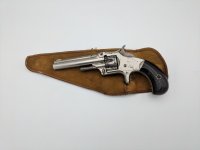
Another Tip Up

Joined
Nov 15, 2018
Messages
4
Reaction score
1
Hello all,

just came across another old S&W and wanted to see if anyone could confirm what I'm thinking about it.

First Model, Third Issue Tip Up
22 Short
Spur Trigger
Rosewood Birdshead Grips
Serial: 878XX
Nickel maybe 70% (seems so subjective at times, and I'm a horrible guess.)

Any opinions or thoughts? I'm normally a old Flintlock kinda person, so this "new" stuff is outside my wheelhouse.
Thanks!
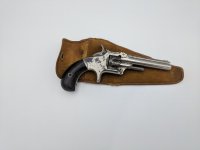
 

Attachments

  • IMG_20181120_095402.jpg
    IMG_20181120_095402.jpg
    35.9 KB
  • IMG_20181120_095338.jpg
    IMG_20181120_095338.jpg
    38.4 KB
I have only seen Rosewood on these. From the introduction of the Model 1 up to the early 1870s there was only one 22 rimfire and it was usually labeled No. 22 or S&W No. 1. It only got the "Short" designation when 22 Longs were introduced for sale. The 22 Short has the same dimensions as the original 22 rimfire round, but certainly not the same ballistics. If one can find some 22 CB Caps or 22 BB Caps you can shoot these little guns without worry. I have shot mine with 22 CB Shorts as well. There were a ton made and it seems that the survival rate is quite high, so value is quite low for such a historic piece of history.
 
Last edited:
Quick question for y'all, despite the age, since theoretically you could chamber available 22 ammo in this (though obviously not advisable) would it still be considered an antique or is it in ffl territory?

Thanks for helping clear up my confusion.
 
Quick question for y'all, despite the age, since theoretically you could chamber available 22 ammo in this (though obviously not advisable) would it still be considered an antique or is it in ffl territory?

Thanks for helping clear up my confusion.

It is still considered antique in the US. Other countries have different laws that require the ammo be obsolete, the US does not.

There's some nuance to the law, but in this application, it's clear cut.
 
I would think its an antique and not subject to needing an FFL transfer. Although it will chamber 22 shorts and the lesser rounds like the 22 BB and CB, they were designed to fire 22 black powder shorts. I think it would take a really picky person to make it an issue.

Kind of like a 44 Russian. Made before the cut off line. You can't walk into any old sporting goods store and buy ammo. But, you can get it off the internet and sometimes find it on the odd gun shops shelf. When I picked mine up the dealer actually had a box of ammo for it on his shelf. Cowboy action is big here and a few guys shoot 44 Russians. So who defines "uses rimfire or conventional centerfire fixed ammunition which is no longer manufactured in the United States and which is not readily available in the ordinary channels of commercial trade"

Buying stuff of the net is pretty ordinary now. Same thing goes for my model 1 1/2s and early double action top breaks in 32S&W. 32 Shorts are hard to find, but not impossible. Same thing I have found them at gun shows, a gun shop and off course the net. Hey finding 22 shorts BB or CB isn't that easy now days for that matter. I think the main thing is when it was made.

Until some one murders somebody with one of these things I doubt the BATF will make it an issue.
 
Steelsaver is correct ... the Model 1 is an antique firearm under current American law.

It's worth noting that the Model 1 is a prohibited firearm in Canada. I corresponded with the RCMP about this a few years ago and was told in no uncertain terms that it is considered a short barreled pistol there, which makes it prohibited.

Mike
 
For BATF purposes it does not make any difference what cartridge a gun fires, so long st the gun was made before 1899. For replica guns made after 1899, the cartridge does make a difference. Not all state laws conform to the BATF definition of an antique firearm.
 
Here is an excerpt from the BATF Regs. I do not understand how so many people do not see the "or" in the definitions.

(16) The term "antique firearm" means—

(A) any firearm (including any firearm with a matchlock, flintlock, percussion cap, or similar type of ignition system) manufactured in or before 1898; or

(B) any replica of any firearm described in subparagraph (A) if such replica—
(i) is not designed or redesigned for using rimfire or conventional centerfire fixed ammunition, or
(ii) uses rimfire or conventional centerfire fixed ammunition which is no longer manufactured in the United States and which is not readily available in the ordinary channels of commercial trade; or

(C) any muzzle loading rifle, muzzle loading shotgun, or muzzle loading pistol, which is designed to use black powder, or a black powder substitute, and which cannot use fixed ammunition. For purposes of this subparagraph, the term "antique firearm" shall not include any weapon which incorporates a firearm frame or receiver, any firearm which is converted into a muzzle loading weapon, or any muzzle loading weapon which can be readily converted to fire fixed ammunition by replacing the barrel, bolt, breechblock, or any combination thereof.
 
Your right, I never to took time before to note that (A) would stand by itself and that (B) and its subs (i) and (ii) would only apply to (B) which only concerns replicas.

I am sure my wife would have pointed that out to me.

(A) any firearm (including any firearm with a matchlock, flintlock, percussion cap, or similar type of ignition system) manufactured in or before 1898; or
 
Back
Top