
BUILDING CODES

cobra44

Member
Joined
Feb 7, 2007
Messages
957
Reaction score
69
I need some help here with building codes.
A friend of mine does construction work full time for many years. He is putting new locks on his house and he has left hand and right hand doors.
He is saying that there are building codes both national and local governing which way the door knob goes on.

He is saying the the key has to go upside down into the lock or it is not legal. He said that that means clocking the door knob as it will not be the same with left and right hand doors. He went to several big building stores and they said that it did not matter which way they go on.

I have searched on the internet and have not found anything on this, including the building codes.:(

Can anyone help me out here? I would really appreciate it.:D
 
That's a new one on me lol.I do remember being taught to install them that way to keep any moisture from settling into the pins.
 
I think he is putting me on also. Thought I would ask.
He seems so serious about it, maybe that is what he believes:confused:

I really like the replies, they are great!!!
 
I've been building forever and I've never heard of this being in the code,but you do install a lock with the pins at the top and some types of knobs and levers do need to be clocked to accomplish that.
 
We have a locksmith here but he spell funny. Kanoe?

I'll wait for him and hope he can help you before this thread gets locked.

Define upside down.
 
That's a new one on me lol.I do remember being taught to install them that way to keep any moisture from settling into the pins.
This is close to what I have always heard.
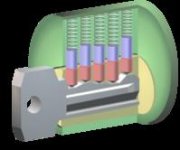
Over the years, a lot of dust, dirt, metal dust from the lock and key wear, and moisture can gunk up a lock. The oldtimers ALWAYS insisted that the lock should be installed so that the pins (tumblers, actually) were on top.
I could see it being written into building codes, but I do not know that it was.
Take a look at the link, and the pics will show you what I mean-
Pin tumbler lock - Wikipedia, the free encyclopedia
 

Attachments

  • 200px-Pin_tumbler_no_key.svg.jpg
    200px-Pin_tumbler_no_key.svg.jpg
    5.4 KB
  • 200px-Pin_tumbler_with_key.svg.jpg
    200px-Pin_tumbler_with_key.svg.jpg
    5.5 KB
Yes, that is what he is talking about.
That makes sense that it could collect dirt, etc. if installed the other way.

Thank you for that information.:D
 
He's wrong. Building codes or life safety codes say nothing about which way the key enters the lock. From a technical standpoint locks are designed so the key enters "teeth" up. With the "teeth" or cuts of the key facing down, over a period of time dust and dirt enter the key way and the tumbler springs are forced to work harder causing them to wear out sooner. Eventually your key may not work.

As far as locks are concerned building codes/life safety codes are were primarily written for the commercial sector where those codes can be enforced. They depend on building occupancy and the type of business it is.

When a house is built inspectors will inspect frequently and after completion will never enter the home again unless you remodel or rebuild. In the commercial sector this can be an ongoing process.
 
To add: Again concerning locks and doors, building codes and life safety codes are only concerned about safety. They could care less whether a lock is upside down or not.

The primary focus is egress. For example, on a warehouse man door with an exit sign above, you can NOT install a deadbolt above the existing handle. Why? The national fire code (NFPA) say's that a child must be able to safely egress using one motion of the hand without having prior knowledge of the door. So, where those laws are enforced you will only see a lever handle or panic bar.

But since your home is not a place of assembly like a church, library, movie theater etc.... They're not concerned about it.

Next time you're in one of those places pay attention to the hardware and look at the many thousands of dollars they had to spend to meet code.:eek:
 
My truck and my wife's car sit and run outside in all kinds of weather.
Their keys both have teeth on the top and on the bottom :eek:
Doesn't seem to be a problem.
 
Exterior residential doors always open inwards. Egress into a room or house will always be a 'push' motion instead of pull. Reason is simple, the hinges (or door opener) are on the interior side. Someone with a screwdriver could simply pop the pin out of the hinges thereby defeating any security locks. Same concepts with rooms. Two occupants may rent a single family residence and interior doors may be locked separately.

As to which way a door swings, its arbitrary. Often times bedrooms will be next to each other and its more 'efficient' to have doors near each other next to the adjoining wall. Efficient because it maximizes wall space. The door hinges will be placed closest to each other, ie. doors will swing in opposite directions.

The code only dictates the height of the lockset which isn't the designer's concern; doors are normally prefabricated by the manufacturer.
 
Exterior residential doors always open inwards.

Not true. I installed an exterior door on my new addition that swings outward.

Doors can swing any way you want them to. The reason most prefer swinging inward is so you can install a screen or storm door on the outside.

Doors that swing outward do have hinges exposed, and therefore have non-removable pins.

Almost all commercial egress doors will swing outwards.

I've been a residential and commercial builder for 30 years.


I had someone try to tell me the grounding prong hole on electrical receptacles must be installed above the hot/neutral holes. The idea was if the plug was out of the socket just a bit, and something fell and contacted the plug prongs, it would hit the ground prong first.

My BIL just received his Master Electrician certification so he's current on regs, and he told me this was bull-pucky. :p

.
 
Exterior residential doors always open inwards. Egress into a room or house will always be a 'push' motion instead of pull. Reason is simple, the hinges (or door opener) are on the interior side. Someone with a screwdriver could simply pop the pin out of the hinges thereby defeating any security locks. Same concepts with rooms. Two occupants may rent a single family residence and interior doors may be locked separately.

As to which way a door swings, its arbitrary. Often times bedrooms will be next to each other and its more 'efficient' to have doors near each other next to the adjoining wall. Efficient because it maximizes wall space. The door hinges will be placed closest to each other, ie. doors will swing in opposite directions.

The code only dictates the height of the lockset which isn't the designer's concern; doors are normally prefabricated by the manufacturer.

Most residential doors open inward. This is for convenience and security. You don't want to open your front door outward when answering your door not knowing who it is and an out swinging door doesn't allow you to add a screen door.

In most cases commercial doors must open outward for emergency egress.
 
Back
Top