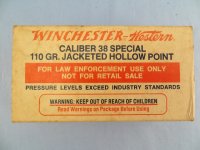
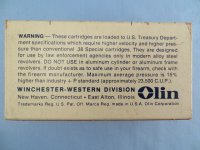
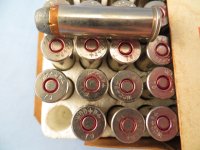
Yes, the 110 Treasury load and the FBI loads are brutal.
These are discussed in the notable thread section of Duplicating the BB load.
To clarify some things. I went to my LGS and obtained this article by Mr Pearce.
It is not an article but a question and answer section.
A reader wrote about duplicating 357 loads in 38 special brass.
Much was said about the development of the 357 Mag from the older 38/44 handguns and tests by Elmer and others.
He then goes on to give some loads (which I will not post here) using H110 and Magnum primers he essentially reduced the 357 Mag load by a few grains for the 158 JHP and some lead bullets.
He states "...approaching 357 Mag performance and PRESSURE"
Not 38 +P.
He does give a load and pressure for a lead Kieth bullet with a load of H110 to achieve pressures of 5% below factory loaded 357 Mag ammo, current max of 36, 000 psi (note SAAMI and SPEER say it is 35,000PSI)
Which raises a question of who is correct on pressure? Mr Pearce or SAAMI?? (disclaimer, the specs may have changed while I am writing this.)
So using his "number" that is 34,200 psi.!! Using 5% less than 35.000 it is still 33,251psi.
As we have already learned the MAX for +P 38 Special is 20,000 PSI
Mr Pearce "recommended using +P or +p+ brass and only using it once or twice and that brass varies even within the same brand". Of course it does, everything manufactured does. He mentions he has seen case separate. OK, so have I.
With these kinds of pressures I have no doubt.
With these excessive pressures I personally think it is unnecessary. If you need that kind of power use a 357 Mag. In a defensive J frame you can only get so much velocity from a 2" barrel.
Based on what I read he is exceeding 38+P pressure standards by a lot and if loaded to these pressures yes, 38 special brass would probably blow, but it is not intended for this!
No manual that I have shows a load of H110 or anything approaching this type of load in a 38 special. Nor do the manuals indicate using +P brass for +P loads
Even Nuclear Speer #8 does not come close?
So if one wants to load near 357 Mags in 38 special of any brand or headstamp based on his few paragraphs in a magazine, then go for it.