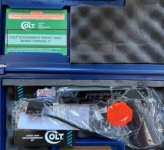
Colt 1911 question

"Government Model" was the marketing name applied by Colt to the civilian version of the Model 1911A-1 US Army, differentiating the model from others within the series (Commander, Ace, Gold Cup, Super .38).

Mk IV designated a variant offered by Colt approx. 1970 to 1980s. Major differences were in the slide/firing pin/trigger-sear mechanism (a safety measure, perhaps induced by liability claims) and the barrel bushing (tensioning device intended to maintain consistent alignment when in battery). Some people thought highly of these "improvements", but others preferred the original designs. Some custom gunsmiths specialized in either the original concept or the Mk IV Series 70 pistols.

In the early 1970s the most common term used was ".45 automatic", which everyone associated with the Colt pistols. About the only other .45s available were a few imports by Llama or Star. The terms "1911-style" and "1911-type" only came into common usage after several other manufacturers jumped on the .45ACP wagon (around 1980s).
 
Last edited:
"Government Model" was the marketing name applied by Colt to the civilian version of the Model 1911A-1 US Army, differentiating the model from others within the series (Commander, Ace, Gold Cup, Super .38).

Mk IV designated a variant offered by Colt approx. 1970 to 1980s. Major differences were in the slide/firing pin/trigger-sear mechanism (a safety measure, perhaps induced by liability claims) and the barrel bushing (tensioning device intended to maintain consistent alignment when in battery). Some people thought highly of these "improvements", but others preferred the original designs. Some custom gunsmiths specialized in either the original concept or the Mk IV Series 70 pistols.

In the early 1970s the most common term used was ".45 automatic", which everyone associated with the Colt pistols. About the only other .45s available were a few imports by Llama or Star. The terms "1911-style" and "1911-type" only came into common usage after several other manufacturers jumped on the .45ACP wagon (around 1980s).

Thanks for the reply, but I am still a bit thick here. Are there MK4’s, not roll marked accordingly?
 
Thanks for the reply, but I am still a bit thick here. Are there MK4’s, not roll marked accordingly?
There may be pistols including Mk IV features but not marked as such. A whole bunch of variations and marketing ideas were tried, modified, discarded. The 1970s and 1980s were difficult times for Colt (and S&W, probably many other big names). Financial, labor issues, legal problems, variable quality controls. The economy went down the drain from about 1976 until the mid-1980s or so, rampant inflation, unemployment rates not seen since the Great Depression, social unrest (a euphemism for riots, etc), mortgage loans went from ~6% to over 18%.

Retail prices of Colts and other brands doubled in the 1970s, then doubled again in the 1980s. A brand new Colt Government Model sold for about $120 in the early 70s, up to over $400 by about 1990, but salaries and wages remained fairly static. Colt and others were struggling to maintain a toehold.

Colt ended up moving the 1911 line-up to the Model 1991A1 which included such lovely features as a plastic trigger and mainspring housing and a black phosphate finish instead of the wonderful Colt "Royal Blue".

Interesting times, but only in retrospect; actually living through those years was a challenge for most of us.
 
I believe their current production isn’t roll marked as mark IV and are series 70 without the collet bushing

I'm so confused. Doesn't series 70 mean that it has a collet bushing?
Does the Mrk IV have the series 80 firing pin block safety?
The last new Colt 1911 I bought was a series 70 in 1980.
Ken
 
I'm so confused. Doesn't series 70 mean that it has a collet bushing?
Does the Mrk IV have the series 80 firing pin block safety?
The last new Colt 1911 I bought was a series 70 in 1980.
Ken

THe original series 70 had a belled barrel and a collet bushing. The series 80 went back to a solid bushing and added a firing pin block. The new series 70 also uses a solid bushing,but it doesn’t have the firing pin block.
 
Last edited:
Traded into a “new” Government Mdl. last year. Thought I would tune it up with trigger job, new sear and disconnector, long metal trigger and add Trijicon or MEPRO sights. Inside of the lower was quite different from older Series 70’s. Frame would not accept match disconnector. Sold it off for what had in it.
 
I believe a Government Model Colt is a term they use for any of their 1911's with a 5" barrel. At least according to person I spoke with at Colt .
By the way I purchased a Government Model the O1911C about 2 yrs. ago . It shoots quite well and I've been very happy with it.
 
Last edited:
Pre Series 70 refers to all the Colt Government Models built before the introduction of the collet bushing in 1970. The Series 70 guns had a rollmark of “Mk. IV / Series 70”. Around 1983 Colt introduced the Series 80 which added the firing pin safety. After a couple of years of Series 80 production the collet bushing was abandoned and the traditional bushing came back. Around 1990 Colt began offering a deluxe line of “Enhanced” Government Models, and the economy 1991 line. The 1991 pistols featured a large “M1991A-1” rollmark, which was replaced with the pre Series 70 style rollmark in the early 2000’s.

In the early 2000’s Colt brought out a Series 70 reproduction, which featured the old “Mk.IV / Series 70” rollmark. The reproduction Series 70 omitted the firing pin safety, but kept the traditional bushing. Mechanically it was really a Pre Series 70, but with the Series 70 roll marks. It also had the wide barrel hood of the old Government Models, the small ejection port, and lacked the Delta Elite style frame cutout. That gun was discontinued in late 2019, and replaced by the “Classic”, which was a hybrid of the Series 70 and Series 80. It’s mainly a Series 80 Colt 1991 without the firing pin safety. The Series 70 rollmark was replaced with the Pre Series 70 roll mark, only it’s now a laser engraving instead of a roll mark. Where the Series 70 reproduction was only offered in .45ACP, the new “Classic” is offered in .45 and .38 Super.
 
Last edited:
The collet bushing improved accuracy, but developed a reputation for breaking a prong off the collet which would then cause the gun to jam.

How often did that really happen? Who knows. Maybe just once. But for the tactically inclined of the day, just the possibility was unacceptable. Colt eventually got the message and reverted to a solid bushing.
 
Back
Top