Early K-22 question

JP@AK

US Veteran
Joined
Mar 9, 2011
Messages
16,193
Reaction score
24,585
City & State/Province
Palmer, Alaska
To those of you who care about minute differences in the early postwar target K frames, here's a value question.
Assuming you had two K-22 revolvers, one-liners made in the late 1940s (obviously). Both are in very high graded condition and are virtually identical but one has the large knob and the other has only the knurled end rod. How much of a price premium does the LERK get in the marketplace?
Thanks!
 
Large knob? Knurled end rod? What are these?
 
OK. Over the years, S&W has used several different extractor rod designs. Until about 1927, a mushroom-shaped knob was used. From then until about 1948, a barrel-shaped knurled knob was used. This is the "Large Extractor Rod Knob" (LERK). Finally, the extractor rod tip was knurled, without a knob. I call that a KERT (Knurled Extractor Rod Tip).
 
Large knob? Knurled end rod? What are these?

The knob on the extractor rod went though an evolution over the years. The earliest knobs on guns with the front locking lug had a two piece configuration with a mushroom shaped knob that screwed onto the end of the rod. This was replaced by a knob of the same shape that was integral to the rod. These knobs required a two-step machined notch on the underside of the barrel to allow the rod to mate with the barrel when the cylinder was closed.
In about 1927, the shape of the knob was changed to resemble a barrel. It was still larger than the rod itself but required only a one-step notch in the barrel, thus simplifying production. This later style is often referred to as a "large knob" or "LERK."
After WWII, the earliest postwar guns had the large knob. In October, 1946, management decreed that the large knob would be eliminated and the end of the rod itself would be knurled. This in turn eliminated the need to machine the bottom of the barrel, since no relief was needed for the rod to clear the bottom of the barrel. It took a little while for the change to be implemented, so there was a transition period during which both styles appeared.
On the K-22, there were only a relatively few guns made with the LERK before it was replaced permanently with the knurled-end rod (sometimes erroneously referred to as a "small knob").

Note: the history provided here applies only to K frame revolvers. The evolution was slightly different on the N frames. Also, the 2" K frames never did have the LERK.
 
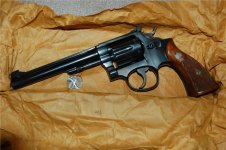
This photo of an M&P that shipped in March, 1946, shows a LERK. You can clearly see the notch in the bottom of the barrel that was required to allow the knob to clear the barrel.
jp-ak-albums-miscellaneous-revolvers-picture8884-early-postwar-m-p-5.jpg
 
I watch the auctions for these pretty closely, and I don't know that I could even guess on the market valuation differential. There aren't very many of these that come up in 98% condition, and when they do, the auction result is highly variable (variable on just what, I'm not sure, but one variable seems to be the seller: David Carroll and "Jack the Dog" seem to be preferred vendors in the marketplace).

The best way I know to answer that question is to tell you what I think would be fair pricing (meaning the point where I would stop bidding in an auction where I was next to 100% certain what I was bidding on, and for the gun only, without the goodies):

for a 98% K22 transition one-liner with the newer ejector rod end: around $1200

for a 98% transition with the pre-war ejector end: around $2000

I wouldn't be buying very many guns at those prices.
 
Let me sprinkle a little cold water here. Remember that there are over 5000 LERK K-22s, which makes them uncommon but not flat-out rare. Prices can get high at the top end of the quality ratings, and I acknowledge that a couple of really nice LERK K-22s have sold for $2000 and above. But I can't believe that the pool of buyers at that level will be very deep. I would expect the LERK premium for a high-90s specimen to be about what it has historically been for K-22s of lower percentage rankings -- say a 25% to 50% kick. If you can get a decent single-line non-LERK K-22 for $700-750, I would think a comparable LERK gun might go for $1000-1200.

This kind of arithmetic would not hold for the K-38 and K-32 LERK Masterpieces, of which the former appear to number in the few hundreds and the latter in the tens. Now those could draw some major prices in comparison to knobless specimens of about the same age and in similar condition.

If I see lower-quality LERK K-22s regularly selling in the $1500-1800 range and the higher-quality guns continuing to change hands at $2000 or above, I'll know I am simply out of touch on this market.

EDITED TO ADD: Jack, I think the LERK gun you show had to have shipped in 1947, not 1946. The first K-22s weren't even available until December of '46, and only two were shipped at that time. The commercial shipment of K-22s got going in January of 1947, and about 12,000 went out by the end of the first full year.
 
Its an interesting thread, but one thing that hasn't been discussed is the value change based on the serial #. It can make a huge difference in what some buyers are willing to pay. Information is coming to light these days. For a long time we were out looking and thinking K101 was there for the picking. Now we know its in a museum. To the best of my knowledge, Drew has the lowest at K117. It helps that its in "fair" condition. :D That should draw him out! :)

Basically, everyone wants the guns in the first 100. Then the premium or demand starts to fall off about K201. As you go up, fewer buyers are willing to pay as much. There are guns out there for sale with lower numbers, so the big money will seek those.

What we've seen is buyers are crazy or insane. But a gun with a cool serial will sell faster and for more money. I would guess repeating numbers, like K111, K222, K333, etc would be very desireable. I've sought the low number guns for a long time. I missed buying one in the K130s, and another in the low K140s. I actually held K188, but the owner hadn't shot it yet. But he gave me his phone number. I bet I called that number over a dozen times. Never an answer. At another gun show the following year the guy was back. He said he never answered phone calls from number he didn't recognize.

Then he sold the gun for the equivalent of about $1300 or so dollars. As I recall it was a trade situation, including a bunch of cash and of all things, a Grock. That may be spelled wrong :) I don't know. But I can live with it since I'd not have paid that much at that time. Now I know better, and both got a good deal.

Back to "Drew" bashing. He found his ratty old gun in a chicken coop, along with a primo gun rug. He never told us how much he'd paid, but I'd guess (and hope) it wasn't much. The story just sounds better if we knew he stole it! :D

So how much will a fool be willing to pay? My guess is K102 is worth maybe $3000 if nearly perfect. I'd also guess that if K1890 was worth $2200, nearly all in the K102 - K199 range in similar condition are worth maybe $2500. We're talking about a premium based solely on the desirability of the serial # and when it probably shipped.

Other factors are the accessories. The box, sitting all by itself at a gun show, won't last long at $150. It will probably sell at $200 over a weekend, if its in nice condition. As far as I know, the K22 2nds were shipped with nickel sight adjusters. Those seem to have continued right after the war so I'd guess the early K22 3rds shipped with them. If you can find one for sale, just buy it. Ten years ago they were $100 items. Sometime after the beginning, S&W seemed to move to the black adjusters. I think we've pretty well settled those are black oxide, an industrial coating that isn't blue. Those were also selling for the $100 ten years ago. The higher number K22s, like those shipping in maybe 1948 and still had their accessories seem to have the black adjusters.

We trashed the gun shops and collectors that separated the guns and their boxes and tools. But the reality was we were purists who did this for love, not for money. Yes, we were romantics and the sellers were "ladies of the evening" in comparison. We left money on the table, they maximized their profits. Boxes had numbers, just like grips and barrels. Screwdrivers didn't. So if you've got the gun in the box, include the screwdriver. Wrap it in a kleenex (brand might not matter) and put it in a ziplock. Keep it together for your heirs. They probably don't have a clue what goes with which gun.
 
Jack, I think the LERK gun you show had to have shipped in 1947, not 1946. The first K-22s weren't even available until December of '46, and only two were shipped at that time. The commercial shipment of K-22s got going in January of 1947, and about 12,000 went out by the end of the first full year.

David
I appreciate you posting this comment. I had it in the back of my head that there were very few K-22 revolvers that left Springfield in 1946, but could not remember the details. So, would you say that K226 probably shipped in maybe January or February, 1947? It is not much above K101, but I don't know how many of those first couple hundred would have been K-22s. Were all of them? When did the K-38 go into production (and at what serial number)?

BTW, I don't think I posted a picture of a K-22 in this thread. The gun I used to illustrate the LERK is an M&P and it does letter to March of 1946. But the gun that prompted this post has serial number K226, and it turns out to have a knurled extractor rod, and no knob (hence, not a LERK). But it does have the numbered box, the Helpful Hints, the cleaning rod (but no mop) and a black oxide SAT. I think the guy will ask about $1100 or $1200 if he decides to sell. I will probably pass, but I don't think that is too far out of line, if at all. The revolver is at least 95% and I think maybe a bit higher.
 
David
I appreciate you posting this comment. I had it in the back of my head that there were very few K-22 revolvers that left Springfield in 1946, but could not remember the details. So, would you say that K226 probably shipped in maybe January or February, 1947? It is not much above K101, but I don't know how many of those first couple hundred would have been K-22s. Were all of them? When did the K-38 go into production (and at what serial number)?

Jack,

According to the SWCA database K226 shipped 3/10/1947 to the California Hardware Co. Serial # K222 that I posted shipped 2/13/1947 to Beck & Gregg Hardware, Atlanta Georgia. Most of the early K-22's are in the database. (IIRC Roy supplied much of the data)
 
David
I appreciate you posting this comment. I had it in the back of my head that there were very few K-22 revolvers that left Springfield in 1946, but could not remember the details. So, would you say that K226 probably shipped in maybe January or February, 1947? It is not much above K101, but I don't know how many of those first couple hundred would have been K-22s. Were all of them? When did the K-38 go into production (and at what serial number)?

BTW, I don't think I posted a picture of a K-22 in this thread. The gun I used to illustrate the LERK is an M&P and it does letter to March of 1946. But the gun that prompted this post has serial number K226, and it turns out to have a knurled extractor rod, and no knob (hence, not a LERK). But it does have the numbered box, the Helpful Hints, the cleaning rod (but no mop) and a black oxide SAT. I think the guy will ask about $1100 or $1200 if he decides to sell. I will probably pass, but I don't think that is too far out of line, if at all. The revolver is at least 95% and I think maybe a bit higher.


Apologies! I just saw a K-frame revolver in a K-22 thread and didn't recognize it for what it was. Proof positive that we see what we expect to see, and not what is actually there. (Or at least that I do.)

We haven't seen all of the first couple of hundred K-22s, but the ones that we have seen are all LERK guns, if my perceptions are correct.

K-38s went into commercial distribution in February 1948. It appears that several dozen to a few hundred were released with serial numbers between K4500 and K5000. Not that many of these are known, but about half of the ones that are known have knobless ejector rods and the remainder are LERK guns. I don't think we know if the K plus four digit guns were produced in 1947 and held for later release, or if the frames were set aside to be built as K-38s and were not assembled until shortly before they were shipped. There is also evidence that a salesman sample or two were produced with K1xxx numbers.

Here's a thread from a couple of years ago about K-38 LERKs. Beware of statements higher in the thread that were disproved by later posts. This thread shows clearly how knowledge can evolve in the process of comparing data.

http://smith-wessonforum.com/s-w-ha...masterpieces-large-ejector-rod-knob-lerk.html
 
This kind of arithmetic would not hold for the K-38 and K-32 LERK Masterpieces, of which the former appear to number in the few hundreds and the latter in the tens. Now those could draw some major prices in comparison to knobless specimens of about the same age and in similar condition.

Now if only I could lay my hands on one of those LERK K-32s, I'd be a happy man....OK - a more happy man. :)


BTW, I don't think I posted a picture of a K-22 in this thread. The gun I used to illustrate the LERK is an M&P and it does letter to March of 1946. But the gun that prompted this post has serial number K226, and it turns out to have a knurled extractor rod, and no knob (hence, not a LERK). But it does have the numbered box, the Helpful Hints, the cleaning rod (but no mop) and a black oxide SAT. I think the guy will ask about $1100 or $1200 if he decides to sell. I will probably pass, but I don't think that is too far out of line, if at all. The revolver is at least 95% and I think maybe a bit higher.

I think that price is a very fair price for the K226 package, unless it looks like the barrel was at some point replaced with a non-cut-out barrel, therefore requiring the change out of the LERK for a knurled tip extractor rod. If the barrel was replaced, I think the price is too high.
 
Last edited:
Thanks to David and Richard for your replies.
Also to bullmack for the shipping date.
I love this Forum!!!
 
Jack,

According to the SWCA database K226 shipped 3/10/1947 to the California Hardware Co. Serial # K222 that I posted shipped 2/13/1947 to Beck & Gregg Hardware, Atlanta Georgia. Most of the early K-22's are in the database. (IIRC Roy supplied much of the data)


On a side note while low serials are an interesting trait factory shipping dates are the actual accepted method in determining a guns DOB , it is not unusual to find post war 3 digit serial K-22's under K300 that have later ship dates than some well above K-300.
 
On a side note while low serials are an interesting trait factory shipping dates are the actual accepted method in determining a guns DOB , it is not unusual to find post war 3 digit serial K-22's under K300 that have later ship dates than some well above K-300.
That is absolutely the case. I once owned a one-line address K-22 with a number in the low K10,000 range. According to Roy, it shipped in December, 1949, long after S&W started using the four-line address. It obviously sat in the vault for many months.
 
That is absolutely the case. I once owned a one-line address K-22 with a number in the low K10,000 range. According to Roy, it shipped in December, 1949, long after S&W started using the four-line address. It obviously sat in the vault for many months.

Was that K10098?
 
Was that K10098?

Yes, as a matter of fact. I liked it a lot, but an acquaintance in the NRA fraternity up here wanted it, so I sold it to him a couple years ago. He loves it and says it is the best shooting .22 he's ever owned and he plans to keep it forever! :)
 
And btw guys, K266 turns out to have the LERK! I never could get pictures of it from the guy, but after pressing him hard and sending photos for comparison, he finally actually looked at the gun and admitted that it had the knob. It also turns out that he has another one with K plus five digits. It has a one-line address and the knurled end. He has original boxes, SATs and papers on both. But is not selling, unfortunately. :(
 
Back
Top