
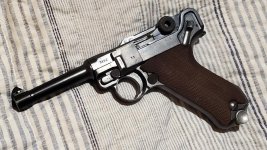
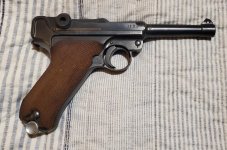
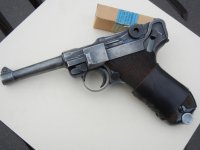
Ran across this WWI 1918 DWM Luger at what I thought was a reasonable price considering it has a nice holster and mag tool. I really don't know much about them, it does have all matching numbers except for the barrel. Thoughts from the Luger enthusiasts on here?

You are using an out of date browser. It may not display this or other websites correctly.
You should upgrade or use an alternative browser.
You should upgrade or use an alternative browser.
First Luger!
- Thread starter Tntcwg3
- Start date



A colleague of mine has a beautiful 1916 Luger with the imperial German eagle on it. A WW2 bring back from gramps.
It also has the Reichs Adler grasping the swastika and some other proof marks from the armory rebuild presumably in the 30s or 40s. The thing is in great shape and shoots really good despite its age.
As far as matching numbers and such, I have no idea.
It also has the Reichs Adler grasping the swastika and some other proof marks from the armory rebuild presumably in the 30s or 40s. The thing is in great shape and shoots really good despite its age.
As far as matching numbers and such, I have no idea.

Scharfschuetzer
Member
You don't see Lugers very often on this site.
Looks like you have a shooter so enjoy. I've always enjoyed shooting them.
Looks like you have a shooter so enjoy. I've always enjoyed shooting them.

I'm far from an expert, but have a 1940 Mauser made Luger my dad brought back after WWII, so I've done a little bit of research.

Mine is matching, except the magazine... it's pretty common for wartime guns to be missing the original mag, so that's worth a premium. With a replaced barrel... I don't know? OP's Luger does look to have been refinished at some point.
There are a variety of reproduction holsters and mag tools on the market, but I'm not knowledgeable enough to comment. I know there are a couple of real Luger folks here that can probably offer some insight if you post some more pics.
Mine is matching, except the magazine... it's pretty common for wartime guns to be missing the original mag, so that's worth a premium. With a replaced barrel... I don't know? OP's Luger does look to have been refinished at some point.
There are a variety of reproduction holsters and mag tools on the market, but I'm not knowledgeable enough to comment. I know there are a couple of real Luger folks here that can probably offer some insight if you post some more pics.
HOUSTON RICK
Member
A functioning Luger is nice to have no matter the collector details. I want one when I grow up. Congratulations!

sigp220.45
US Veteran
Every gun guy should have a Luger.
I only own one now, this .30 1920 commercial one. I love it.

I only own one now, this .30 1920 commercial one. I love it.
Hard to answer your question directly because you don’t say what the “reasonable price” is.

Absalom
SWCA Member, Absent Comrade
Ran across this WWI 1918 DWM Luger ….
…..it does have all matching numbers except for the barrel….
Aluminum-bottom magazines were to my knowledge not produced until the 1920s, so I’d be surprised if the magazine is matching on this 1918 DWM.
Congrats on your Luger but beware, they can become habit forming.
Need more pics from all angles, would be able to give you more information. From what I can see this Luger went through a rework for the Police. This is evidenced by the the piece of steel that is riveted on the top running across the top of the sideplate. The dome of the rivet should be in the white. If it isn't, the pistol was probably redone by someone without regard to originality. The ejector is heat treated to a "straw" color but from the photos it appears that the other parts that should be strawed aren't. These parts are the trigger, safety lever, take down lever and mag release.
The unnumbered barrel may very well be proper for this Luger. If it started out as an artillery model the long barrel would have been removed and 4 inch installed. If this is what was done there should be some markings on the barrel. Look above the date and if there is a notch cut in the receiver this luger started out as an artillery.
Really need more pics, front of frame, front gripstrap and bottom of mag. If the mag is numbered 1 or 2 it is a police magazine. Would like to see serial number of mag.
Here is a 1918 DWM Artillery(I just happen to have one on hand) that was converted to Police use. Notice the sear safety and the notch in the receiver in pic 2.


Need more pics from all angles, would be able to give you more information. From what I can see this Luger went through a rework for the Police. This is evidenced by the the piece of steel that is riveted on the top running across the top of the sideplate. The dome of the rivet should be in the white. If it isn't, the pistol was probably redone by someone without regard to originality. The ejector is heat treated to a "straw" color but from the photos it appears that the other parts that should be strawed aren't. These parts are the trigger, safety lever, take down lever and mag release.
The unnumbered barrel may very well be proper for this Luger. If it started out as an artillery model the long barrel would have been removed and 4 inch installed. If this is what was done there should be some markings on the barrel. Look above the date and if there is a notch cut in the receiver this luger started out as an artillery.
Really need more pics, front of frame, front gripstrap and bottom of mag. If the mag is numbered 1 or 2 it is a police magazine. Would like to see serial number of mag.
Here is a 1918 DWM Artillery(I just happen to have one on hand) that was converted to Police use. Notice the sear safety and the notch in the receiver in pic 2.
Last edited:
CLASSIC12
Member
I agree that at least one Luger should be in any gun lover’s collection
Here’s my 1936 Mauser


Then there’s the Swiss Luger addiction


Here’s my 1936 Mauser
Then there’s the Swiss Luger addiction
leonardocarrillo
Member
The fact that the numbers don't match disqualifies it as a collectible weapon, but it can make for a really fun gun to shoot.
Absalom
SWCA Member, Absent Comrade
…. I really don't know much about them, it does have all matching numbers except for the barrel….
Just to clarify this: Is the barrel unnumbered or actually mismatched?
The picture resolution is insufficient, but there is an acceptance stamp visible on the right side of the barrel.
The pistol was most likely reworked right after WW I for the police, especially if it has the artillery notch in the receiver as mentioned by CZU.
After August 1933 the Schiwy safety was riveted to the left side. It was never cut for the Walther safety.

bgrafsr
Absent Comrade
Mauser BYF 41. Has matching wood grips along with the black plastic ones, 3 FXO magazines, and holster, loading tool:


PALADIN85020
US Veteran
A quick tipoff that the 1918 gun is not original is that the smaller components (trigger, safety lever, takedown lever, mag release etc.) are blued or blackened rather than "strawed" or golden in color. The German guns had these components strawed through 1936, when Mauser was making them. Here is a Mauser example clearly showing the straw colors.
Yours is not collectible, but still a nice shooter.
John

Yours is not collectible, but still a nice shooter.
John
Last edited:

GypsmJim
Member
- Joined
- Oct 16, 2009
- Messages
- 4,512
- Reaction score
- 8,103
To reiterate what others have said, it does look reblued. Many of that era were when rearsenaled. The mag is also of WWII vintage.
I have an artillery model that was put back into service with 2 State Police departments during its lifetime. Thus, my barrel was replaced. It DOES have the matching number embossed on the bottom of the barrel, but NO proof mark on the right side. So, I guess there are inconsistencies.
Mine is also double dated. I believe military weapons that were put back into service after WWI were stamped with a second 1920 date. I have a Danzig Kar 98 Carbine that also has the second date.
Regardless, still a nice piece of history and should perform well.
I have an artillery model that was put back into service with 2 State Police departments during its lifetime. Thus, my barrel was replaced. It DOES have the matching number embossed on the bottom of the barrel, but NO proof mark on the right side. So, I guess there are inconsistencies.
Mine is also double dated. I believe military weapons that were put back into service after WWI were stamped with a second 1920 date. I have a Danzig Kar 98 Carbine that also has the second date.
Regardless, still a nice piece of history and should perform well.
The frame proofs are WW1 era (1914-18) DWM .
Erfurt used slightly different proof marks.
Is there a Chamber Date?
The single mark on the right side of the bbl at the breech is a
German Military proof mark.
It looks like the earlier style mark that was used 1908 to 1913 by both DWM and Erfurt on the bbl and the breechblock . But I can't be sure just looking at the pic.
Then starting in WW1 and thru to the end of that War that proof mark was only used on the breech block and a slightly different version was then used on the bbl.
Refinished, yes. But a decent Luger as well. No doubt a fine shooter and one that you can take out and enjoy w/o getting the OMG's over ruining a collectors piece.
They certainly are special.
Mine need to get out more!
Erfurt used slightly different proof marks.
Is there a Chamber Date?
The single mark on the right side of the bbl at the breech is a
German Military proof mark.
It looks like the earlier style mark that was used 1908 to 1913 by both DWM and Erfurt on the bbl and the breechblock . But I can't be sure just looking at the pic.
Then starting in WW1 and thru to the end of that War that proof mark was only used on the breech block and a slightly different version was then used on the bbl.
Refinished, yes. But a decent Luger as well. No doubt a fine shooter and one that you can take out and enjoy w/o getting the OMG's over ruining a collectors piece.
They certainly are special.
Mine need to get out more!
Absalom
SWCA Member, Absent Comrade
…
Mine is also double dated. I believe military weapons that were put back into service after WWI were stamped with a second 1920 date.
Based on a Weimar law from August 1920, the “1920” was an identification stamp for weapons in possession of the Reichswehr (army) and Sipo (security police).
Since this is often misunderstood, a brief explanation:
At the time, the government was trying to get military weapons out of civilian hands through a buyback. Some folks immediately blather about “gun control”, but this was mostly about heavy hardware; since the Imperial army never surrendered, but just dissolved more or less orderly, lots of people just took weapons home and then used them in the civil unrest of 1919/20. There are pictures of people standing in line clutching machine guns, flamethrowers, and mortar tubes, to collect the bounties.
To prevent guns from being “disappeared” and then turned in again, for more money, all were given the 1920 stamp when turned over to the Reichswehr.
Four military handguns are listed as falling under the regulation: the Reichsrevolvers M79 and M83, the Mauser C96, and the Luger in 9mm. Quite a few Mauser 1914’s have a 1920 stamp, even though they actually didn’t need one.
No civilian guns, longarms or handguns, were affected. But even among military guns, the success rate was moderate; many guns disappeared under floorboards or elsewise, and even heavy stuff like machine guns and even cannon were tucked away in clandestine armories of various political and paramilitary organizations.
So any double-date police Luger can safely be assumed to have come into police service most likely by way of a Reichswehr depot, which had lots of pistols on offer for any agency that asked.
Last edited:
GypsmJim
Member
- Joined
- Oct 16, 2009
- Messages
- 4,512
- Reaction score
- 8,103
Based on a Weimar law from
At the time, the government was trying to get military weapons out of civilian hands through a buyback. Some folks immediately blather about “gun control”, but this was mostly about heavy hardware; since the Imperial army never surrendered, but just dissolved more or less orderly, lots of people just took weapons home and then used them in the civil unrest of 1919/20. There are pictures of people standing in line clutching machine guns, flamethrowers, and mortar tubes, to collect the bounties.
No civilian guns, longarms or handguns, were affected. But even among military guns, the success rate was moderate; many guns disappeared under floorboards or elsewise, and even heavy stuff like machine guns and even cannon were tucked away in clandestine armories of various political and paramilitary organizations.
My Grandpa and Great Uncle were youths during WWI, so they never saw military service. After the war, they both became firearm proficient and often spoke highly of their Mauser rifles.
As they told the story "regular" rifles and ammo were stockpiled in Post Offices, and were readily available for any citizen to take for free. Naturally, with the army all but dismantled they relied on the citizenry (and formal "police") for protection of the country.
In 1925 both emigrated to America thru Ellis Island, leaving their Mausers behind. They communicated by letter to their family and even sent money to them. Letters were forbidden in about 1935. Their last correspondence informed them that all the family guns had been confiscated for the army. Gun control started then. We all know how that turned out.
Reconnecting with the family didn't take place until the 1950's.
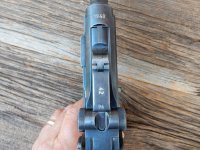
My double dated Luger has 2 State Police Unit markings. One is XXX'd out, so I guess it had been transferred from one unit to another.
Last edited:

moosedog
Member

Absalom
SWCA Member, Absent Comrade
…..
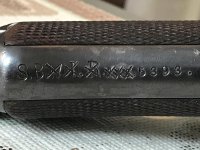
My double dated Luger has 2 State Police Unit markings. One is XXX'd out, so I guess it had been transferred from one unit to another.
Either that, or it was also common for early markings following the 1922 Prussian regulations (or even earlier non-standard local ones) to be cancelled out and updated to the 1932 simplified rules, without the gun going anywhere.
Can you post a photo of the front strap?
I have a Berlin police gun with both 1922 and 1932 markings:
Attachments

22lrfan
Member

sheepdawg
Member
- Joined
- Dec 25, 2010
- Messages
- 5,608
- Reaction score
- 15,985
- City & State/Province
- Hills of North Georgia
My dad bought a matching 1916 DWM, except for the two WW2 Mauser mags, holster, tool, 6 boxes of 1944 stamped 9mm. ammo, 1944 U.S. Army folding roadmap of France, Belgium and Luxembourg, a very nice German m40 helmet and a pair of original Luger black widow grips in 1960 for $100. I still have it all.
I guess it was decent deal.
I guess it was decent deal.
Absalom
SWCA Member, Absent Comrade
…. in 1960 for $100. I still have it all.
I guess it was decent deal.
Well, according to common inflation calculators that would be about $935 today.
Still one heck of a deal you could easily multiply a few times if necessary in today‘s market

GypsmJim
Member
- Joined
- Oct 16, 2009
- Messages
- 4,512
- Reaction score
- 8,103
Either that, or it was also common for early markings following the 1922 Prussian regulations (or even earlier non-standard local ones) to be cancelled out and updated to the 1932 simplified rules, without the gun going anywhere.
Can you post a photo of the front strap?
I have a Berlin police gun with both 1922 and 1932 markings:

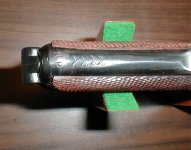
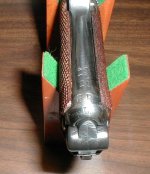
Here are 2 shots...
The XXX'd out letters appear to be "S.L. Pol." The visible letters are "SP. L."
Attachments
Last edited:
Absalom
SWCA Member, Absent Comrade
Here are 2 shots...
The XXX'd out letters appear to be "S.L. Pol." The visible letters are "SP. L."
Indeed. The gun didn‘t change hands and may have continued to be carried by the same officer. Except this wasn‘t Prussia, but Saxony, so they had their own reorganization and timeline. The old marking is from around 1920, the new style was introduced in 1928.
The old marking stands for „Sächsische Landespolizei“ (Saxon State Police).
The new marking S.P. denotes „Schutzpolizei“, a standard term for the uniformed police, and the L. for the city of Leipzig in Saxony.

Every gun guy should have a Luger.
This pretty much sums up why I own one lol. My dad always said that you have to shoot one to appreciate it. Well, I can't say it made much difference to me. I do think my stainless Stoeger American Eagle is pretty, that's about the nicest thing I can say about any Luger. They are too heavy for a single stack 9mm, sights are well... functional, and the toggle action is just plain weird. Still, it does feel good in the hand, and walnut and steel are always a plus in my book. I guess I'll keep it around a while longer
 .
.
Last edited:
GypsmJim
Member
- Joined
- Oct 16, 2009
- Messages
- 4,512
- Reaction score
- 8,103
Thank you so much for the info. I had done research many years ago but what you provided was much more thorough.Indeed. The gun didn‘t change hands and may have continued to be carried by the same officer. Except this wasn‘t Prussia, but Saxony, so they had their own reorganization and timeline. The old marking is from around 1920, the new style was introduced in 1928.
The old marking stands for „Sächsische Landespolizei“ (Saxon State Police).
The new marking S.P. denotes „Schutzpolizei“, a standard term for the uniformed police, and the L. for the city of Leipzig in Saxony.
Interestingly enough, Leipzig is only about 100 miles from my ancestor's home town.
I bought the gun in 1986. It was the first Luger I ever saw that was in my price range. The dealer was an old guy that had a small shop in his basement and all he sold were handguns. Looking back I wish I had asked more questions. It is not import marked, so all I know is that is came over before 1968.

boykinlp
Member
A Luger is on my "want" list. Maybe one day. There are so many things to learn. I think I will get a commercial one. Seems like you can get one in better condition, for less money, than one with military or police history.
Larry
Larry
Last edited:
Similar threads

- Replies
- 13
- Views
- 493

- Replies
- 11
- Views
- 297

- Replies
- 21
- Views
- 1K


