
You are using an out of date browser. It may not display this or other websites correctly.
You should upgrade or use an alternative browser.
You should upgrade or use an alternative browser.
Hand Ejector
- Thread starter Czar1
- Start date

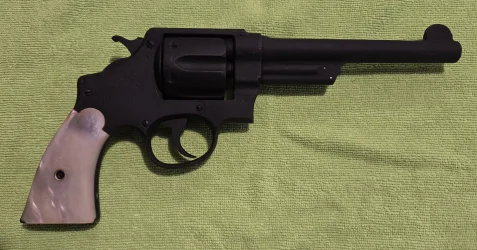
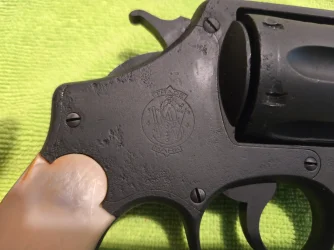
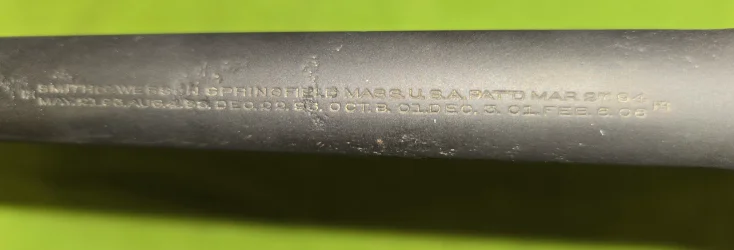
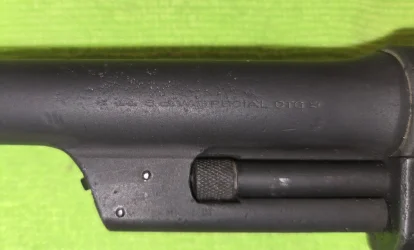
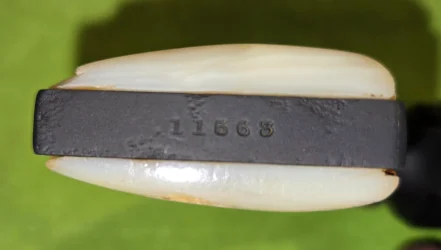
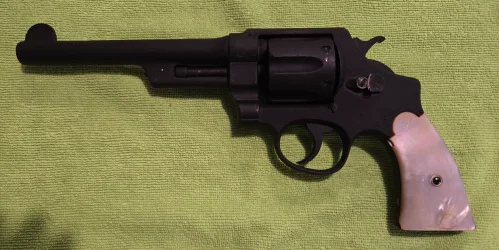

Looks like a Triple Lock with a 6.5” barrel, after market pearl grips that has been refinished at some point in its life after being rode hard. It is still an attractive piece and if the mechanics and bore are good should make a great shooter.
Measure the barrel from the end of the cylinder to the end of the barrel for us.
Measure the barrel from the end of the cylinder to the end of the barrel for us.
From the end of the barrel to the beginning of the cylinder is approximately 6.5". It was originally nickel plated. However, when I was stationed down at Fort Huachuca I sent it off to Robar Companies, Inc. for their input. They recommended putting this coating on it to cover the pitting.Looks like a Triple Lock with a 6.5” barrel, after market pearl grips that has been refinished at some point in its life after being rode hard. It is still an attractive piece and if the mechanics and bore are good should make a great shooter.
Measure the barrel from the end of the cylinder to the end of the barrel for us.
Any idea on date of manufacture?From the end of the barrel to the beginning of the cylinder is approximately 6.5". It was originally nickel plated. However, when I was stationed down at Fort Huachuca I sent it off to Robar Companies, Inc. for their input. They recommended putting this coating on it to cover the pitting.

- Joined
- Apr 13, 2012
- Messages
- 1,588
- Reaction score
- 8,211
It probably shipped around 1915.
Hondo44
Member
Welcome to the forum!Any idea on date of manufacture?
You have what used to be a very desirable and valuable S&W: the .44 S&W Special 1st Model Hand Ejector, Military model, New Century. More commonly known as the Triple Lock for its unique 3 locking devices to lock the cylinder in place.
Dates of manufacturer are not available at the factory. But they can supply shipping dates.
Here are numbers near yours with confirmed ship dates:
11308 6 ½” nickel, shipped October 21, 1915,
11370 6 ½” nickel, Aug 18, 1915
11701 shipped February 23, 1916, outlined logo
12064 6 ½”, nickel, shipped 9/1/15 to Belknap Hardware, Louisville, KY, sent back to S&W 10/46 for micro click sights
Clearly the coating was not successful and did not perform in hiding the pitting as it was recommended. What did that cost?
To confirm if it was originally nickel from the factory, you should look for the serial number in the extractor shroud under the barrel.
With bright light and magnification, search for the tiny serial # stamped in the front end of the extractor rod groove, and a 'B' in front of #. If it does not have a B for blue, it was shipped from the factory originally nickel plated.
That would be a good thing because Re-nickel plating is the only possible option to make the gun visually acceptable, if desired.
After chemically stripping the coating it needs brazing to flow brass rod into all the pitted areas. Then the surfaces leveled, and polished for nickel plating. Most nickel platers do not have that expertise but experienced firearm refinishers do. And they also know which parts are not plated to be a correct restoration. The hammer, trigger, middle lock cam plate should be color case hardened and the ejector star of the cylinder should be blued.
Of course you'd want to confirm it's mechanically functional first, even if you just want it as a shooter. What condition is the barrel bore?
Last edited:

Flygas
Member
That brings a tear to my eye.
oldmanmontgomery
Member
.44 S&W Special. How delightful. How sad is the pitting and following finish.

Looks like it sat in the bottom of the boat for a long time..44 S&W Special. How delightful. How sad is the pitting and following finish.
Hondo44
Member
Yeah it sat somewhere unprotected for awhile. But it's not as bad as many I've seen.
I wouldn't consider restoring it if it wasn't a Triple Lock with only so few ever made. I hate to think about losing another one.
I wouldn't consider restoring it if it wasn't a Triple Lock with only so few ever made. I hate to think about losing another one.
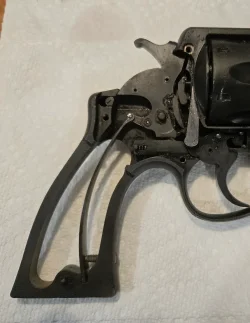
I'm having an issue getting the cylinder to release. The ejector lever seems to be in the forward position, but the ejector rod lock doesn’t seem to be releasing (no visible movement in the ejector shroud 'pin'). Any suggestions? I've attached some additional pics.
History
The pistol was originally my grandfather's and spent the majority of its time in a leather holster hanging in a barn in northern Wisconsin. My grandfather was a World War I veteran.
History
The pistol was originally my grandfather's and spent the majority of its time in a leather holster hanging in a barn in northern Wisconsin. My grandfather was a World War I veteran.
Attachments
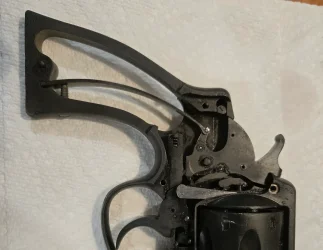
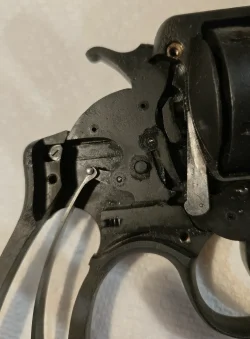
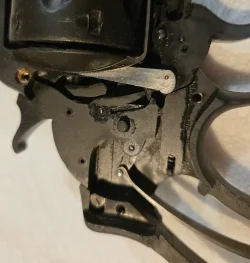
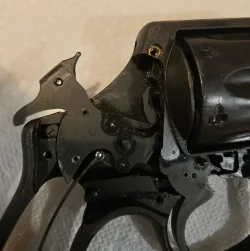

In my opinion the only proper thing to do to a family heirloom Triple Lock would be to take it to a gunsmith and get it into good working order and then have it refinished back to nickel.I'm having an issue getting the cylinder to release. The ejector lever seems to be in the forward position, but the ejector rod lock doesn’t seem to be releasing (no visible movement in the ejector shroud 'pin'). Any suggestions? I've attached some additional pics.
History
The pistol was originally my grandfather's and spent the majority of its time in a leather holster hanging in a barn in northern Wisconsin. My grandfather was a World War I veteran.
It will be pricey but that is a highly sought after piece, and with that history, well it would be worth it to me. Oh, and get a letter on it first…
Oh and, whoever Robar is, they certainly didn’t do you any favors…
Can you recommend a reputable place to do the restoration and what does that typically cost?Oh and, whoever Robar is, they certainly didn’t do you any favors…
I don’t know anyone, but hopefully someone can chime in and we’ll both know.Can you recommend a reputable place to do the restoration and what does that typically cost?
Price…I can only imagine it would be several hundred or into a few thousand, but that is a gun I would do it with.
Hondo44
Member
No wonder! Hung in a barn in Wisconsin.
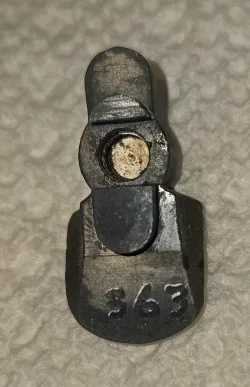
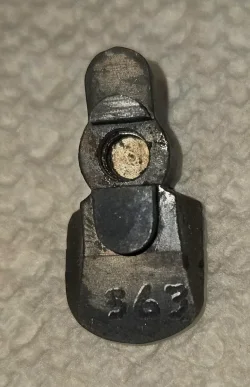
Thx for the additional photos, I learned something; we always thought the TL had the serial # stamped in 7 locations, 10 if it had target sights.
But this photo shows the last 3 digits on the back of the thumb release, so that makes 8 locations. Now I've got to go thru my TLs and other pre war models and check that location.
The extractor rod rod hang up is not unusual on old guns in poor shape. There are numerous points to check and lubricate the extractor rod, They all need to be sprayed liberally with a quality gun cleaner:
The front 1st locking lug, at the top,
and the 2nd middle locking lug in the extractor rod housing that engages the cam lock in the yoke,
The extractor rod and center pin inside in the center of the cylinder
The 3rd locking lug in the breech face where the center pin locks the cyl closed under thumbpiece shown in your photo with the side plate off.
Cost to restore the finish is not the same as a refinish so it doesn't have a fixed cost, it's determined based on the work needed.
I haven't needed their services or talked to any of these in 5 years but here's those with the best recommendations:
The following are some refinishers that have been given high marks for their work on Smiths. Some may be able to re-roll mark the S&W trademark logo, but you'll have to check with them.
Here's some of the true professionals who have the skills of a Master finishing:
Professional Gunsmith - Accurate Plating & Weaponry | Cogan Custom
https://apwcogan.com/
Possibly the best all around metal finisher. They don't offer a Colt Royal Blue type mirror polish.
Glenrock Blue Phone: 307-436-2330 Email: [email protected]
Possibly the best bluing operation. Many top custom gunsmiths used them when they want the absolutely finest quality blue job. They offer a true mirror polish finish.
Precision Bluing | America's #1 Bluing Company!
https://precisionbluing.com/ (See time lapse photography of a gun rusting)
Ron's Gun Shop - 262-255-4920, Milwaukee, WI
A top restoration service that can also replicate, not reproduce, original S&W carbonia blue.
https://www.ronsgunshop.com/
Custom Shop, Inc. Montana
https://www.customshopinc.com/
They specialize in S&W revolvers
Thx for the additional photos, I learned something; we always thought the TL had the serial # stamped in 7 locations, 10 if it had target sights.
- Grip frame butt (prefixed by a letter(s) following WWII except I frames) - or fore strap on I frame Regulation Police models and single shots with grips that cover the butt.
- Barrel - bottom of barrel or in extractor shroud, (Triple locks have tiny #s stamped in front end of the shroud; sideways/vertical if over 3 numerical digits, otherwise horizontal).
- Yoke - on rear face only visible thru a chamber with a flashlight (except the .32 Model 1896 and no doubt a few others).
- Extractor star – backside (which is actually the side facing the muzzle).
- Cylinder - rear face.
- Right stock only - on back, scratched or penciled depending on vintage and stock material, stamped after 1929, (except most post war target grips because individual fitting not required.)
- .44 TL models only: rear side of middle lock cam plate (Triple Lock models only)
But this photo shows the last 3 digits on the back of the thumb release, so that makes 8 locations. Now I've got to go thru my TLs and other pre war models and check that location.
The extractor rod rod hang up is not unusual on old guns in poor shape. There are numerous points to check and lubricate the extractor rod, They all need to be sprayed liberally with a quality gun cleaner:
The front 1st locking lug, at the top,
and the 2nd middle locking lug in the extractor rod housing that engages the cam lock in the yoke,
The extractor rod and center pin inside in the center of the cylinder
The 3rd locking lug in the breech face where the center pin locks the cyl closed under thumbpiece shown in your photo with the side plate off.
Cost to restore the finish is not the same as a refinish so it doesn't have a fixed cost, it's determined based on the work needed.
I haven't needed their services or talked to any of these in 5 years but here's those with the best recommendations:
The following are some refinishers that have been given high marks for their work on Smiths. Some may be able to re-roll mark the S&W trademark logo, but you'll have to check with them.
Here's some of the true professionals who have the skills of a Master finishing:
Professional Gunsmith - Accurate Plating & Weaponry | Cogan Custom
https://apwcogan.com/
Possibly the best all around metal finisher. They don't offer a Colt Royal Blue type mirror polish.
Glenrock Blue Phone: 307-436-2330 Email: [email protected]
Possibly the best bluing operation. Many top custom gunsmiths used them when they want the absolutely finest quality blue job. They offer a true mirror polish finish.
Precision Bluing | America's #1 Bluing Company!
https://precisionbluing.com/ (See time lapse photography of a gun rusting)
Ron's Gun Shop - 262-255-4920, Milwaukee, WI
A top restoration service that can also replicate, not reproduce, original S&W carbonia blue.
https://www.ronsgunshop.com/
Custom Shop, Inc. Montana
https://www.customshopinc.com/
They specialize in S&W revolvers

As for the work done by Robar, that company evolved into ArmorLube with their NP3 and NP3+ teflon type plating. My gunshow partner, Steve, recently acquired a 29-2 that, after being returned to S&W, was later refinished by ArmorLube. The NP3 is a really slick finish and what surprised me was the fact that all internal parts (other than the springs) received the plating as well as the exterior. The action on this revolver as amazing. Not knowing the condition of his gun prior to the NP3 plating, I am certain it was much better than the Triple Lock being discussed here. The barrel on Steves 44 Magnum was ported during the plating process, which was a service ArmorLube also provided. No pictures of the gun, but I will get some and post them in another thread.

I remember Robar as being somehow a blend of nickel and teflon...I never understood the exact procedure, but I have bought and traded for guns that received the finish, and the actions were always very slick and consistent... ...Ben
...Ben
Major 2
Member
Having seen your gun's photos, I am not a fan of Robar.
IMHO it's butt ugly, course that's my opinion and not meant to be offensive.
Being the gun is a desirable Triple Lock and with granddads history, I believe I would get it restored. Knowing full well the value is only in the provenance and as an heirloom.
IMHO it's butt ugly, course that's my opinion and not meant to be offensive.
Being the gun is a desirable Triple Lock and with granddads history, I believe I would get it restored. Knowing full well the value is only in the provenance and as an heirloom.
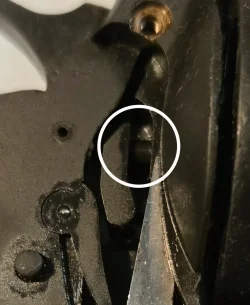
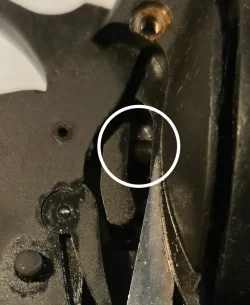
So you can't open the cylinder?Should the circled 'center pin' be able to go in farther than it is now? Because it won't go any further.
Bolt won't push it. Might need to disassemble and remove bolt to push the pin if that's the issue. Soak with Kroil see if pin will break loose.
Hondo44
Member
Your photo doesn't show the cylinder center pin, which can't be seen inside the action. It doesn't protrude thru the breech face. What shows in your photo is the short stud on the front of the rear cylinder lock. It needs to be pushed all the way forward until it doesn't show.
What you need to know that's different on the TL from all other Hand Ejectors:
The Triple Lock has three cyl and yoke locks, one additional to the usual two locks of other Hand Ejector models: front under the barrel at front of extractor rod and at rear back of the cyl in the recoil shield. The middle or 3rd lock, hence the nickname "Triple Lock", is in the yoke at the front of the cyl. They all release simultaneously with a push of the cyl release thumb piece. The locking cyl center pin is sprung to the front, opposite from any other N frame, therefore there is no 'divot' in the TL recoil shield unlike all other N frames.
The three locks. The #1 lock is actually U shaped with two locking bolts, one short on top and a long bolt on the bottom which goes all the way back to the yoke.
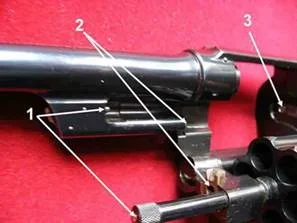
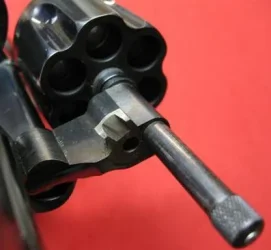
Is the thumbpiece movable??
What you need to know that's different on the TL from all other Hand Ejectors:
The Triple Lock has three cyl and yoke locks, one additional to the usual two locks of other Hand Ejector models: front under the barrel at front of extractor rod and at rear back of the cyl in the recoil shield. The middle or 3rd lock, hence the nickname "Triple Lock", is in the yoke at the front of the cyl. They all release simultaneously with a push of the cyl release thumb piece. The locking cyl center pin is sprung to the front, opposite from any other N frame, therefore there is no 'divot' in the TL recoil shield unlike all other N frames.
The three locks. The #1 lock is actually U shaped with two locking bolts, one short on top and a long bolt on the bottom which goes all the way back to the yoke.
Is the thumbpiece movable??

45NUTT
Member
It would be nice if you could ressurect that old Triple Lock!

A couple more restoration options to consider.
As for the stocks, they are poor fitting MOP that were not original to the revolver. Pearl stocks of the era would have had gold medallions, bout most were concave diamond walnut service stocks prior to 1910 and gold medallion diamond walnuts throughout the teens.
As for the stocks, they are poor fitting MOP that were not original to the revolver. Pearl stocks of the era would have had gold medallions, bout most were concave diamond walnut service stocks prior to 1910 and gold medallion diamond walnuts throughout the teens.
Sure sounds like the center pin is corroded. If soaking it from the barrel locking bolt end doesn't get it free. My suggestion to disassemble would be necessary. Since you already have sideplate off, that's what I'd be looking at. Remove hammer, then bolt and carefully get to the end of center pin to tap it free through the rear of recoil shield.The thumb release moves in a rearward motion only, approximately 1/16". Once released, it returns forward to its original position.

Last edited:
Hondo44
Member
That should only be when the cylinder is open! In all your photos I can see the locking bolt/connected to the thumb release is all the way back. That would mean you have to hold the thumb release to the rear to cock the hammer, is that correct?The thumb release moves in a rearward motion only, approximately 1/16". Once released, it returns forward to its original position.
The normal at rest position of the release is fully to the rear. And prevent the cylinder from opening when the gun is cocked.
The thumb release should normally move about an 1/8" forward to open the cylinder, and stay in that position until the cylinder is closed,
You have to get cleaner into the front end of the cylinder center hole which is harder when the cylinder is closed. But if spray enough into the space where the front end of the cylinder rotates against the yoke around the extractor rod, it will migrate to the center pin inside the cylinder.
Is this the way it was returned to you from Robar? Or were you able to open the cylinder when it was returned???

handejector
Staff member
- Joined
- Mar 17, 2005
- Messages
- 31,152
- Reaction score
- 48,452
I'm having an issue getting the cylinder to release.
Should the circled 'center pin' be able to go in farther than it is now? Because it won't go any further.
Did it function correctly when you got it back from Robar?
That part is called the Bolt. Yes, it should go further in than that. Is the spring and plunger still in the rear end of it? When the thumb latch is attached, it should NOT come far enough to the rear to be out of the hole in the frame. If it will, something is wrong. Robar may have bent the bolt by forcing it when they disassembled the gun.
See if you can wiggle it back into the hole and attach the thumb latch.
handejector
Staff member
- Joined
- Mar 17, 2005
- Messages
- 31,152
- Reaction score
- 48,452
Can you remove the hammer? If so, remove it and the cylinder and the bolt and check to see what is blocking the hole in the frame. Maybe some of that finish has flaked and is plugging it. Maybe dried oil. If the hole is clean, it may be a bent bolt. Get it all clean and see if the bolt will slide freely into the hole.View attachment 900311
View attachment 900313
That part is called the Bolt. Yes, it should go further in than that. Is the spring and plunger still in the rear end of it? When the thumb latch is attached, it should NOT come far enough to the rear to be out of the hole in the frame. If it will, something is wrong. Robar may have bent the bolt by forcing it when they disassembled the gun.
See if you can wiggle it back into the hole and attach the thumb latch.
Similar threads
- Replies
- 31
- Views
- 987
- Replies
- 3
- Views
- 108

- Replies
- 15
- Views
- 854


