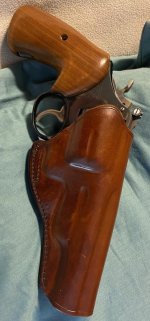
Hello, I'm shopping for a custom holster for 3" M13. Looking at several makers, Wright, Lobo, Sparks, Kramer, to name a few. Some of the makers offer a suede or smooth lining and charge for the extra option.
My questions are, do these linings offer any value? Do the reduce wear to the gun finish? Do they add bulk?
Curious and not sure I want to spend the extra $$. Any suggestions are appreciated.
Let's take a more scientific view for the answer. A leather lining in a veg tanned leather holster is not a functional feature, like power steering on a '60s Chevelle; it's an ornamental feature like a vinyl top on that car.
Meaning, that when the veg leather has been pasted and rolled completely smooth at the tannery, and the holster maker has detail molded the leather to the pistol (both of which began in the '60s), the lining does nothing for the pistol's finish than one gets from the veg leather itself.
The smooth 'flesh' side is as smooth as the grain side (outermost layer) of both cowhide and horsehide, and the molding's original purpose was to fit the pistol so well that there were no high spots left in the leather to wear the pistol; and to keep the pistol from shifting inside the holster which then creates muzzle wear, for example. If it's NOT it's because the holster maker has chosen his leathers poorly, or has chosen to split his own leather thicknesses with a bandsplitter.
The first engineered holster, that is best known as the Brill, had a lining -- only on its fender to protect the pants, and virtually none of its lining was inside the holster. Like the infamous red dress, the lining was not there for the pistol but for the clothing.
Now I'm speaking of the thin linings one would find on a concealment holster. When one chooses a double thickness cowhide holster the game changes because it's not 'lined' in the same sense. Now the holster is thick, it's heavy, it's stiff and best suited to a gunbelt. In this case the two layers, when glued and stitched, stiffen the holster to the point where even a metal stiffener is no longer needed! And this is why an Askins Avenger stays open at the mouth w/out metal: the layered area refuses to lay flat with the rest of the thinner holster.
The absolute ideal is unlined horsehide. There is only one tannery in the West so all makers use horse 'strips' from Horween; 'shells' are stupidly expensive and used only for expensive men's shoe soles. The flesh side of the Horween leather is so smooth one can't FEEL any difference between it and the grain side. Horsehide is also so thin, but stiff, that one can never end up with a holster that is too thick, heavy and bulky. But few makers use it (and I wouldn't use anything else.
When suedes (splits) are used the added layer only takes away from holster stiffness because the cowhide m/b thinner -- the patterns were designed around unlined. The holster then becomes softer; and the total layers resist precise wet detailing to the pistol.
So: I recommend you simply skip the lining if its performance and light weight you value, and a detailed molding for wear (and darned, it looks good, eh?).