(More) Help with Identification

PNHNDLR

Member
Joined
Dec 25, 2018
Messages
9
Reaction score
16
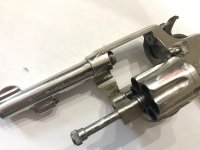
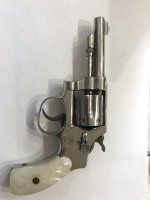
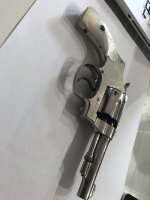
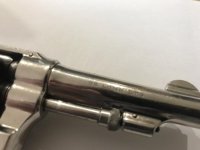
You guys were a huge help identifying my great-grandmothers gun, so I went through the safe and found another gun I would like some more information on. Here are the details:

Hand Ejector
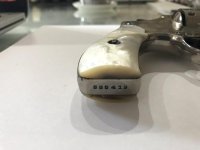
SN: 385419
32 Long
3 1/4” barrel
Sights: Hand Ejector Fixed Rear Sights

Extra Data
Strain Screw: Yes
5 Screw
Mother of Pearl hand guard
 

Attachments

  • IMG_0757.jpg
    IMG_0757.jpg
    43.5 KB
  • IMG_0755.jpg
    IMG_0755.jpg
    26.7 KB
  • IMG_0753.jpg
    IMG_0753.jpg
    30.8 KB
  • IMG_0754.jpg
    IMG_0754.jpg
    38.9 KB
  • IMG_0756.jpg
    IMG_0756.jpg
    27.7 KB
32 Hand Ejector, Third Model that would have shipped around 1925. The stocks are a toss-up on whether they are correct or not. It seems that the practice of adding medallions to the MOP stocks stopped in the 1920s, but no knowledge if it was mid of late-'20s. If the stocks are thin, they are after-market and if they are ad thick as the hard rubber stocks, they might be factory.
 
Same as the other one, except that this one dates to between mid 1922 and the late 1920s. The grips may be replacements.

You guys work quick.... So I have my hands on two 32 Hand Ejector Model of 1903 5th Changes.... interestingly enough, both are from different sides of the family. This one my mother carried in her purse when she was closing the family store in the 70's and 80's.

Thanks again.

Is there anything that's stumped you guys?
 
32 Hand Ejector, Third Model that would have shipped around 1925. The stocks are a toss-up on whether they are correct or not. It seems that the practice of adding medallions to the MOP stocks stopped in the 1920s, but no knowledge if it was mid of late-'20s. If the stocks are thin, they are after-market and if they are ad thick as the hard rubber stocks, they might be factory.

Thank you. After dinner I will get the two out and compare the thicknesses.
 
32 Hand Ejector, Third Model that would have shipped around 1925. The stocks are a toss-up on whether they are correct or not. It seems that the practice of adding medallions to the MOP stocks stopped in the 1920s, but no knowledge if it was mid of late-'20s. If the stocks are thin, they are after-market and if they are ad thick as the hard rubber stocks, they might be factory.

What makes you think its a "3rd Model" vs a "5th Change?"

I am still trying to learn all these terms, but it seems as the opinion on my previous post was 5th Change and that was a lower serial number than this one.

Thanks for the input and helping me learn the history of these guns.
 
I was incorrect on my post above. I should have stated it was a third model, rather than a .32 Model of 1903, 5th change. I have changed my post.

The difference is that a new hammer block arm is present in the 3rd model.

Get a copy of the Standard Catalog of Smith & Wesson-4th edition, written by Jim Supica and Rick Nahas. It details the information on S&Ws.
 
Last edited:
I was incorrect on my post above. I should have stated it was a third model, rather than a .32 Model of 1903, 5th change. I have changed my post.

The difference is that a new hammer block arm is present in the 3rd model.

Get a copy of the Standard Catalog of Smith & Wesson-4th edition, written by Jim Supica and Rick Nahas. It details the information on S&Ws.

Can you expand on the difference between the 5th Change and the Third Model? Is it more than the the hammer block you discussed? Is the other gun I put up a 5th Change and this is a 3rd Model?

At least this isn't confusing at all!
 
Can you expand on the difference between the 5th Change and the Third Model?
The first thing you need to understand is that this "1st change," "2d change" etc., stuff is entirely artificial. That isn't to say it is "wrong," but that it was invented by a couple collectors in the 1930s to help collectors identify engineering changes that were made to various models over time. These are not model designations per se and were never used by the factory, nor did that language appear contemporaneously with the guns. They are strictly collector-speak.

With respect to the .32 Hand Ejector, S&W made the First Model in 1896. A redesign was implemented in 1903 and that became the Second Model, or Model of 1903. There was no alteration of that basic design again until 1919, when the Third Model was released. It looked the same as the Second Model externally, but the lockworks were improved significantly with the addition of the new hammer block safety device.

The Second Model lasted from 1903 until the end of 1918. Yes, there were engineering improvements during those years and collectors like to make note of them. But they were not considered model changes by the S&W company. An analogy can be made with more modern guns - for example, the .38 Combat Masterpiece. You see the Model 15-1, Model 15-2 and Model 15-3. Engineering changes are reflected by the dash numbers, but it is the same model gun.

I hope this helps.
 
Last edited:
Yes, the 1st .32 you posted is a Model of 1903-5th change and the one in this post is a .32 Hand Ejector third model. The only difference I can find is the new hammer block arm.

Be aware these are names given to the firearms by collectors, not by the factory.
 
385419
On my list are SN 379xxx which shipped in 10/1923 and SN 381xxx which shipped in 8/1924. As S&W did not ship in SN order, there is no way to get an exact shipping date unless you are willing to pay $75 per gun to get a historical letter. Just assume 1923-24.
 
The first thing you need to understand is that this "1st change," "2d change" etc., stuff is entirely artificial. That isn't to say it is "wrong," but that it was invented by a couple collectors in the 1930s to help collectors identify engineering changes that were made to various models over time. These are not model designations per se and were never used by the factory, nor did that language appear contemporaneously with the guns. They are strictly collector-speak.

With respect to the .32 Hand Ejector, S&W made the First Model in 1896. A redesign was implemented in 1903 and that became the Second Model, or Model of 1903. There was no alteration of that basic design again until 1919, when the Third Model was released. It looked the same as the Second Model externally, but the lockworks were improved significantly with the addition of the new hammer block safety device.

The Second Model lasted from 1903 until the end of 1918. Yes, there were engineering improvements during those years and collectors like to make note of them. But they were not considered model changes by the S&W company. An analogy can be made with more modern guns - for example, the .38 Combat Masterpiece. You see the Model 15-1, Model 15-2 and Model 15-3. Engineering changes are reflected by the dash numbers, but it is the same model gun.

I hope this helps.

Thanks. This really helps clear it up. Thanks for taking the time to do that.
 
Back
Top