Need help identifying tip-up

Joined
Nov 7, 2013
Messages
3
Reaction score
0
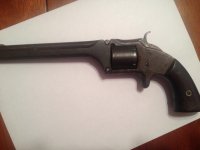
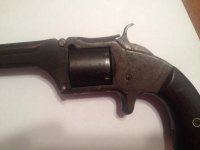
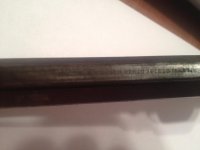
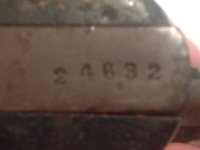
Hi, I just received this from a family friend and have no idea what model it is or any other details such as caliber, manufacture date, value, etc.. Any help would be greatly appreciated. I have attached pictures and one includes what I believe to be the serial number on the butt and the other is the markings on the barrel showing Smith and Wesson......there are no other markings.

The barrel is 6".

Thanks,

Mick
 

Attachments

  • photo 1.jpg
    photo 1.jpg
    43.6 KB
  • photo 2.jpg
    photo 2.jpg
    46 KB
  • photo 3.jpg
    photo 3.jpg
    35.6 KB
  • photo 4.jpg
    photo 4.jpg
    66.6 KB
Welcome! You have a model 2 Army in .32 Rimfire. It may have been shipped late in the Civil War time frame or just after, but there are several antique collectors here on the Forum that can provide more specifics. Is there any family history with it? Hope t
his is helpful.
 
Alan - thanks for the very helpful and quick reply. I am in the process of getting as much history on the firearm as I can, but as of right now I don' t have any.
 
Welcome to the Forum. Your revolver would have almost certainly been shipped in 1864. It appears that it has a 6" barrel, but there are some problems to discuss. This Model should have an ejector rod under the barrel to assist in pushing out spend casings from the cylinder. It also looks like the pivot screw has been replaced, maybe to tighen up a loose hinge. The weakest point on a Model 2 design is the hinge, since it would often loosen with use and make the barrel wobble on the frame.

The Model 2 Army, as it was called, was a major advancement in technology, since before its introduction, only cap & ball or small caliber rimfire handguns were available. With the start of production in 1861, this six shooter immediately became very popular as a private purchase gun during the civil war. Production ended in 1874, with over 77,000 made. If you can find 32 rimfire ammunition, these revolvers still shoot great and most are still very accurate.
 
Gary - Thanks for the info. I was wondering about the ejector rod as well, but the hole where it should go is solid. I am not sure if it was done after the fact, but it looks professionally done if so. I have attached additional photos for your review.

D3B5DA8C-951F-4654-A3CB-DD14B1BF18EE-1447-0000009209294DA1_zps5ddb8d34.jpg

91CE624B-22B9-4E8D-8F46-D07BC0DD19C6-1447-00000091FD4B99B6_zpsd3df3ff5.jpg

5E1B38FE-08FE-4086-B92F-B55CDF57C9C6-1447-00000091F0ED540D_zps826def12.jpg

CA77A73E-8ADD-481C-A230-FC916084C6CA-1447-00000091E540E1F2_zps7287d0e5.jpg
 
I'm not sure what the photos are supposed to tell us. They don't show where the ejector rod "hole" is plugged. Can you photo that ( in focus?) Ed.
 
I guess in identifying a gun and its model, one must never assume that what applies to one make or model is exactly applicable to another. You will find the gun maker's name stamped or engraved on the weapon. From there, an Internet search can often lead you to the model. Enter the gun manufacturer and a few descriptive words. Then browse through images until you find your gun. If you still cannot determine the make and model, a good local gunsmith may be able to identify your weapon for you:) I hope this helps.
 
Howdy

This is what your #2 should look like. The ejector rod is fastened in a hole in the front of the frame and secured by a small screw from underneath. Do not confuse this type of ejector rod with the ejector in a modern revolver. To use the ejector, the cylinder was removed and the empties were popped out by poking the rod into each chamber. The hole in your photo is the hole for the nub at the front of the cylinder rides in.

The SN on this #2 is 142XX and it shipped in 1863.

No2OldArmy02_zps0c4ea28a.jpg
 
Judging from your photos, I believe you are mistaking the indentation in the rear of the barrel, just below the bore, as a "plugged" hole for the extractor. That indentation is for the cylinder pin, or axle, not for the extractor. The extractor "hole" is on the front side of the barrel above the latch and does not extend through to the rear of the barrel. Ed.
 
Back
Top