Need recommendations for -

Joined
Jun 25, 2017
Messages
1,312
Reaction score
2,402
City & State/Province
NYS
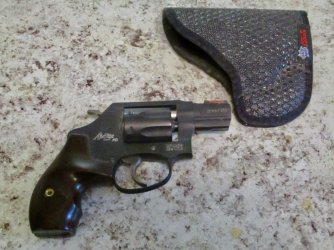
A friend just got his carry license and has asked me to recommend a small, simple handgun. Given the fact that he needs to learn how to shoot and practice regularly, I thought he should start out with the new S&W Model 36 that came out, rather than complicate things for him and eliminate him knowing very little and fiddling with a semi-auto.

I'd like to know your recommendations as well. Please post your suggestions - and thank you.

Rich
 
Just remember that snub .38’s are darn tough to master. Short sight radius, decent amount of “kick” and a pretty loud blast. I love J frames but imho they are NOT a beginner’s gun. I had a lady from church that I taught to shoot a few years ago. ‘Expert” at a local shop had sold her a 642. Girl had Never fired a gun in her life. I put her gun away and started teaching her with a .22. Meanwhile I showed her the “lay a penny on the barrel and smoothly pull the trigger without knocking the penny off” trick and had her practice it at home until she got pretty good at it. She had developed confidence in shooting using the .22 but the kick from the .38 was still disturbing to her the first few times. I believe if the first thing she’d fired had been the .38 she would have given up. She wound up being very comfortable with her J frame. But it took a while.
 
A revolver, I think, is the simplest handgun when it comes to manual of arms. Semi-auto pistols require the loading of and insertion of a magazine, plus chambering a round from the magazine and possibly a manual safety. Revolvers require opening the cylinder, insert rounds, close the cylinder and it's ready to go. Revolvers also are less prone to a negligent or accidental discharge. Both require attention to detail when it comes to cleaning and maintenance, but revolvers usually do not require disassembly.

For carry, a J-frame revolver is tough to beat. Aluminum or scandium frames do save weight, but the frame can crack in the crane recess, just under the barrel, and that destroys the frame. Steel or stainless steel J-frames weigh more, but are far more durable. Any J-frame, however, is going to be difficult for a new shooter to master. J-frames do not have the grip size, sight radius, nor the lock work to make them amenable to learning to shoot. I'm not saying that it is impossible, but I feel that it is difficult and would require a lot of determination and trigger time, both live and dry firing.

I agree with Shibadog, a .22LR handgun is a far better learning tool and it costs a whole lot less to buy .22LR by the hundreds than it does to buy any centerfire cartridge. Even if it involves going to a range where handguns can be rented, it's better to learn with a .22LR, then transition to a .38 Special. When I started shooting handguns, I did start with a .357 Magnum revolver, but it was a Dan Wesson with an 8 inch barrel. Big, heavy, long sight radius, all of that made learning easier, but even with that, my next handgun purchase was Ruger Mk II Government Target, which is a .22LR pistol, just so that I could shoot a whole lot more.
 
Last edited:
The 351 PD is a nice light low recoil revolver in 22 WMR. I just put in in a pocket holster and shove it in my pocket for daily early AM 4 mile run in the N Idaho forest. I think it's a decent choice for someone new to guns. I only wish it had an adjustable rear sight but it seems like that's not very common for revolvers in this category. Another good one is a Ruger LCRx which has an adjustable rear sight.

IMG_2418.JPG

(I'm switching to a chest rig soon with something bigger with all the wild animals up here.)
 
I am not a fan of rimfire's as defensive weapons. There is a higher chance of a rimfire going "click" instead of "bang" than with a centerfire cartridge.


I'm not one that believes a J frame is a good idea for a new shooter. And I'm a guy that loves revolvers. If you want to start a new shooter with a revolver it should be a K or L frame and have a 4" barrel, but then it's not a great concealed carry gun in many if not most circumstances. So have him buy a nice K-22 to learn and practice with and a nice round butt K frame snubbie 38. What? He doesn't want to drop $1500 to $2500 to start out with?

Taurus G3C 9mm for less than 3 bills (Possibly as low as $235). There's a Taurus rebate for two 25 round boxes of Hornady carry ammo. The current affordable price of 9mm ammo makes the 9mm the ticket. The gun is cheap enough that he can move up to something else when he's ready as he won't be too heavily invested in this one. UPC 7-25327-94045-6 comes with a 10 round mag and a IWB holster. I'm guessing 2 mags. UPC 7-25327-94044-9 comes with the 12 round mags and the holster.

I won't claim it's the best gun but it's a good starter gun. I've found the series to be reliable. The 9mm recoil should be very acceptable for a new shooter. The G3C is no target gun and is just combat accurate but at 9mm ammo prices can be a fun plinker.

Yeah, I realize this is a thread in a S&W revolver sub-forum. Sorry...well not really.
 
I’ve bumped into this question several times and always recommended a Model 15, or something similar. I’d not suggest any J-frame to a beginner.

I’ve never thought of semi-automatic pistols as being especially complicated but if your friend is averse to them, that’s ok. There’s nothing wrong with a 6-shot revolver, for most of us. After he gets comfortable at the range with a nice, easily handled revolver like a Model 15, he will have acquired enough experience to consider other weapons, if he thinks it necessary. A good student can learn a lot in 1000 rounds, shooting 50 at a range session.
 
Post 1,
Another "no" regarding a Mod. 36 S&W for a 1st/only handgun.
I'm actually surprised NY will even issue a permit without the person getting some type of prescribed training, some of which would expose the carry holder to different firearms. Even so, congratulations to that future handgun carrier.

The Mod. 36 (probably a 2" barrel version) might be good from contact shots out to whatever distance (an initial goal might be 5 yards) the user will become/feel competent in a given scenario and with limited capacity; and with arguably more difficulty in reloading. To go from 5 to 10 yards in competency could be training and practice with another 1000 rounds (~$500 ammo cost alone) of shooting.

OP, I suspect you've got some variety of handguns which, perhaps, you'd be willing to let your friend handle and shoot. I don't believe new shooters have to start with a revolver or a .22LR or similar. AFAIK, many, if not, all police (and military) academies aren't bothering with revolvers or .22LR-type handguns nowadays. Instead, the generally-issued handgun is likely used for training right from the start. Alternatively, if personally-owned-weapons are used, then a handgun from a list or being approved by management is another possibility.

Post 7, the money will need to be spent to, not only purchase the initial hardware, but for ammo and training. That $2500 is a good estimate.

https://www.corneredcat.com/contents/Whether male or female, do read the "Choosing a Firearm" article in the referenced old website for further guidance.

Many things come to mind for a new concealed handgun carrier, which may include:
-cost
-size/weight/dimensions
-caliber, ammo types
-holsters (could be several)
-any physical limitations of the carrier/user/buyer/owner
-reliability
-ability to maintain
-perhaps other accessories wanted (like grips, etc.), to include cleaning gear; personal protective equipment (PPE); storage

It should instill confidence along with the user's training & proficiency.
It should be something the user will carry/use.
There may be needs for more than one firearm, due to different carry circumstances; or even just a spare should the primary go down for any reason.

OP, maybe let us know what this friend ends up getting.
 
A revolver for someone new to learn shooting basics (site picture, trigger control, etc, is ok. But,I would not recommend a snub nose revolver. As has been mentioned they are difficult to master and even then difficult to shoot well due to the very short site radius and recoil. There are so many striker fired "wonder nines" available today that are much easier to shoot and really are not that difficult to learn to use. Other than loading a magazine and wracking a slide the triggers feel much like a double action revolver. I've taught young nieces, nephews, and my own wife and daughter how to safely and efficiently operate semi-automatic pistols. SA/DA pistols such as the 1911, CZ75, etc. require a little more training because of the manual safeties or decockers.
 
The 36 is a great carry gun but IMHO it is not for the beginner. Snub nose revolvers require more training to be proficient at any distance. That goes for the tiny semi autos that are popular now.

The question to ask. Is how much training is the new permit holder willing to commit to? Live fire and dry fire. I am huge believer in dry fire. I have run the gamut from people who are willing to commit to huge amounts of training and some that feel the bare minimum are good enough. And having the funds to commit to training is also at play. M

Another thing to consider is current LE trends. Police academy’s are designed to bring a non shooter up to a set standard in a minimum amount of time. Someone who has never handled a firearm before is given a full-size firearm and brought to a set standard usually in a weeks time. That’s it. The era of police being experts with pistols are long gone. Yes there are exceptions but today’s police are not usually gun people.

So my nod is to a full-size 9mm such as a Glock 19, 17, 19x, 47 etc. you can get LE turn ins for 300-400. And I think the 19 would fit the bill. It can be concealed fairly well, proficiency can be mastered fairly quickly and it’s 9mm, so it will be cheap to shoot.
 
My brother, I love revolvers with all of my heart and soul. I think mechanically a fine revolver is a work of art. I've heard them referred to as a "watchmaker's gun," and indeed, they are marvels of intelligent mechanical design. I am fascinated with them for this reason.

All that said, and no offense to those who advocate them for carry guns... I'm personally not a fan of a revolver as a self-defense carry gun against 2-legged predators. I just think they aren't very size-efficient for their capacity. Even a small J-frame is wider than a subcompact semiauto, and usually with up to half the round capacity to go along with the tradeoff.

I've never bought into the whole "better reliability" argument when comparing revolvers against a GOOD semiauto. I've never found that to be true. I've never had any reliabiity issues after firing many thousands of rounds through quality, proven semiautos with good defensive ammo my guns like. It seems intuitive that revolvers would be more reliable, but they are also more open and susceptible to debris getting into places it shouldn't and locking up the action. In the event you need to reload, revolvers are much slower if you're not Jerry Miculek. You have much more rapid follow-up shots with a semiauto than with a revolver, again unless you're Jerry Miculek, due to lower bore axis and having a more stable grip on the gun by not having to worry about parts of your hand intruding on a revolver's cylinder/forcing cone gap. That aspect of revolver operation is one that could hamper a beginner's ability to apply sufficient grip placement to best control the gun.

Some complain that racking slides are difficult for them, but that is really a training issue. I taught my arthritic mother-in-law how to rack the slide of her Shield despite her complaining that she "couldn't do it" and despite her low hand strength. She also isn't gun savvy and had no problem quickly learning how to operate her Shield. It really isn't any more "difficult" for a beginner to learn to operate a semiauto than it is a revolver. I guess loading magazines is more cumbersome than loading cylinders, but in exchange, you are rewarded with higher capacity and if you're carrying pre-loaded spares, reloading is much faster. Otherwise, what is there to know that's so different? If you select one without an external safety, it's still just point and pull the trigger. A slide release is analogous to a cylinder latch. Yes, you also have a mag release button, but that isn't hard to commit to muscle memory. What else would make the manual of arms more difficult to master?

...and... if one is committing to carrying a CCW, one damn well better also commit to lots of training with their chosen weapon or it could be as much a liability as an asset in a high stress encounter!

So, with a good subcompact semiauto, for example a Sig P365, FN Reflex, S&W Shield and the like, you get a gun that is significantly more slender and easier to conceal, clears a holster easier, allows more aggressive grip coverage and control, while at the same time offering at least twice the round capacity in the process. Today's 9mm performance is every bit as effective as .38 special, maybe more so, and I highly doubt there is any statistical difference in 9mm effectiveness vs .357 mag at defensive shot distances given good shot placement with both. And, it's easier to get good shot placement and follow-up shots with 9mm vs .357, with less muzzle flip and more follow-up shots on tap should you need them.

But there are varying schools of thought on this, and I'm not saying my opinion is best for everyone. It's just hard for me to ignore the obvious advantages of a semiauto as a CCW.
 
Last edited:
A friend just got his carry license and has asked me to recommend a small, simple handgun. Given the fact that he needs to learn how to shoot and practice regularly, I thought he should start out with the new S&W Model 36 that came out, rather than complicate things for him and eliminate him knowing very little and fiddling with a semi-auto.

I'd like to know your recommendations as well. Please post your suggestions - and thank you.

Rich
I'm with those who suggest seperating out the learning to shoot from the purchase choice if at all possible. Unless there is a pressing clear and immediate need (and I've been in such circumstances) have him learn with something that will build on safe practices and build confidence and capability.

Depending on his build, his hand strength, dextrity with mechanical things etc pick two, no more than three handguns that you think are suitable. Limit the inital introduction because spending too much time and mental energy on learning manual arms is going to be overwhelming. K-frame with .38 Spl is better than J-with +P. But the stocks and barrel etc all can make a difference.

As far as what to carry, that will in good part depend on his build, the clothing he wears, the type of work and activities, etc.
 
I also agree he needs firearms familiarization first, selection of firearms second.

Similar to newbies wanting a motorcycle. Learn how to ride first, then pick out a bike . . . not the other way around.
 
I am not a fan of rimfire's as defensive weapons. There is a higher chance of a rimfire going "click" instead of "bang" than with a centerfire cartridge.
Apparently not with .22 Magnum, from what I understand.
I think the magnum has a thicker rim with more priming compound, and thus more forgiving of less than optimum firing pin protrusion issues which plague many handguns in .22 LR caliber.
What say you guys who have the S&W .22 Magnum revolvers?
 
I've seen commentary from really savvy people about the positives of the .22 Magnum for older/weaker shooters.

But: I am in with the crowd that generally opposes a J frame. I am also in with the crowd that advocates going to a good range that has test/rental guns. Hopefully, such a place also has instructors that can start him out with basic safety and marksmanship, preferably with a .22 on a K frame or similar. Shoot the dickens out of that for initial training. 500 rounds of .22 won't cost much and won't introduce a flinch. Then, assuming a revolver is still his choice, I'd look for a decent 4" K frame in .38/.357 or the new .357 Mountain Gun. I like to buy revolvers in .357, even though I rarely shoot that round, just because if ammo is hard to find again, it gives options. A 3" RB K frame (10/13/64/65) is not a bad platform except that with my eyes, the fixed sights are not great. (If I had one, I'd look at some custom sights.) In .38, I would carry standard velocity SWC or target WC; but them in bulk (500 rounds minimum). As Jordan noted, the .38 is about the upper end of what most men can shoot well. With those projectiles, ballistic performance should be adequate.

If he gets decent training and becomes willing to shoot/carry an auto pistol, I'd look really hard at the new Glocks with Single column mags (48?, I think) and their RDS package in conjunction with Aimpoint. 9mm is roughly about the same recoil and controllability as .38 Special. Good ammo will be more expensive, I think; take a look at Doc Roberts' duty ammo recommendations and get at least 500 malfunction free rounds downrange. This option is likely to be more expensive.
 
Similar to newbies wanting a motorcycle. Learn how to ride first, then pick out a bike . . . not the other way around.
THIS!
A DA/SA .22 revolver. low recoil, low muzzle blast, both deterrents to learning. Low cost of ammo so one can shoot more. Once one is competent with a DA trigger while hitting the target, everything else is a breeze. While in the learning stage (the length of which is dependent on willingness to practice good practice) one can take their time and see what best for them. Not as fun or as cool as jumping both feet in the deep end of the pool the first time, but better results in the end. Just because your licensed to do something don't mean you have to.
 
Needs firearm familiarization and basic marksmanship classes before anything. Then as Tom posted a trip to a range with 22 revolver rental and lots of shooting. IMHO a older Mdl.10 4” barrel would be fine for his first pistol.
 
For a really long time I have recommended 22LR for new shooters.
Yes, it can be unreliable. I’ve had FTF’s lately.
But don’t recall have two in a row!
And Revolvers are usually easier for newbies than Autos.
 
I have 'J' frames, but honestly I don't count on them for SD. My regular 9mm Shield, my 9mm Shield EZ (that I'm sitting on right now), my Sig 250 (bedside) and a 'K' frame model 10 in the drawer are there for either of us. Missus Smiff has a .380 Shield EZ that she is good with that stays close to her, also. If that ain't enough, I've got several 3rd Gen Smiths I can call on as well as some heavier stuff.
 
anyone with gray hair probably learned to shoot with a 22lr rifle way back when. i still think a 22lr rifle is an excellent choice especially if one has access to an outdoor shooting venue.

only 22lr firearms offer lots of practice that is easy on both wallet and body.

if a rifle simply isnt on the table then i suggest a top end 22lr handgun but not a double action revolver as trigger pulls are stiff.

a ruger super wrangler single action revolver is super intuitive, and offers both 22lr for pleasant training and 22wmr for barking protection.

if i wanted my choice to be a ccw too then i suggest a ruger sr22 or s&w m&p compact 22lr pistol. both are handy, reliable, easy to fieldstrip (always crucial to proper gun ownership), gateways to larger caliber pistol siblings.

my first and only ccw and home defense piece for 25 years in then antigun locales was a steel taurus m85 38sp snubbie with thicker pachmayr grips. for an occasional shooter a 38sp revolver is tops, easily customize it with grips and ammo choices to suit your tolerances.
 
A friend just got his carry license and has asked me to recommend a small, simple handgun. Given the fact that he needs to learn how to shoot and practice regularly …
Beretta 25 ACP with a tip up barrel.

For some people the KISS Principle is the best thing. Most people don’t become a Gun Enthusiast with the first handgun.
 
The problem with .25 ACP is terrible ammo selection, poor bullet expansion, and poor terminal performance. I would never depend on it to protect my life. It's certainly better than nothing, but 9mm, .45, .38/.357 are your best choices for a CCW given the realities of today's ammo availability and bullet technology. Even .380 is far superior to .25.
 
Opinions are like oral cavities (mouths); everybody has one, so here's mine: You were talking about a carry gun for a friend. As an octogenarian with small hands, I think reducing recoil is a good thing, and yet a carry gun should be, well, 'carry-able'. Most of the comments here stress good training and I would heartily agree. Having said that, I would recommend a small revolver in .32 H&R Mag. (yeah, I know, 'mouse gun'). I've carried 1911s, K and N frame Smiths, and somehow these days I gravitate to the .32 H&R. Light, small, and doesn't require me to wear suspenders to keep my pants up. .327 Federal is also a good choice, but more noise and recoil and ammo is sketchy.
Trying various guns and calibers is vital; you never know what will work best for you. My oldest daughter, about 110 lbs and small hands, carries and shoots a Star PD in .45ACP; the middle daughter is happy with a Glock 19, You never know!
 
A revolver for someone new to learn shooting basics (site picture, trigger control, etc, is ok. But,I would not recommend a snub nose revolver. As has been mentioned they are difficult to master and even then difficult to shoot well due to the very short site radius and recoil. There are so many striker fired "wonder nines" available today that are much easier to shoot and really are not that difficult to learn to use. Other than loading a magazine and wracking a slide the triggers feel much like a double action revolver. I've taught young nieces, nephews, and my own wife and daughter how to safely and efficiently operate semi-automatic pistols. SA/DA pistols such as the 1911, CZ75, etc. require a little more training because of the manual safeties or decockers.
A model 18 or 17
 
Since concealed carry was only a dream, when i came of age and open carry was allowable, I started my handguning with a Ruger Single six for bunny hunting. Soon after I saw this gorgeous Colt Diamondback 22 2.5" and learned how difficult it was to shoot a short sight radius and double action. About the time I thought I had it down pat, I found out what i didn't know. I had bought a m-17 and started to shoot bullseye and learned just how bad a shot i was. Those 22's allowed me to learn at a price I could afford and it took a bit of learning I must say.
Only after I learned to shoot those,did i move on to a 27-2 6" and a 25-2 6.5". Those lead to handloading to afford enough ammo to become proficient enough for bullseye. After that, I started practical pistol and learned how to shoot double action fast and accurate enough to shoot pins.
To make this long story shorter I highly recommend a good 22 revolver shoot the hell out of it and then find a similar centerfire from the same manufacturer and learn to reload. Either that or be wealthy enough to buy at least 50 rounds of factory centerfire for practice a week till your good.
M-18 and m-15 great combo. Or 617 and 686. Or start with a 63 and J frame 38. Owned them all and depends on what fits your needs.
 
S&W M&P .22 Compact. Virtually the same size as a Shield 2.0.

Edit: Never mind, you're looking for revolvers.
 
Back
Top