New Python - Turn line?

mfholmes

Member
Joined
Sep 5, 2013
Messages
78
Reaction score
102
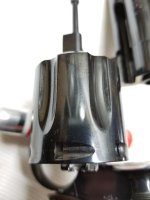
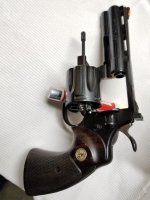
So I've almost always collected Smiths, but I've always had that yearning for a Colt Python. Well, I finally found one I couldn't resist. Early 90's, all the original gear and box. Still probably paid too much, but I'm not gonna beat myself up over a few extra hundred. Gorgeous blueing that just grabs you and looks virtually unfired. But here's the thing; there's been just enough "fondling" of this fine piece so that it has a faint turn line that will probably get sharper since I intend to shoot it once in a while. (Heck, if I can't shoot it I don't buy it. I even shoot my old original Schofield once in a while thanks to correct black powder loads from Buffalo Arms.)
Now I have plenty of Smiths from new to antique, and I just don't get the turn line issue that you see with Colts. Can anyone tell me what the deal is with the bolt in the Colt action?? Why is it prone to sticking up and giving us these turn lines, and is there anything that can be done about it. I've seen this on my old Colt SAA too, but not in my Smiths. Now most of my newer Smiths are SS, and the older ones are generally softly faded, but still - the colt cylinders seem much more prone to the turn line. Why?
 

Attachments
  • Colt_Open.jpg
    Colt_Open.jpg
    54.3 KB
  • Colt_Cylinder.jpg
    Colt_Cylinder.jpg
    35.6 KB
Last edited:
Because people can't resist fondling them.

Seriously, you can do a lot to mitigate the turn line on a Python if you learn to close the cylinder correctly. Every real gun nut knows better than to close the cylinder Hollywood style with a flick of the wrist. But many think it's proper to "roll" the cylinder in, however gently, until it locks....wrong.

The best way to close any double action revolver is to grip the cylinder with the thumb in one flute while the middle finger comes thru the frame from the backside to grip the opposite flute. Then, without allowing the cylinder to turn, it is "placed" in the frame, not "rolled" into the frame. This brings the cylinder notch into direct contact with the bolt with minimal dragging over the blank surface between the notches.

Proper closing will help to minimize the turn line. Beyond that, polishing the bolt can help as well. But if you want to shoot a couple thousand rounds with ZERO turnline, you need a 3-screw Blackhawk like this one...:)

VS04xR8.jpg
 
Now most of my newer Smiths are SS, and the older ones are generally softly faded, but still - the colt cylinders seem much more prone to the turn line. Why?

I've never noticed that Colts are more prone to turn lines than S&W's or Rugers, etc.......but it is a foregone conclusion that "all" revolvers will have a turn line if the cylinder is cycled.

You state that you intend to shoot the Python...if so, shoot it & enjoy it, and don't fret about the turn line, because it is going to happen and is perfectly normal.

Don
 
Last edited:
I always polish the face of the revolver's cylinder bolt, and then use CRC silicone on my handguns finish surface as protection.
Together, that slows the cylinder line marking capability to the bare minimum.
 
What turn line?

I suggest you study some on the Colt V spring action design to better familiarize yourself with your new gun. That wear you see is perfectly normal, the "line" is within the lead-ins, like it should be.

A Colt V spring action such as the Python will not develop a FULL turn line if the bolt drop is tuned to factory specs, which is to drop within the lead-ins, ideally the middle.

Actually, S&W revolver are pretty much guaranteed to get a turn line, fully. The bolt isn't timed on them and it falls on the cylinder, not lead-ins.

What determines how bad the line is, is the surface of the bolt. If the factory leaves a bur it will create a line immediately. Bolt head should always be de-burred. That will greatly lessen any turn line.

For the Colts, they get a FULL turn line by not aligning the cylinder before closing, and there by having to spin the cylinder until locked, all the while bolt riding across the cylinder and not the leads. Always close the Colt cylinder with a chamber ready to be lined up with the bore, it will lock immediately when closed.

A properly tuned and operated Colt will NOT develop a full turn line, just in the middle of the lead-in to the notch.

Also, if a Colt has a turn line, I would not rely on ANY unfired or brand new in box claims. Doesn't mean it could be, but probably 99% of the time it's BS.
 
See those little furrows that the bolt rides in before the locking slot. That's what it's THERE For.

Embrace the turn line. There by design.
 
If you don't want a turn line on your revolver.. don't handle or shoot it.

If you don't want the brake rotors on your car with wear lines.. leave the car in the driveway.

If you don't want the soles on your shoes worn.. don't walk anywhere.

Sounds simple I know.

Hammer nails with your gun, been done but not recommended.
 
Back in 1973, I bought a Python for "duty use" thru my Agency and I paid 167 Dollars for it. That's right,,,167 Dollars.
 
A properly timed python shouldn't develop a turn line from shooting it.Closing it without lining up the cylinder will mark it up though
 
Take 2 Valium and call me in the morning.
Doc
 
Turn line is like tire wear, and can't be avoided. You drive 10 feet out of the tire shop with new tires, you've got tire wear. ;):D
 
See those little furrows that the bolt rides in before the locking slot. That's what it's THERE For.

Embrace the turn line. There by design.

Just a point of parliamentary procedure, but the part we're talking about, at least in S&W parlance, is the cylinder stop. The bolt, again, at least in S&W parlance, is a completely different part . . .
 
Noted.

I was using, "bolt" in the generic make/model agnostic way but I hear you.
Just a point of parliamentary procedure, but the part we're talking about, at least in S&W parlance, is the cylinder stop. The bolt, again, at least in S&W parlance, is a completely different part . . .
 
Last edited:
What's a little turn line....

That's beautiful. I'm not a big Python fan but there's no denying the quality and the looks.

The only thing that bothers me about Pythons is that when I first saw one back in the 60's it appeared to be overtly made to LOOK bad. That's silly because it IS a bad gun. Unreasonable, yeah, well....
 
I bought mine 3 years ago from a bush pilot who had used it exactly for 13 shots(no,I ain't superstitious);12 shots of .38 spl and 1 shot .357 Mag.He gave me the boxes of ammo with the price tag on them.$6.95 if I remember good.The gun and ammo were bought in 1956(barrel underlug hollowed out).
When he became a line pilot,he didn't need it any more and,being afraid to have it stolen,he opened up a wall and stashed it there with brand new drywall,paint,etc.
2015,one divorce and remarriage later,he decides to add a dining room to the house and retrieves the Python.Long story short,he sells it to me for(hang on to your socks gentlemen)$600.
It didn't have a drag line when I bought it.Now,it does.So don't worry about the drag line on your Python,it is normal.Nancy Sinatra once sang that ''these boots were made for walking''...well,these Pythons were made for shooting!
 
Last edited:
Now that's what I love about this forum. No matter how dumb the question you'll get straight answers from a wide group that's here for the shootin. Glad to hear that I didn't get any lectures from collectors. Thanks for the tips folks.
 
rwsmith: Are you saying "bad" as in not very good, or "bad" as in BAD*** ? Sometimes it's a mite hard to tell w/o audio.

Larry
 
Just a point of parliamentary procedure, but the part we're talking about, at least in S&W parlance, is the cylinder stop. The bolt, again, at least in S&W parlance, is a completely different part . . .

I suspect this discrepancy in terminology dates back to the origin of Smith & Wesson. Since Colt preceded by S&W by a few years I have a hunch that S&W had concerns that Colt might have had Copyrights on the name for items such as what we call the Cylinder Stop. That likely carried over to the time when swing out cylinders were being introduced, so what we call a Yoke is called a Crane on a Colt. In addition there is the naming convention for some ammunition's such as the 38 S&W Special becoming the 38 Long Colt , something I have always found a bit amusing.

As for Turn Lines I did a bit of thought experimenting on the process that causes this. First step in the firing sequence is to release the cylinder by dropping the Stop (or Bolt). All well and good in addition to being absolutely necessary. However nice it would be if the trigger could keep the Stop down until the cylinder is just coming to the latching point doing this with a simple shaped lever on the trigger would approach impossible. In addition anything that requires absolutely perfect fit and timing will eventually wear to the point where it becomes unreliable. So, the second method to do this would require some extra "linkage", probably attached to the Hand in some manner. So, what happens when you add extra linkages to what is currently a rather simple lockwork. End result is an unreliable revolver. In addition if the cylinder misses the stop my "just enough" to permit the primer to ignite with the chamber out of line with the barrel the end result of this failure will NOT be very pleasant. In fact the shooter might suffer some rather painful injuries.

My final conclusion is that Turn Lines are actually an indicator of Safe Function so instead of finding them unsightly we should view them as an indication that our revolver is working well.
 
My final conclusion is that Turn Lines are actually an indicator of Safe Function so instead of finding them unsightly we should view them as an indication that our revolver is working well.

Thus the reason for my, "...there by design..." comment.

The designer decided better to err on the side of caution and have the bolt/stop deploy early and be guided and caught.

"Just in time" ("timing") with close to perfect reliability would not be a mass produced product.

If I ever decide to sell my 27 and the prospective buyer tries to negotiate on the basis of NORMAL use marks I'll tell him he's out of luck on that count.

Conversely, I'll never pay a "never fired" premium as there is no such thing.

"Fired very little" is a different matter.

TG
 
Last edited:
Back
Top