Nickel vs Blued

Rambler42

Member
Joined
Sep 2, 2016
Messages
238
Reaction score
410
City & State/Province
Houston, Texas
In my research about Top Break revolvers it seems that the majority are finished in nickel, and blued ones are fairly uncommon. Since a nickel finish is more expensive it seems it should be the other way around. Is it because nickel is more corrosion resistant or just what the market demanded back then?
 
"Is it because nickel is more corrosion resistant or just what the market demanded back then?" It's a bit of both. Nickel was the 'anti-corrosion' elixir back then.
 
Originally blued' guns having original factory bluing still remaining is the true rarity I think. Most have been "touched up" some?
It really depends on which manufacturer we are talking about. Some offered bluing standard and charged additional fee's for nickel finish. It also depends on what time or decade we are talking about. By the 1890's most shops were running electric equipment so nickel finish became much easier to apply in mass production. With the industry and customers of that time clearly preferring nickel finish over early bluing due to the much more durable finish that nickel is known for. Not to mention that the application of nickel finish was much easier for the industry in mass production by that same time frame. "The electrified industry" of the 1890's.
 
Last edited:
Nickel finished guns are more resistant to the corrosive effects of black powder residue.
 
I agree that there were two major reasons why nickel was popular. In the black powder days, nickel was more resistant to corrosion from use, plus many owners were unaware of the requirements to keep their guns very clean after every outing. My grandfather would only clean his 22 squirrel rifle when it became hard to see the riflings in the barrel or when the action would no longer close. Of course, by the time I was old enough to shoot it, there was no rifling left. Also, more people carried their guns in the late 1800s and they saw some pretty tough weather conditions, and nickel offered a more durable finish than blue. There was also an element of bling appeal among gun owners, especially in the late 1800s. By the time it was widely accepted that gun oil was a good thing and smokeless powder was the only ammo available, nickel sales slowed.

From 1900 on, there was no price difference between nickel and blue for S&W. While looking for finish price differences, I looked at the price lists fro 1900 to the start of WWII and found it interesting to see the price changes. I picked standard 38 M&P revolvers and came up with the following:

1900 - $14
1906 - $15
1923 - $31
1931 - $32
1936 - $33
1941 - $24

All those price lists state these prices for either nickel or blue.
 
Electroless vs Electroplated

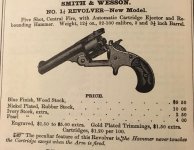
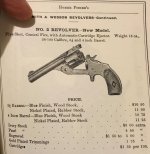
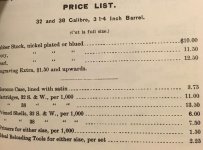
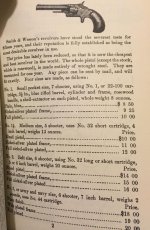
If we follow documented history from a timeline perspective? We can see a definite change in the industry from the early 1870’s to the late 1880’s when electroplating( Nickel finish) became basically cheaper to apply. Prior to the advent of Electricity in the shops the Nickel process was generally chemically applied with Electroless methods. Which was costly and time consuming. You can see the additional costs listed in the photos “ Prior” to 1880.
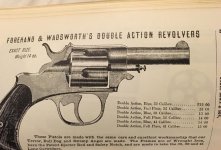
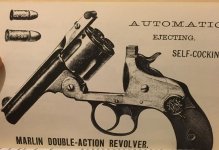
The photos show early Smith & Wesson’s progressing to later models in the late 1870’s then the Marlin Double action of 1887. Where there was no difference in the cost between Nickel and Blued finish.
Most of the early reloading tools by the mid 1880’s were Nickel plated also. However, An argument can be presented that all Winchester loading tools and molds were deep blued up and beyond 1900 so I suppose it really became a personal preference after electricity was well established.
The only real impact or change documented in the industry was really the cost to apply Nickel plating.
 

Attachments

  • 6A1920DB-9A7F-42F9-894E-DFFE2B7D8E14.jpg
    6A1920DB-9A7F-42F9-894E-DFFE2B7D8E14.jpg
    74.3 KB
  • 95CB6B94-874E-475A-A90C-A533C467AF52.jpg
    95CB6B94-874E-475A-A90C-A533C467AF52.jpg
    74.4 KB
  • 51E90E68-8989-4660-9385-6195E203B12D.jpg
    51E90E68-8989-4660-9385-6195E203B12D.jpg
    69.7 KB
  • 542581F7-B467-4DB3-8B92-AECC03A2470F.jpg
    542581F7-B467-4DB3-8B92-AECC03A2470F.jpg
    62.5 KB
  • 2B85B732-C412-4F53-95CA-CADAF39D6C4B.jpg
    2B85B732-C412-4F53-95CA-CADAF39D6C4B.jpg
    54.9 KB
Earliest production

Additional photo of the earliest production you can see the significant difference in cost for full Nickel plating
 

Attachments

  • 2A86B0D9-2165-4539-8E84-57119B8DB6F2.jpg
    2A86B0D9-2165-4539-8E84-57119B8DB6F2.jpg
    79.8 KB
Additional photo of the earliest production you can see the significant difference in cost for full Nickel plating

#3 44 cal 7" barrel
would this be 2nd model russian? !875/76
 
Distributor listings

Iby
These are Distributor listings. They often make up their own model designation, use other makers drawings and mix up calibers. The only thing we can capture as legit from Distributor listings is confirmation of timeline. In other words the product was available for sale at the time of the listing and what they sold for. The photos I posted are from 1878 and 1880 Homer Fisher catalog and the 1887 Marlin factory listing. It doesn’t mean that the listed firearms were actually still being manufactured because the distributor was often assigned the task of unloading surplus items. We also can’t believe what they list as a “ New Model” because they often list old surplus items as New as a market ploy to sell old stock! “ New Model” was a common lie!
 
Back
Top