Postwar Transitional 1917?

Joined
Jul 13, 2013
Messages
1,130
Reaction score
5,479
Well, I've been looking for a decent 1917 to add to my 25/625 stable for some time now and I think I may have scored a winner with this one. A good friend turned me onto this specimen the other day and after checking it over, I made a deal with the owner and took it home.

First and foremost, the condition is excellent IMO. The barrel, cylinder and grips all match the serial and the commercial blue finish is the nicest I've ever seen on a 1917. From my research, I believe it to be a commercial post war transitional model with the high shoulder black diamond magnas, lanyard ring, and no military markings. I expected it to have an S Prefix serial but no dice. I've read some other threads and the SCSW says some were not assembled with an S Prefix serial. It is 21005X, so it would put it in the range for what I think it is. Maybe 1946/1947? Hopefully others can nail down the year of production while I wait for the letter.

It did not come with the box or any vintage moon clips which would have been icing on the cake but I feel privileged to now be the caretaker. It will be shot some, as it does look to have been fired (albeit not much since the recoil shield looks near mint). I suspect it will be just as accurate as my other 45 revolvers :)

Any notes or comments are greatly appreciated and of course, if you have a postwar transitional 1917 you'd like to show off I'd love to see a pic or two!!

Cheers all
SVT28


342d93fbf7a8b831686061591819e8fa.jpg
39b4c8674eafdba39e6beee9cda789f8.jpg


Sent from my SM-G935V using Tapatalk
 
After WWII, the Coml model of 1917 Army 45 was reintroduced in May of 1946 in a very limited number prior to the introduction of the Model of 1950 45 Army which became the Model 22.

Almost all early post war reintroduced models had some pre war features, but also the post war satin blue finish and new hammer block safety; the exception being the 38 M&P which was in continuous production all thru the war.

Because of these "cross over" features, collectors dubbed them Post War Transitionals in all models. Features that may be observed are:

Pre war style hammer spur, albeit notched on the face for the new post war sliding bar hammer block safety and usually having an S serial # prefix,
Patent dates on the barrel,
the barrel style pre war extractor rod knob,
pre war style cyl release thumb piece,
"sharp shoulder" Magna stocks on K & N frames, etc.

In addition, Model 1917 Coml examples were built on pre war/surplus military frames and often have lanyard swivels as does yours. As you indicated a serial # range of 881 #s is known, with others outside that range making the usually accepted total of 991 PW Transitional models.

For reasons lost to history some as yours do not have the S prefix, albeit do have the new style safety hammer block.

You have one of the nicest examples I've ever seen, with the additional scarcity factor of the "missing S".

Congrats and enjoy!
 
Last edited:
Thanks Jim for the note and history. Mine does have the patent dates on the top of the barrel as well as the pre war spurred hammer. I dropped a loaded Wilson Combat 25/625 moon clip in yesterday to check fit etc and did not have any issues.

Question: Should I be concerned with certain ammo types with this gun? Most of my 45 shooting is done with Winchester Service 230 grain fmj ball ammo since I have a small stockpile of it. Is this ammo good to go with this 1917?

SVT28
 
Last edited:
Couple of questions here.

First do we have a consensus, that whether or not "S" prefixed, all the something around thousand WWII postwar Model 1917, in fact were equipped with the hammer-block safety?


Second not only a question for myself here. Rather, perhaps instructive in context of just what is and isn't a postwar N frame transition hammer.
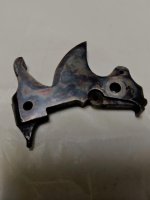
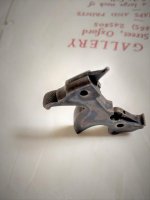
The lineup. One hammer, four 'presumptive' mug shot angles below. Either I need just one more of these buggers, or if it's not correct, needing two. Perhaps also helpful for others who may wish to identify proper transition hammers.

If not correct, would sure be helpful to know what it fits. Even more so, if someone with the a correct 3rd Transitional N frame hammer floating around, to provide a quick pix here. None of my guns even convenient to get to at the moment.

Thanks!
 

Attachments

  • IMG_20180522_161630233 - Copy.jpg
    IMG_20180522_161630233 - Copy.jpg
    49.1 KB
  • IMG_20180522_163512330 - Copy.jpg
    IMG_20180522_163512330 - Copy.jpg
    37.4 KB
  • IMG_20180522_163528135 - Copy.jpg
    IMG_20180522_163528135 - Copy.jpg
    24.3 KB
  • IMG_20180522_165027121_HDR.jpg
    IMG_20180522_165027121_HDR.jpg
    23.5 KB
That is a post war transitional hammer: it has the pre war style spur and notched below the hammer nose for the post war sliding bar hammer block safety.

Your transitional hammer looks like an I/J frame size and was introduced with the reintroduced I frames in 1946 and used until 1952 when it was modified (no longer a transitional hammer) for use with a coil mainspring that looked the same on the outside of the gun. And on the 1950 J frame which was introduced with the modified version; used until the 1953 thru 1954, including on the early Model of 1953 New I and New J frames.

The same type K and N frame hammer style was used until the 1950 models when the new short action hammers/actions were introduced with new style 'high speed action' hammers.

And on the 38 M&P models beginning with the sliding bar safety retrofitted versions towards the end of the war until 1948 when the new short action hammer/action was introduced with new style 'high speed action' hammers.

All of the above transitional hammers will work in pre war models.
 
Last edited:
My 1917 post WWII (above) was originally equipped with a hammer block. While it wasn't in there, you could see the wear on the inside of the side plate and the rebound slide had the activating pin in place. I found a hammer block and installed it.

Stu
 
OP,
NICE Transitional! Most show good amounts of use.


First do we have a consensus, that whether or not "S" prefixed, all the something around thousand WWII postwar Model 1917, in fact were equipped with the hammer-block safety?
All Transition 1917s I have ever seen have the modern hammer block, with or without the S prefix.
I have seen a few dozen, probably about evenly divided between S and non-S.
 
That is a post war transitional hammer: it has the pre war style spur and notched below the hammer nose for the post war sliding bar hammer block safety.

Your transitional hammer looks like an I/J frame size and was introduced with the reintroduced I frames in 1946 and used until 1952 when it was modified (no longer a transitional hammer) for use with a coil mainspring that looked the same on the outside of the gun. And on the 1950 J frame was introduced with the modified version; used until 1953.

The same type K and N frame hammer style was used until the 1950 models when the new short action hammers/actions were introduced with new style 'high speed action' hammers.

And on the 38 M&P models beginning with the sliding bar safety retrofitted versions towards the end of the war until 1948 when the new short action hammer/action was introduced with new style 'high speed action' hammers.

All of the above transitional hammers will work in pre war models.


Thanks Jim for confirming all of the postwar 1917s likely 'true
transitions' as defined by presence of the hammer block feature. Next time I have my out in daylight, to confirm. Only if a tilt, returning with update. Thanks also for the hammer ID analysis. Sounds like I'm going to need two N frame transitional hammers! Groan! Ah well, good to know!
iskra/John

Just now reviewing this Thread for inclusion of data in notes re my 1917 'post'. Noting I omitted due "Thanks" to our Administrator Lee at the time for his confirmation suggesting 'all with hammer block'. This a point I've wondered about and my own model locked away and safe behind a load of furniture! Sure easier to inquire than major move!
Again, thanks to all contributing to this subject of "To "S" or not to "S", that as the question!
iskra
 
Last edited:
jebstuart ,that I could afford thing always gets me to.SVT28 your gun is a beauty thanks for shareing with us . Also I just want to take a moment and mention the experts who weigh in with different information the time you spend shareing your knowledge with us newer folks is truly appreciated .
 
Yep, I'd say that one's pretty decent! I'd like to find a decent 1917 like that, that I could afford (see, there's always a catch).
Congrats on a beauty,

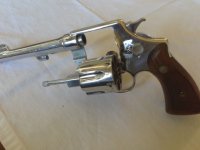
Here's one you could afford, but as you say "there's always a catch." In this case the catch is a re-finish in nickel. . .but one of the very last ones made I think.

Jeff
SWCA #1457
 

Attachments

  • 1917 re-finish Post WWII 45 ACP.jpg
    1917 re-finish Post WWII 45 ACP.jpg
    31.1 KB
  • 1917 Post WWII S210775.jpg
    1917 Post WWII S210775.jpg
    25.3 KB
Here's one you could afford, but as you say "there's always a catch." In this case the catch is a re-finish in nickel. . .but one of the very last ones made I think.

Jeff
SWCA #1457

I'll bet that's a hoot to shoot. You should buy a lanyard ring to plug the hole. Small parts like that are pretty easy to nickel yourself - mirror polishing prep on a piece like that is the tricky bit. The proper ring is easy to come by though.
 
Last edited:
Hammer and trigger are both nickel; apparently whoever did the re-finish had plenty of nickel handy.

Jeff
SWCA #1457

I would (and have) polish up a lanyard ring best I could with a few different grits of compound and a Dremel w/pointed felt bobs then nickel it.

Other option (done this too) remove the nickel from the hammer & trigger with reverse electrolysis & you can do a pretty good imitation of case color with cold blue and a Q-Tip on small parts.

If you've never done reverse electrolysis, all you need is a 5-gal. (properly wired) pail, water, soda wash & a battery charger. YouTube it. I have de-rusted several Commission 1888 Carbines & an 1894 Spanish Carbine (Teddy Roosevelt's Cuban booty) that way, bores too, and it removes hundred year old rust, lead fouling, gunk, etc. right down to clean metal with no work or scrubbing.

For nickel, just replace water & soda wash with sulfuric acid in a smaller container. Midway USA (Larry Potterfield) has a great YouTube on it. Both processes is a piece of cake.
 
Last edited:
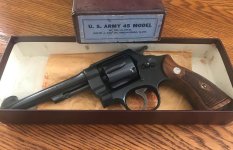
U. S. ARMY 45 MODEL, S210364, NIB, w/bill of sale, indicating 1950 purchase. It shipped in November 1947 to Warshal's Sporting Goods in Seattle. The gentleman I purchased it from many moons ago, an avid S&W collector and member of the S&WCA who is now deceased, told me "... it was kind of vanilla." Lucky for me, I like vanilla. Of the original 991 produced, there can't be too many around in this condition w/all.
 

Attachments

  • IMG_1852 1950 ARMY.jpg
    IMG_1852 1950 ARMY.jpg
    96.6 KB
  • IMG_1853.jpg
    IMG_1853.jpg
    67.6 KB
Last edited:
Nope, except he'll lose the case coloring in the notch cut, but that's hard to see. A little cold blue and oil on a Q-tip will cover the shiny metal in a light blotchy blue resembling CCH.

Pre war hammers may be just almost as hard to find.
 
Yes but as many 1917 hammers that are out there, it widens his opportunities. I should say N frame rather than 1917.

Guy

You're right, the volume of 1917 hammers produced will far outnumber all the other pre war N frame hammers.

Lee has said at one time that 1917 hammers are slightly different than other pre war N frames. However, I suppose that would include transitional 1917s.
 
If I hand a hammer...

Thanks Gents!
Interesting idea! Even assuming '17 hammers are plentiful, here machinist labor costs likely significant and small jobs sometimes disproportionately so! Thanks for the suggestion! Gun below, not really 'collectible'. Just nice shooter. Absent a 'drop-in cure, perhaps next owner to inherit the problem! :)
Thanks for the thoughts/discussions/help!
John
 

Attachments

  • 53 - 2.jpg
    53 - 2.jpg
    199.7 KB
Last edited:
iskra,

Now that I know the reason for replacement hammers, the simplest solution to that bobbed hammer is to tig weld or have tig welded, a new spur to the bobbed hammer, since it's not collectible. The 1950 and newer spur style is a vast improvement to the skimpy pre war style. Either the .375" standard spur or the .500" target spur is better.

This is similar to how King Gunworks made custom "cockeyed" target hammer spurs on pre war guns. This is what they look like, and also what the rare pre war target hammer option S&W offered for $1 looks like:

orig.jpg


Letter confirming factory pre war target hammer at the bottom of letter:

a1bbb423290dc24051bfcccb26dc9e12.jpg
 
Last edited:
Back
Top