Primer comparison question

jmclfrsh

Member
Joined
Jul 14, 2017
Messages
261
Reaction score
338
City & State/Province
Central Ohio
I recently got back into reloading after a layoff of firearms for 33 years.

I purchased Federal primers for my first batch of reloads, and even with 850-1000 FPS reduced loads, the primers seem flattened as much as 90% FMJ loads.

They also seem flatter than the primers I used in the past, which were CCI probably.

I look at fired primer flattening to indicate higher pressures than I like. Knowing even reduced loads make the Federal primers indicate a higher pressure that they have to be operating under, I have come to the conclusion that the Federal primers (being reportedly softer than others) just indicate higher pressure than other primers do, like Winchester or CCI.

A false reading, if you will.

They are not completely flattened, just more so than normal it seems. Is that a common occurrence with Federal primers?

If so, I may just use the remainder of these 1000 for my reduced loads, and get some CCI primers to help me better judge when I am reaching higher pressures with faster loads.

Thoughts? And thank you for your responses.
 
Last edited:
I've noticed from the # of your posts that you appear to be somewhat new to this forum. Three topics that will cause a firestorm on this forum is Politics, Religion, & Primer hardness. :eek: :D :eek:

There is NO difference in the hardness of primers !! :mad: This is from the people that know what they know, and don't want to be confused by the facts.

Now you will hear from folks that have shoot thousands of rounds in competition that Federal primers are softer and the only primer they use or the only primer that will work in their competition firearm. You will even see product like Miculek spring kits that say
their product only works with Federal primers. But those people really have NO idea what they are talking about.:eek:

:D Sorry, I'm being totally facetious here. :D

Federal primers are my first choice. Winchester my 2nd choice.
And I have used both with somewhat warm / hot loads. And CCI's are harder than chinese arithmetic.
But that is just my uninformed opinion. :rolleyes: :confused:
 
Last edited:
I've noticed from the # of your posts that you appear to be somewhat new to this forum. Three topics that will cause a firestorm on this forum is Politics, Religion, & Primer hardness. :eek: :D

There is NO difference in the hardness of primers !! This is from the people that know what they know and don't what to be confused by the facts.

Now you will hear from folks that have shoot thousands of rounds in competition that Federal primers are softer and the only primer they use or the only primer that will work in their competition firearm. You will even see product like Miculek spring kits that say
their product only works with Federal primers. But those people really have NO idea what they are talking about.:eek:

:D Sorry, I'm being total facetious here. :D

Federal primers are my first choice and the softest. Winchester my 2nd choice. And CCI's are harder than chinese arithmetic. But that is just my uninformed opinion. :rolleyes: :confused:


No the primers are not HARDER, the cup may and is THICKER.;)

Semantics:)
 
No the primers are not HARDER, the cup may and is THICKER.;)

Semantics:)

Harder ,, Thicker ,, Don't go bang as easy,, ?? :confused: :D

I know they are all the same :D .. Sorry :eek:

Anybody know why Federal small pistol primers are so hard to find ??
 
Last edited:
For handgun loads you can not determine anything about pressure by primers. It's like reading tea leaves,

If the primers truly flatten it's to late, you will have a more serious problem:eek:

What Rule3 said.
What caliber,, powder charge, bullet weight, OAL , etc.. ?
I have had some extremely flat ( Federal ) primers out of my 929 ( 9mm revolver). That were not that hot of a load and showed No signs of pressure or flat primers out of autos.
 
Last edited:
. . . There is NO difference in the hardness of primers !! :mad: This is from the people that know what they know, and don't want to be confused by the facts.
:D Sorry, I'm being totally facetious here. :D

I look at a Forum like this one as an opportunity to learn and/or help others with my own research & experiences. One thing that continues to amaze me is that there are so many people who absolutely-positively know the answer to a question and are not shy about stating it. Problem is that they bring no facts, experiences, or insights to the issue to support their opinions. Who are these "people" and where are the references, so others can learn??

I started loading 30-06 for a newly acquired Model 1903 Springfield a year ago. Not needing to hot-rod the rounds, I settled on loading in the 2500 - 2700 fps, using 150 grain FMJ & one of the standard 30-06 powders, IMR 4895.

I was using Federal primers on my test loads at the range, resulting in an average speed of 2650 fps, but noticed that the primer looked flat. Concerned about this, I loaded 5 rounds each of Federal, CCI, and Winchester primers and back to the range. There was a BIG difference in appearance after firing the rounds. Speed difference was minimal, less than 50 fps from one primer to the other, but appearance was significantly different. Federal primers, once again were flattened against the bolt and edges looked square. Winchester primers showed some flattening, but CCI primers looked original, with round edges as before firing.

With this evidence and lots of years of fretting and stewing about one thing or another I have read, I have come to the conclusion that flattened primers cannot accurately tell you if your reload is hot or not. Did all primers go off - yes; were there any indications of over-pressuring the rifle - no, would I use any of the three primer brands again - yes; will I automatically reduce my loading if primers look flattened - no; are CCI primers harder than others - don't care.
 
Harder ,, Thicker ,, Don't go bang as easy,, ?? :confused: :D

I know they are all the same :D .. Sorry :eek:

Anybody know why Federal small pistol primers are so hard to find ??

Don't go "bang" is the technical term:D

Also why are Federal Primers required to have such large packaging??

Because the company wants to pay more for boxing them up? No, because they are more sensitive.

Heck I liked the CCI in APS strips, the packaging case of primers is so much smaller as each little primer is in it's own little cocoon.:)
 
This is from CCI a long time ago, no it doen't compare between brands but other companies are tight lipped about their products and would not tell me. There are posts out there on the Web that have measurements of other brands. Hope that is proof enough.

below you will find the primer differences.

Large rifle primers
CCI-200............................ standard mix, standard cup, and standard anvil.
CCI-250............................ Magnum primer, Mag primer mix, thick cup, standard anvil.
BR2.................................... thick cup, standard priming mix held to a tighter tolerance, standard anvil.

So they are really not harder primers, just a thicker c

Make Every Shot Count!
Justin M.
2299 Snake River Ave.
Lewiston, ID 83501
CCI/Speer
(800)379-1732
 
The principal difference among primers of like type (S or L) is not so much the primer composition or amount, or who makes the primers, but the primer cup thickness. That influences impact sensitivity, and of course thicker cups will withstand higher pressures without failure.
 
The one thing that isn't talked about in this thread; would the reason YOUR primers are flattening on THESE LOADS!

I can think of a few;

The easiest is that in earlier loading equipment, There were flat seating primer posts and convex primer seating posts & some brands of primers came one way or the other. This adds up to NO BIG DEAL.

The worst I can think of is Improper head spacing. This is pretty unusual and if factory ammo is working fine, you have ruled that out.

Somewhere in the middle is your load. It may be too reduced! When fired the case flies against the recoil shield, then rebounds foreword. The pressure is still building and the primer does funny things, these include, the primer backs out, the primer flows in firing pin hole, or the primer flattens in the primer pocket. There may be more! But I believe you need to increase you load. (This is assuming you hadn't made a mistake in the original loads, e.g. similar but wrong powder.)

Hope that this helps.

Ivan
 
Good stuff, but does not address different results using different primers in the same gun, using the same dies and press, with the same loading? If the only variable is the primer, I am pretty sure that Federals flatten, Winchester not so much, & CCIs do not, but it does not concern me as long as I know velocities. I truly believe that anyone who reloads, needs a chronograph and should rely on velocities way more than primer appearance. If you don't experiment with untested powders and use published load data, how can one go wrong?

I think that a lot of unfounded claims are made about flattened primers; hot loads, excess head-space, etc . . . and don't get me started on head-space doom and gloom warnings!!:D
 
Federal primers are nice for pistols if you can find them.
Otherwise I use cci or win std primers for my pistols and revolvers.

Rifles are a whole new ball game.
With standard, magnum and match grades out there you have a lot to go
through to see if there really is a difference in your loads and accuracy.

In my 270, I found that std. and Mag CCI primers are needed in the different loads.
In my 30-06 with a 180 and 200gr BT bullet my groups in my '03
were cut in half switching from a cci and going to a win. primer with IMR4350.

Otherwise just buy one type and use the best load and save yourself a lot of trouble.

Safe loading.
 
Where do Remington primers fall on the hard/soft or thick/thin cup continuum? I have never used them, but one of my LGSs has a lot of them at a lower price than CCI and Winchester go for at the other local shops.

Federal primers seem to be like hens' teeth around here.
 
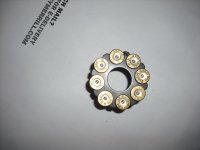
A picture of primers fired in my 929. :eek: I was quite concerned
I normally don't post my loads. But, these were, a 147 gr. xtreme plated .356 bullet,, with 3.5 grs. of Bullseye,, Federal SP primers, 1.135 OAL averaged 853 fps out of the 929.
I usually used only Winchester brass in the 929,, but tried different brass to see if it made a difference.

Never had any problems with them ,, but it sure flatten the primers in the revolver.

I don't have a picture of the same load shot out of my autos. But the primers were not flatten at all, and average 950 fps out of my autos.

I also have other firearms that uses moonclips and rimless cartridges and have never noticed the primers this flat?
 

Attachments

  • DSCF0011.jpg
    DSCF0011.jpg
    61.3 KB
Last edited:
Primer Tribal Knowledge

The reloading hobby has a few unexplored frontiers of knowledge. One of them is primers. To my knowledge there are no published, verifiable data sets on primer hardness or brisance. The manufacturers don't do anything to lower the mysticism with marketing labels like "magnum". This is not unusual in manufacturing and marketing. Nobody really wants objective, data driven comparisons lest their marketers and advertisers be put out of business. This is why reloading manuals are recipe based, or rule based, if you will. Ballistic science relies on a lot of trial and error experience because much of its data is difficult or impossible to obtain. Pressure data is largely confined to test labs who have only in the last few generations been able to get away from crude pressure measurement schemes like copper and lead crusher methods. Primer "hardness" would be another of these mysterious areas that could stand the bright light of objective data, but you won't soon see CCI, Federal or any manufacturer publish objective hardness or strength data on their cups, let alone pressure curves or energy output. What's a reloader to do? Rely on recipes and do as the manuals say. Start low and work up, watching for indicative, but indirect, signs of overpressure.
 
Most experienced National Match rifle shooters know the number one cause of slam fires in an M1 or M14 is soft, commercial primers - especially Federal Match primers. I've seen or heard about a dozen over the years during 600 yard slow flire. All of them were from loading single rounds and dropping the bolt instead loading from a magazine or SLED. The safety bridge is supposed to keep the firing pin to the rear until it has lost enough momentum to set off the primer prematurely, and the bolt is fully in battery.

It can get ugly.
 

Attachments

  • images.jpg
    images.jpg
    7.3 KB
I truly believe that anyone who reloads, needs a chronograph and should rely on velocities way more than primer appearance.

I agree with this. For quite awhile I didn't have a chrono, and it always sucked not knowing the power of my loads.

Eventually I got an affordable chrono and love it. I now know what my loads clock at, and it is really helpful.

Watch for deals and promos and one can find a good chrono for about $100.
 
Ignoring the "flatness" of the firing result, I did a test on performance a couple years ago. Loading 38 Special, target load, 3.2 gr W231.

I carefully loaded the same make brass (Winchester), with measured load of powder, and carefully seated to the same OAL. I loaded 20 rounds of each, Winchester, Federal, CCI, and Remington. The only difference in any of the loads was the primer.

All rounds were shot from a bench rest, over a chronograph. The difference in Group size, Velocity, Standard Deviation, Extreme Spread was so negligible as to just be ignored. For handguns, I buy whatever primers I can get for the best price.
 
. . . It can get ugly.

Here is another learning experience. Can you tell us more about the accident? I am curious how a slam fire in a semi-auto rifle can cause the damage you show in your picture? I can only assume that the round went off before the bolt went into battery? Sorry for the loss of a fine rifle!
 
Reading primers is kind of a voodoo thing. They all vary in cup hardness. Federal will "flatten" sooner than others but honestly, most reloaders have no idea what a true flattened primer looks like. These are marginally flattened. Not mine just a pic I pulled off the net. A serious flattened primer has no edge at all. I see them on the range sometimes, 9mm major usually.
 
I think there is some confusion when many of us say 'softer cup' or 'thinner cup' when it is really the whole primer working as a system. For me the bottom line seems to be...
Is the primer easier to set off than another brand of same group style?
In my experience the answer is, yes. FED100 sets off much easier than the others.
Here is my ranking of standard small pistol primers from easiest - hardest to set off. Feel free to disagree, but this is what I think based on use.

Federal
Winchester
Fiocchi
Remington
Tula
CCI
 
Here is another learning experience. Can you tell us more about the accident? I am curious how a slam fire in a semi-auto rifle can cause the damage you show in your picture? I can only assume that the round went off before the bolt went into battery? Sorry for the loss of a fine rifle!

Not my rifle, was only on the range when it happened. It appears bolt was not fully closed when the rifle went off. The story from the shooter was he had loaded a round into the chamber and hit the bolt release and it went off. It was the fourth or fifth round in the string.

High primer, soft primer, broken firing pin? I do not know for certain.
 
Head clearance or the amount of "air space" between the rear of the case and the bolt face can also effect how the primer looks. The first thing that happens when the cartridge fires is the primer moves to the rear and out of the primer pocket. The next thing that happens as the chamber pressure reaches maximum the case is forced to the rear until it contact the bolt face. This action can cause the primer to become mushroom shaped with sharper edges when it is reseated when the case contacts the bolt face.

HK76WCp.jpg


NOTE, your head clearance is caused by the amount of shoulder bump, rim thickness and the firearms headspace.

Below the amount of expansion just above the rim or extractor groove will tell you how much pressure the case can take. It is not a indication of pressure as much as the elastic limits of the brass meaning its strength.

Simple Trick for Monitoring Pressure of Your Rifle Reloads
Simple Trick for Monitoring Pressure of Your Rifle Reloads | Hodgdon Reloading

Another example below from the Accurate shooter reloading forum. This competitive shooter increased the load until he had brass flow into the ejector. He then backed off the load 1 to 2 grains knowing the elastic limits of that brand of case. This brass flow corresponds with the case base expansion.

KtO65uH.jpg


Bottom line, you have primer cup thickness and hardness which effects how much the primer flattens. And also how far the primer backs out of the primer pocket that effects primer flattening.
 
Sometimes a lighter than normal hammer spring can contribute to flattened primers. Looking at your photo, I don't think you have anything to worry about.
 
I look at fired primer flattening to indicate higher pressures than I like. Knowing even reduced loads make the Federal primers indicate a higher pressure that they have to be operating under, I have come to the conclusion that the Federal primers (being reportedly softer than others) just indicate higher pressure than other primers do, like Winchester or CCI.

A false reading, if you will.

They are not completely flattened, just more so than normal it seems. Is that a common occurrence with Federal primers?

If so, I may just use the remainder of these 1000 for my reduced loads, and get some CCI primers to help me better judge when I am reaching higher pressures with faster loads.
From the photo I don't think you have an issue either, but you really should get a chrono.
 
"Here is my ranking of standard small pistol primers from easiest - hardest to set off. Feel free to disagree, but this is what I think based on use.

Federal
Winchester
Fiocchi
Remington
Tula
CCI"

Do you have any hard evidence to support what you think? If you do, you will be the first one who has ever posted anything like this here. If someone can provide some substantiated published lab results from a reliable source instead of guesswork, parroted anecdotal stories, or old wives' tales, maybe I'll believe it. Otherwise, I don't. And no one else should either.
 
Anybody know why Federal small pistol primers are so hard to find ??

Not hard to find at all, m8. I have 2k right on my shelves downstairs :D

I liked them for DA shooting with my Target Masterpiece, which can be a little picky, but it's a much-loved gun so rather than ask it to change I simply use the primers that work when it gets cranky. I walked into one reloading shop perhaps a year ago, and they had no Fed Smalls at all (whereas previously, they had plenty).

Next shop I walked into, same day, I asked how many the guy had. He said, "Two bricks," and I said, "I'll take 'em."

Haven't seen any since.
 
Some imported primers......

Some imported primers have been known to be very soft, or thin, or however you want to put it.

I think that there is some difference in domestic primers, but it doesn't seem to be different enough to make much difference.
 
Back
Top