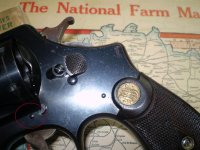
Reblue?

With tongue planted firmly in cheek!

Ralph Tremaine

And as an aside for those in need, Turnbull hasn't done a S&W for quite some time---more years than I can count---even if I already knew the answer. (And that's because his primary interest is in making money, and the customer base with S&Ws to be restored (not refinished), AND with the money to pay for it is pitifully small, AND pitifully small is not the amount of money in which Turnbull's primary interest lies, AND if you'll take notice of what we'll call Turnbull's specialties, you'll note they are relatively simple/easy to prepare (compared to the typical S&W revolver, which, when one examines the myriad different surfaces, one will (more or less) quickly come to the realization proper preparation of myriad surfaces takes A LOT of time (unless you have formed wheels like the factory does---or did-----AND wished they still did if they don't)----AND there ain't a whole lot of folks willing and able to pay the freight for that sort of work-----NOHOW!!!!)

Got all that?!!
 
Last edited:
Weren't guns of that era done in bright shiny blue? That looks like a matte blue.
In a word, NO.
The 1920s finishes don't equal Pre WW I finishes or the finishes of the 1930s that returned to the high polish. ;)


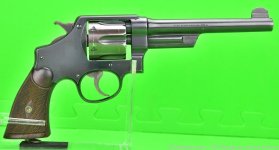
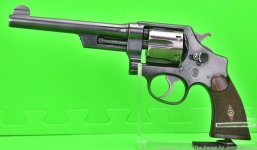
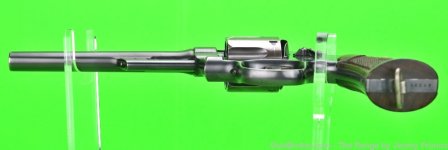
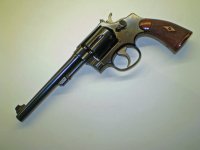
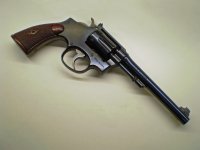
I don't see ANY indication of a reblue. That is an early 44-3rd with a round top frame in the rather rare 6-1/2". Being an unrepentant 44 SLUT, I'd get all over that! :D ;);)
 
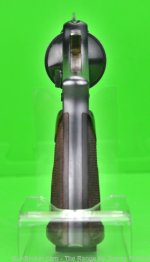
All I have to examine is these pics. The seller says that it might be an old reblue, he does not know for sure. He does mention that "The cylinder has turned to an even plum color" to quote him. I am not seeing it from the pics, but it seems to me that might be an indication of a reblue if so. I have seen that a lot on older blueing jobs. Apparently it is something that happens if the formula is not heated right or something. I have never seen it happen to factory bluing. I might be wrong?

I probably should have mentioned this in the beginning. Sorry.
 
Last edited:
Opinions vary, but that revolver could be correct for the time. First, the cylinder on many fine looking refinishes age to plum color because the cylinder is re-blued for the same amount of time as the rest of the parts. The harder steel in cylinders needs a longer amount of soak time, which few gunsmith refinisher consider. There are, however, factory guns that have shown this color change that have been deemed original.

I do not collect N frames, but finish is the same for all models of the era. Most of my K frame Target collection from the 1920s are all deep black carbonia blue with high gloss finish. Lacking the gloss, a 1920s gun could still well be original, given my notes on the subject.

Matte ("Satin") blue and high polish ("Bright") blue finish on K frame guns from the 1910s & 1920s. Satin blue was the standard, and bright was available on order, on both service and target grade guns.

I cannot tell for sure, but is the MADE IN USA weak on the right side of the frame? Lighting can turn dark bluing to grey color, but gloss guns will still be shiny. Your revolver has the type of finish that is standard for the era, so I lean towards original finish. Only an in-hands inspection could tell for sure.

Here is one example of a gloss finish option done by the factory.

attachment.php

attachment.php
 

Attachments

  • P1010003.jpg
    P1010003.jpg
    69.2 KB
  • P1010009.jpg
    P1010009.jpg
    67.7 KB
Last edited:
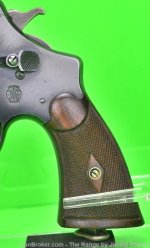
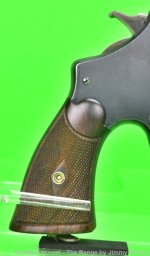
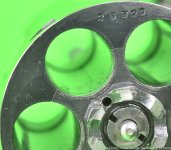
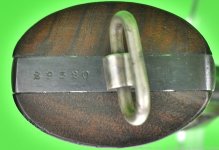
If the seller will send more pics, ask him to remove the left stock and send a photo of the grip frame. If refinished by S&W, it will show there.
Also, ask for a pic of the front of the ejector rod knob. S&W left that area in the white, and an after-market refinish usually blues that area, too.
Good luck.....that's still one of my bucket list guns.
 
All I have to examine is these pics. The seller says that it might be an old reblue, he does not know for sure. He does mention that "The cylinder has turned to an even plum color" to quote him. I am not seeing it from the pics, but it seems to me that might be an indication of a reblue if so. I have seen that a lot on older blueing jobs. Apparently it is something that happens if the formula is not heated right or something. I have never seen it happen to factory bluing. I might be wrong?

I probably should have mentioned this in the beginning. Sorry.

Not mentioning it is actually a good thing, if you can get some independent analysis before "poisoning the well" so to speak you can still get feedback after you supply this information.

This forum is excellent, the people here are wonderful, and going about asking advice here this way will only net you positive results.


I might add something to my previous post regarding this, and it has to do with owning and buying reblued guns.

I hate bad reblues. Hate in fact isn't a strong enough word. I despise them, and when a gun lurks in my gun room that has been sullied in that way it just eats at me until I rid myself of it. That said, I currently own at *least* a dozen re-finished guns, all of which please me immensely.

After experiencing some fine (documented) factory re-finishes, I was forced to evaluate my early collecting aversion to re-finished guns. There are so many atrocious reblues, and for so long "factory original", "mint", "new in box", etc, have mattered tremendously in collecting, my impulse was to just dismiss re-finished guns. In time I came to realize that this impulse has no place in a time when we can be provided excellent photographs, and evaluate the gun on it's own merits. Modified, refinished, abused, well used but cared for... all of these guns can occupy a pleasing space in a collection.

The second part for me was overcoming this notion that collecting my guns was "investing". It's not. As a hobby it can be cash neutral, or even grow in value if you buy right, but it's still my hobby. I personally do consider resale in my purchase decisions, but I am no longer deceiving myself that my guns are an "investment", despite having done very well in growing the value of my collection over the decade and a half I've been collecting.


As to the pictured gun, my personal assessment of it going into my collection would be that the finish is righteous, or so well re-finished as to not matter. To me that is. I'd personally believe that the cylinder has gone a bit off because of the heat treating, and I'd be happy. If I had it at the right price it would be a gun that pleased me and stayed in my collection. .44spl is grand, pre-war N-frames are grand, sharp markings, edges, etc... All a beautiful package. But. That's me. As the value of these extremely wonderful guns continues to climb, and the price to be paid to possess them becomes more dear, so too does the calculation for how pleasing it is to own. And that's a calculation everyone needs to sit down and think through for themselves.

As excellent as the community is here I don't think anyone should simply take the advice and have it override their personal feelings. It used to be different when such guns were an absolute steal to buy, but now that more people understand how wonderful these are and want them... those days are largely gone.
 
It looks original to me. The cylinder does suggest something, but I'm not sure what. The case hardening looks factory though and largely unworn which makes me think it's been in a sock drawer all its life. If it is a reblue it was done carefully, cause I can't tell. I think it's the real thing though.
 
I'm not a collector so I don't know the ins and outs of when the bright finishes were used and when the brushed (satin?) finishes were etc.

2 things,,,
The guns finish strikes me as as a rust blued finish look. That's just looking at the pics of course.
There's no polishing lines at all under the blued finish.
Maybe there isn't supposed to be.

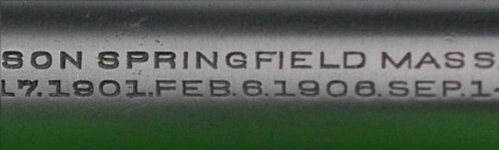
#2. There is some pitting in the metal in and around the bbl lettering.
You can see it just looking at the pic of the bbl address. But if you enlarge it you can really pick it out.
That suggests to me a refinish,,that area at least was pitted somewhat and the polishing done to the metal was very careful so as not to disturb the bbl markings.
In doing so a very small amt of pin point pitting was left in and around the lettering.

When you do this stuff you have to either stop polishing at a point to secure the sharp and distinct lettering at the cost of leaving some of the damage you are trying to polish away.
Or continue to polish all of the pitting away and go ahead and take the lettering with it either slightly or in total.
This second approach has to be taken only with the ability to restore or have restored that lettering after the polishing is complete.

There is also some pitting,,or at least it appears as such in the pic,,in the chamfered edge betw the backstrap and the flat 'butt' area.
The pic of the bottom of the grip w/ser# and swivel shows it.
The area to the right of the flat where it transitions around to the backstrap.
Either pitting under the blue,,dust on the metal when the pic taken..
Maybe the Satin finish was applied by Particle Blasting??
If so it's a bit heavy right there as compared to the other surfaces.
It just looks different,,like some fine pitting..

The reddish hue color on the cylinder gets my attention as well.
That's usually Hot Salt Blue result,,choose your issue that causes it. But hot salt blueing is generally the blue method where it pops up.


That's just my observations of course.
A great looking piece. but I'd question the finish as being original.
 
Last edited:
. . . The guns finish strikes me as as a rust blued finish look. That's just looking at the pics of course.
There's no polishing lines at all under the blued finish.
Maybe there isn't supposed to be.

#2. There is some pitting in the metal in and around the bbl lettering . . .

I agree with the issues above, plus one more. Problem with assessing the finish it that the images do not enlarge with enough detail to see much other than the color. Satin Carbonia blue shows very much like the gun in question, but the preparation marks do not show up.

Downloading the images and enlarging them does show something about the barrel, maybe fine pits, or other damage??

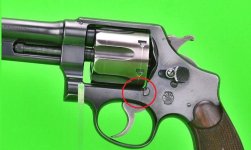
Here is something I had not noticed before, the trigger stud is polished flat, something that was not done on any S&W made during that era. You should see nicely crowned stud showing under the cylinder, but that is not the case with this gun. Images below.

attachment.php

attachment.php

attachment.php
 

Attachments

  • pix123654427.jpg
    pix123654427.jpg
    25.7 KB
  • pix218344233.jpg
    pix218344233.jpg
    60.8 KB
  • 2.jpg
    2.jpg
    103.8 KB
I agree with the issues above, plus one more. Problem with assessing the finish it that the images do not enlarge with enough detail to see much other than the color. Satin Carbonia blue shows very much like the gun in question, but the preparation marks do not show up.

Downloading the images and enlarging them does show something about the barrel, maybe fine pits, or other damage??

Here is something I had not noticed before, the trigger stud is polished flat, something that was not done on any S&W made during that era. You should see nicely crowned stud showing under the cylinder, but that is not the case with this gun. Images below.

That does answer the question definitively. Again, thank you all. I have received a lot of help and learned a lot here.
 
Here is something I had not noticed before, the trigger stud is polished flat, something that was not done on any S&W made during that era. You should see nicely crowned stud showing under the cylinder, but that is not the case with this gun. Images below.


attachment.php

attachment.php

Emphasis added... Is this something unique to the .44 HE? Or are you saying this is true of all Pre-War S&Ws?

I'm far from an expert on these, but I have seen many photos of pre-war S&Ws where the trigger pin was polished flat. I own several pre-war guns on I, K and N frames and they are all polished flat. I have a very hard time believing all these guns have been refinished.

:confused::confused:
 
Here is something I had not noticed before, the trigger stud is polished flat, something that was not done on any S&W made during that era. You should see nicely crowned stud showing under the cylinder, but that is not the case with this gun.
Gary,
That is not correct. By 1925, and probably a year or two or even three earlier, the trigger stud on N frames is polished flush. I own and have owned a bunch of them. So, you aren't likely to see a Mod 1926 with a domed trigger stud. ;)


2 things,,,
The guns finish strikes me as as a rust blued finish look. That's just looking at the pics of course.
There's no polishing lines at all under the blued finish.
Maybe there isn't supposed to be.

#2. There is some pitting in the metal in and around the bbl lettering.
You can see it just looking at the pic of the bbl address. But if you enlarge it you can really pick it out.
That suggests to me a refinish,,that area at least was pitted somewhat and the polishing done to the metal was very careful so as not to disturb the bbl markings.
In doing so a very small amt of pin point pitting was left in and around the lettering.
J,
I hate to argue with you because I know your expertise level, but there are nuances to S&W finishes you may not know. The "pitting" you see around the barrel address is, IMO, just current freckles. The "pitting" you see in the letters is carbon deposits left by the carbona bluing. I have actually seen lumps of carbon inside S&Ws left by the bluing process! ;) Roy has told us that the trigger guard screw was abandoned largely because that screw hole and tunnel would often clog with carbon and was very problematical to clear without damage to the finish.


Also-
The plum color on the cylinder occasionally occurred even with carbona bluing. I cannot explain how, unless it was caused by faulty temp control when a batch of cylinders were blued. I do know that when guns were blued, all parts were not blued in the same oven. An oven would contain nothing but cylinders. See Images of America - Smith & Wesson, page 106. I have observed several Post War 38/44 HDs that had slightly plum cylinders. They were probably done in the same batch.

If the seller will send more pics, ask him to remove the left stock and send a photo of the grip frame. If refinished by S&W, it will show there.
There is the possibility that this is a Factory refinished gun, but I doubt it. The condition of the grips and the case colors just don't indicate that this gun had that rough a life.
 
Last edited:

Latest posts

Back
Top