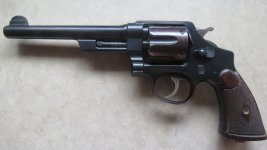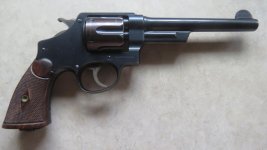

Reblue?

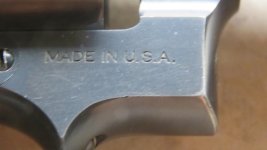
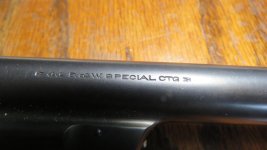
I actually didn't see anything down in the individual lettering stamps themselves.
I was just looking at what looks to me to be small pitting under the blue finish around the lettering.
Especially easy to see around the 'Spring--' in Springfield and the '1901' date below it.
Since it's only around the lettering and not anywhere else on the metal once you get away from the lettering markings, that's what makes me think the surface was repolished and the metal reblued.

The repolishing carefully done to avoid disturbing the sharp roll stamp markings.
But also done as far as possible to remove as much of the pitting that is in betw and around the lettering as well.
Can't get it all w/o starting to make the lettering disappear and that would really make a re-finish stand out.


Also this area that I mentioned earlier.

pix790636792.jpg


The small rounded area on the right where the bottom flat transitions to the front grip strap.
It appears to have fine pitting on it (at least to me).
I think it's underneath the blue,,but it may be just a worn are in the bluing and now has some fine pitting in it. Hard to tell in a pic.
 
Also this area that I mentioned earlier.

pix790636792.jpg

baby sleeping on me so one hand typing on a bad keyboard, but this picture does have one thing that strikes me as odd enough that I am going to try to mention it, so bear with my bad post.

All of my guns with a lanyard have scratches caused by the lanyard spinning. I don't see them here...

Is that just because my guns have looser lanyard rings that spin? Or is that actually an oddity?
 
baby sleeping on me so one hand typing on a bad keyboard, but this picture does have one thing that strikes me as odd enough that I am going to try to mention it, so bear with my bad post.

All of my guns with a lanyard have scratches caused by the lanyard spinning. I don't see them here...

Is that just because my guns have looser lanyard rings that spin? Or is that actually an oddity?

pix790636792.jpg


I don't think it's an oddity, I do also notice the sharp edge on each side of the bottom flat has slightly dulled edges in 4 places,,see the light reflection areas giving the edges a white appearance in 4 short lengths,,2 on each edge.

What I think that is the wear from the old, loose lanyard swivel turning upon the flat as you point out.
It would also wear both the bottom flat and the grip wood as well.

Equally dulled edge marks in 4 positions right where the swivel would have reached when rotating around and around wearing upon the wood and metal together.

It wears a dull edge to the flats in those areas much like dulling a knife blade edge.
Now you see the light reflecting back at you on a very fine edge as the bottom flat have been polished flat once again. But the very edge where some of wear still exists is still there.

I'd bet those 'dulled edges' seen in the pics w/the light bouncing back and appearing to be in the white are actuallly blued right now.
They would not be if worn from the swivel making them dull, they would be worn bright thru the original finish.
But again no wear to the flat metal and none to the wood.


A tiny bit more polishng would have cleaned up those marks, but they are still these.
They could not have been worn into those edges and remained there w/o some matching wear to the flat of the butt metal and the grip wood as well.

Any scratches on the bottom flat metal were made to disappear in polishing.
The bottom flat of the wood grips appear to have been carefully flattened a small amt and some refininishing done as well.

Again just my opinion and guesses based on what I can see in the pics.
 
Last edited:
Also this area that I mentioned earlier.

pix790636792.jpg

baby sleeping on me so one hand typing on a bad keyboard, but this picture does have one thing that strikes me as odd enough that I am going to try to mention it, so bear with my bad post.

All of my guns with a lanyard have scratches caused by the lanyard spinning. I don't see them here...

Is that just because my guns have looser lanyard rings that spin? Or is that actually an oddity?


Some swivels are tighter. Some guns just haven't been used as much. The gun discussed here appears to have seen little use, so I'm OK with it lacking the "swivel circle".


Here is a gun that saw some use, but not much, and it lacks the circle:
The Young LT's Triple Lock .455


handejector-albums--455-triple-lock-picture9670-455-tl-6-a.jpg
 
Last edited:
I'd be OK with it not having any wear to it too, but those 4 small 'light' areas on the edges, 2 on each side/edge and right where the swivel would rotate over suggest to me there was wear.
..and now everything to indicate any wear that also produced those marks as well is gone. Just left with a thin remnant of those small worn spots on the edges left behind.

The Lt's gun would take an awful lot of wear to start showing those marks I am refering to.
Those grips are slightly proud of the metal (at least it appears so in the pic).

If the swivel is rotating around on the Lt's gun, it can't reach or touch the edges of the bottom flat. The proud wood keeps the swivel from rolling over those edges.
I suspect the swivel will bridge the bottom flat all together as it rides the proud wood from one grip panel on over to the other as it revolves.
An extremely loose fitting swivel may allow it to tilt and one end, the rounded portion, drag accross the flat, but that'd be about it.

The swivel rotating around would have to wear the wood down to the level of the metal before it ever has a chance to begin to additionally wear more wood &metal as one to get at the sharp edges or the flat.

It's those dulled edges to the flat polished butt in 4 locations that I see in the orig pic,,the short 'white lines' in the pic.

What I see is the result of the wear described above, then the bottom flat polished flat to elliminate it.
But leaving just a hint of the rounding or wear to the edges where the swivel went around and wore it down.
A little more polishing to the flat would have removed those 4 short rounded edges.

I can't think of any other thing that would place those 4 equally placed marks onto the edges of the metal, on opposite sides of the flat from each other & from the center of the swivel.
 
You folks were so helpful, and obviously interested in this old Smith that I thought that I ought to come back here and tell you how the story ends.

I won it tonight. I paid $2,175.00 for it before shipping and transfer.

I still can not say whether it is a reblue or not, for sure. I have greatly valued all of your thinking, and strong arguments have been made for both sides of the reblue issue. In the end, for this kind of money, I don't really care if it is a reblue or not. I personally ended up in the camp that does not believe that it is, but it could be. If so, it is so good that I am not going to worry about it.

Another thing that helped me make up my mind was stumbling on to this one in my research. They kind of talked about it in the add for my gun, but it kind of got lost in the noise. I found the actual Rock Island gun that they spoke of. My gun and this gun are five numbers, or four guns apart. The Rock Island gun has a Smith letter. It is described as one of 25 of this barrel length and configuration that went to W+K in April of 1927. Rock Island says that their gun was part of the first shipment of this model gun by S&W. The letter does not say that, but they claim to know this somehow. That certainly bears further research on my part, but is sounds plausible. Anyway, my gun, being the fourth gun made after their's is probably part of that group. Again, no proof. But plausible. Again, I will need to get a letter and whatever else I can find for verification, but I suspect that this is my gun's story. If you look carefully at the Rock Island gun, you can see that the cylinder on that gun is not exactly the same shade as the rest of the gun. I would not call it plum, but, there is something going on in a minor way at this point.

Anyway, the Rock Island gun cost its happy owner the best part of $9,000.00 by the time he paid his bidder's fees. So, I could not pass on this for what it cost me.

Here is the Rock Island gun: Fantastic Early Wolf & Klar Shipped Smith & Wesson .44 | Rock Island Auction
 
Last edited:
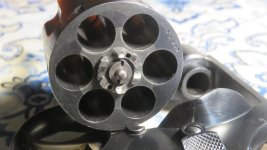
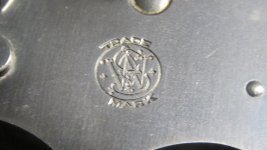
Here are the best pics that I can take with what I have for equipment. The pics of the various lettering and insignia are as close as I can get. They are a bit blurry, but it can be seen that the edges are as sharp as can be.

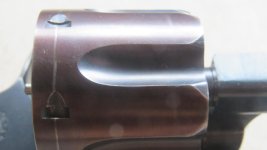
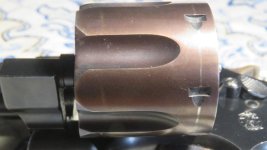
The plumming is kind of "splotchy". Heavier in some areas than others. More pronounced inside some flutes, barely present in others.

Since thinking about buying, and since buying this gun I have gone on an extensive hunt of Smith revolvers with plumming. I have come across a bunch of them that I know are original with various degrees of plum. Most often cylinder, but I have seen a few frames. I have seen several 38/44s from this general era with noticeably plum cylinders that absolutely were not refinished. So, I know, that though rare, the factory did put out some finish jobs that turned plum in later years.

So, I do not believe that it has been reblued. But, I will submit these pics to see what others think.
 

Attachments

  • IMG_1600.jpg
    IMG_1600.jpg
    52.3 KB
  • IMG_1601.jpg
    IMG_1601.jpg
    48.5 KB
  • IMG_1602.jpg
    IMG_1602.jpg
    34.8 KB
  • IMG_1606.jpg
    IMG_1606.jpg
    50.2 KB
  • IMG_1605.jpg
    IMG_1605.jpg
    63.2 KB
A few more pics.................
 

Attachments

  • IMG_1597.jpg
    IMG_1597.jpg
    36.6 KB
  • IMG_1610.jpg
    IMG_1610.jpg
    55.7 KB
  • IMG_1612.jpg
    IMG_1612.jpg
    50.1 KB
I am confident that your revolver has NOT been reblued. Others far more knowledgeable than I already have chimed in as to potential causes of the plum coloration of the cylinder.
 
Last edited:

Latest posts

Back
Top