

Replacing 686 Barrel

Tripwire229

Member
Joined
Apr 15, 2012
Messages
78
Reaction score
0
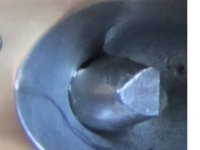
Does anyone know if having S&W replace the barrel on a 686-6 will cause the frame thread to be damaged or lossen them up at all when the new barrel is installed? I am going to send a new 686-6 2.5 inch back because the locking bolt pin hole was drilled too far back and allows the locking bolt to stick out so far that the little channel that the pin rides in on the locking bolt sticks out of the hole a little and cause a gap that hangs up the locking bolt sometimes when closing the cylinder. The locking bolt was also ground down to shorten it because it probably stuck out too far originally. I know a lot of people get their barrels replaced and don't seem to have any issues but I worry about stripping threads a lot. Here is a pic so you can see the gap
 

Attachments

  • 2.5.jpg
    2.5.jpg
    92.8 KB
Unlike with some local gunsmiths, there will be zero problems with the S&W factory.
They have all the right tools and the master gunsmiths who know exactly what they're doing.

On this earth, there's no way a S&W gunsmith is going to strip a barrel thread.
Barrels are precision parts. They don't put them in like screwing a bolt into a old car engine.
 
So maybe what is getting me is that many people describe the barrel fitting as a "crush fit" which to me suggests that the threads are mashed together inside so they don't come loose but may be buggered up and not want to be used again, maybe someone can elaborate on exactly what is meant by "crush fit"
 
Crush fit is the tight fit of the barrel shoulder to the front of the frame.

A new barrel is adjusted by lathe trimming the barrel shoulder so that when the barrel is torqued in place the front sight will be at 12:00 o'clock top dead center.
The torque is commonly referred to as a crush fit.
If you screw a bolt into a threaded hole until the head of the bolt is tight against the surface, that's a crush fit.

While the torque has to be tight enough to insure the barrel won't loosen, it's not nearly enough to upset or damage the threads. You'd likely crack the frame before stripping or damaging the threads.
 
Dfariswheel,

So are you saying that having the barrel replaced at the factory won't result in a "weaker" fit than it had with its original barrel? And the reason I worry about threaded fits is that I come from a bicycle background and there are lots of aluminum screw holes with steel screws and you have to be damn careful not to strip them out. It probably makes me think that the steel on steel barrel fit is more fragile and prone to warping than it really is.
 
Done correctly a re-barrel is just as secure and strong as it was when it left the factor originally.

Revolver threads even in aluminum frames are plenty strong and you'd have to actually try to strip them.

Again, when a barrel is installed, it's shoulder is trimmed with a lathe until it will screw on the frame with the front sight at 12:00 o'clock top dead center when it's torqued into place.
The correct amount of torque is determined by how far the barrel has to be turned after the shoulder first contacts the frame.
The amount needed is nowhere near enough to strip or damage the threads.

In order to damage or strip the threads some goon would have to tighten the barrel so far, the frame would likely crack before the threads would strip.
 
Cool, thanks a lot you've made me feel a lot more confident in sending it back the factory.
 
...dfariswheel is exactly right...the barrel/frame thread on a revolver is a large thread...and both male and female threads are made of excellent materials and are well fitted. I can't imagine the torque it would take to do damage...but either the frame or barrel would give first...not the thread...
 
I have a 686 (no dash) 6", that I decided needed a 4" barrel instead. I obtained the 4" barrel, installed it, and after a couple of months decided I liked the 6" barrel better. I took off the 4" barrel, re-installed the 6" one, and had no problems whatsoever doing the barrel swaps. From now on though, if "I think I need a different barrel length", I will buy a gun with the barrel length I want.:o
 
I have a 686 (no dash) 6", that I decided needed a 4" barrel instead. I obtained the 4" barrel, installed it, and after a couple of months decided I liked the 6" barrel better. I took off the 4" barrel, re-installed the 6" one, and had no problems whatsoever doing the barrel swaps. From now on though, if "I think I need a different barrel length", I will buy a gun with the barrel length I want.:o

Got a question about this. Sent pm.
 
I always found it interesting that Taurus started using purely crush fit revolvers when S&W was still pinning them.

I don't know if S&W sometimes have a problem with over torquing barrels causing constriction as Ruger does now & again. The .44 & .45 cal. Rugers, with thinner forcing cone areas, seem more prone to this problem than .357. There are a few theories on why this happens and one is as good as another.
 

Latest posts

Back
Top