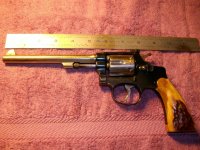
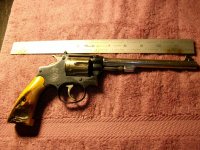
Yes! You have a wonderful little .22/32 Heavy Frame Target just barely pre WW II by about 200 #s. The earliest version looked like this when new:
A .22 LR made on the .32 S&W Long frame, hence the name 'heavy frame' which sounds incongruous from it's size. Because the barrel and cylinder are nickel, and this model was not produced in a pinto version, or nickel (at least in any quantity to speak of if special ordered), it raises some questions of originality as in were the barrel and cyl replaced at some time? or just refinished?
Therefore please check under the barrel and on the rear face of the cyl to confirm the serial #s match the # on the foregrip strap behind the trigger guard. Is there a star on the forestrap or a date on the frame under the left grip panel? These are evidence that the gun went back to the factory for rework.
If the barrel # doesn't match, it's been replaced and may have even been a 4" barrel in which case it was a .22/32 Kit Gun.
A little history of your gun, first produced in 1911:
Phil Bekeart, a San Francisco gun dealer, is credited with the concept of a larger (than the existing 7 shot .22 Long ‘M’ frame) .22 target revolver built on the I frame. He agreed to order a large quantity of the new model if S&W would make it. The early models are known as "Bekearts", highly sought after and are categorized in the four levels of collectability.
On April 25, 1911 an order for the 1st production run of 1,050 Bekeart models began in the serial range of # 138226 thru # 139275, completed on July 10, 1911. Only 1,044 revolvers were actually completed/shipped and their grips were #’d 1 - 1044.
Bekeart serial numbers were in the .32 Hand Ejector serial number series, so there are huge gaps in the Bekeart serial #s. For example, the next production run started at 160,000.
When Smith added this model to regular production it was given the model name of 22/32 Heavy Frame Target since the only other Smith .22 at the time was the tiny M frame Ladysmith.