Titanium?

Joined
Nov 2, 2012
Messages
1,367
Reaction score
1,814
City & State/Province
Sullivan County PA
How is titanium actually used in S&W firearms? Is it only used as a coating? Are parts marked titaniun actually that, or are they alloys with steel or aluminum? Are the titanium parts magnetic?
 
I don’t believe Titanium is alloyed with anything when it’s used in S&W cylinders. It’s not a coating. Some of the frames of the airweights, night guards, etc., are aluminum alloyed with a small amount of Scandium, but S&W only uses Titanium in their cylinders. Titanium is not magnetic.
 
How is titanium actually used in S&W firearms? Is it only used as a coating? Are parts marked titaniun actually that, or are they alloys with steel or aluminum? Are the titanium parts magnetic?
No, it is not a coating, and yes it is real titanium, but pure 100% titanium is seldom used because pure titanium would be too soft and lack strength in raw form, and the alloys added enable it to be heat treated. Titanium alloys have unusual material properties in that it is relatively soft, but has tremendous tensile strength and toughness. The titanium alloy used for S&W revolver cylinders is Ti-6Al-4V or some variation of it, often referred to as "grade 5 titanium alloy." It is a titanium alloy containing 6% aluminum and 4% vanadium, among other trace elements. The aluminum and vanadium are added to stabilize the material, improve its ductility/formability, enable it to be heat treated and increase its tensile strength and heat resistance. The strength increase when alloyed is beyond the material properties of the individual alloying metals themselves. It is the most common titanium alloy used in industry. No, it is not magnetic.
 
Last edited:
I don’t believe Titanium is alloyed with anything when it’s used in S&W cylinders. It’s not a coating. Some of the frames of the airweights, night guards, etc., are aluminum alloyed with a small amount of Scandium, but S&W only uses Titanium in their cylinders. Titanium is not magnetic.
Almost all titanium is alloyed with aluminum and vanadium to varying degrees in industrial applications. It is not practical or desirable to use 100% titanium. Almost all metals used for structural components are alloys of multiple metals, steels and aluminums included.
 
Almost all titanium is alloyed with aluminum and vanadium to varying degrees in industrial applications. It is not practical or desirable to use 100% titanium. Almost all metals used for structural components are alloys of multiple metals, steels and aluminums included.
Hmmm…learn something new every day😉
 
Hmmm…learn something new every day😉
I think 100% pure titanium is sometimes used in medical implants for reasons having to do with the conditions inside the human body, but apart from that, there wouldn't be a compelling reason to not use some flavor of titanium alloy instead for structural parts.
 
How is titanium actually used in S&W firearms?
It is used to sell more guns to the "lighter is better" crowd. But the parts are trickier to use and clean without accelerated wear (compared to steel parts). Low weight / high velocity rounds erode the Titanium cylinder, as do many common gun cleaning products.
 
I think 100% pure titanium is sometimes used in medical implants for reasons having to do with the conditions inside the human body, but apart from that, there wouldn't be a compelling reason to not use some flavor of titanium alloy instead for structural parts.
I used to work at a titanium foundry. Some of the things we worked on were hip and knee implants. they were made of standard Ti 6-4 alloy. We made parts for fighter jets, drones and howitzers. None of it was made with pure Ti.
 
But the parts are trickier to use and clean without accelerated wear (compared to steel parts). Low weight / high velocity rounds erode the Titanium cylinder, as do many common gun cleaning products.


I've never ever heard of either of these two things.
 
You can't use steel or brass brushes like you can on common steel cylinders because the Ti itself is "softer", and because there is a protective coating on the Ti to help protect against the burning gasses. Many many posts over the years also advise to not use cleaners with Ammonia (like common Hoppes9) because it chemically takes the protective coating off. You are also not to use hot light-weight rounds because the still-burning gasses erode the face of the cylinder.

This is quoted directly from the S&W factory instruction manual regarding light weight revolvers with Ti cylinders:
"CAUTION: Do not use Magnum loads with bullet weights of less
than 120 grains - This will reduce the possibility of premature ero-
sion in titanium alloy cylinders".

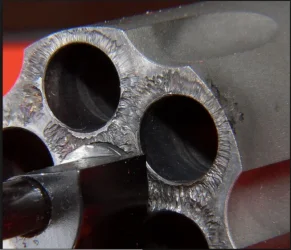
Here's a pic of this erosion:
1000026808.webp

I like light weight for edc, but any gun that will "self destruct" if I use the same cleaners/cleaning methods or ammo that work FINE on all my other carry revolvers... has no place in my rotation.

That's why I swapped out the cylinder on my 386pd (pictured previously). It brought the weight up from 17 to 23 or so ounces, which is nicer to shoot and still very light for an L frame. And I can clean and load it just like all my 686, 64, 65, 340 etc..
 
If anything but the lightest weight is your priority, don't buy a titanium revolver. Its light weight is the ONLY advantage over steel; for anything else, especially durability, titanium is not your friend...
 
I've also heard that titanium cylinders improve longevity for gun games like USPSA. In fast double action shooting, the weight of a steel cylinder repeatedly slamming into place can cause premature wear to the cylinder stop notch (I think - not something I've experienced myself).
 
Regarding this "special coating" that is mentioned repeatedly for S&W titanium cylinders... I'm almost certain that the "coating" that S&W refers to isn't anything S&W applies to the cylinder, but instead the natural titanium dioxide passive layer that naturally forms on the surface of titanium and titanium alloys from its chemical reaction with oxygen in the air. This titanium dioxide layer is the basis for titanium's corrosion resistance, and it also has some heat resistance as well. Titanium is a reactive material that quickly oxidizes on the surface. Using aggressive abrasives creates scratches that disrupt the passive TiO2 layer and also contaminates it, reducing its corrosion and heat resistance. The same applies to stainless steels, where the chromium in the material reacts with the oxygen in the air to form a passive layer of chromium oxide, giving it the same protective outer skin.
 
Regarding this "special coating" that is mentioned repeatedly for S&W titanium cylinders... I'm almost certain that the "coating" that S&W refers to isn't anything S&W applies to the cylinder, but instead the natural titanium dioxide passive layer that naturally forms on the surface of titanium and titanium alloys from its chemical reaction with oxygen in the air. This titanium dioxide layer is the basis for titanium's corrosion resistance, and it also has some heat resistance as well. Titanium is a reactive material that quickly oxidizes on the surface. Using aggressive abrasives creates scratches that disrupt the passive TiO2 layer and also contaminates it, reducing its corrosion and heat resistance. The same applies to stainless steels, where the chromium in the material reacts with the oxygen in the air to form a passive layer of chromium oxide, giving it the same protective outer skin.
Aluminum also forms an oxide layer on its surface and aluminum oxide is quite hard.
 
Have see posts where someone removed the protective coating from a S&W cylinder and was put on the "no fly list" for doing that:-)

Here is a polished Titanium unit - go figure:

https://gunmagwarehouse.com/blog/taurus-85-total-titanium-a-quality-revolver/

P.S. Wish S&W would use steel cylinders on their competition based revolvers (986/929), leave the Titanium on the carry guns.
On that Taurus, it does have a coating. The "bluish irridescent" finish the author refers to is a PVD (physical vapor deposition) coating that is very hard that was applied to the outer surface of the titanium. It is much like the so-called "rainbow" finish Sig applies to some of their pistol slides. It is a super hard micro thin coating that is like the coatings applied to carbide cutting tools like end mills, drills, and machining inserts used for metal cutting to improve heat and wear resistance. DLC and TiN are examples of types of PVD coatings that are commonly used on firearms.
 
If anything but the lightest weight is your priority, don't buy a titanium revolver. Its light weight is the ONLY advantage over steel; for anything else, especially durability, titanium is not your friend...
Well, it does require being cautious about not scratching it up and not using harsh chemicals on it, but it's not as delicate as people make it sound. As long as you don't scrub it with something abrasive and scratch it up or use heavy ammonia solvents on it, it will last a long time. Just be aware of that, and clean the surface with a CLP and a cloth, and you're fine. Sure, it's not as forgiving of hard use as steel, but it does have other advantages over steel besides weight savings. Titanium is also super corrosion resistant, more corrosion resistant than even stainless steel is.
 
In my practical shooting days, Ti was used on various 1911 parts. Not as durable as steel . Gains where imaginary but expense was not.
 
Back
Top