trigger job

creekman

Member
Joined
Sep 26, 2017
Messages
205
Reaction score
60
City & State/Province
Murrells Inlet, SC 29576
Has anyone had a trigger job done on a Colt Combat Commander? If so, what was done, and how did it turn out? I and a friend former pro shooter feel it is rather heavy out of the box.
 
A very open ended question with so many factors that it cannot be answered without knowing what was done to YOUR gun...
 
Since most triggers lighten up with use, I recommend breaking it in before dropping money on a trigger job.
 
Difficult to answer as there are a lot of variations in 1911's, and since I do all my own I have seen some hammers with the hook having way too much engagement, and recently a S&W where the hammer and sear were coated with a black matte finish that was not smooth. Had to stone through it, didn't take much was more of a baked on paint. Also changed the mainspring to a 19 lb competition spring.

In some guns the inner trigger bow channels are rough and that contributes to a poor trigger. So, it could be several things. If you haven't done one before, you may want to consult a gunsmith unless you are willing to make your present gun a learning experience.

Get the Kunhausen Shop Manual for 1911's, and see several youtube video's on 1911 trigger jobs.
 
Most 1911's today have pretty decent triggers out of the box. Still, all stock 1911's can be made to have a better trigger with just some internal polishing.

To your specific gun, it really depends on what you intend to do with it. The trigger on most new Colts I've handed would be just fine for a self defense purposed gun. However, if you want a range/competition gun, you may want to rework it to some degree.
Personally, I don't think that lighter is always better in a carry gun.
 
One of the tricks I use is a Wilson 4 leaf Mainspring. It reduces the pressure on the trigger bow. Also you can add a lighter power hammer spring.

There are gunsmiths that hone the engagement of the sear, but I'm not one (nor am I a gunsmith!)

When replacing trigger, disconnector and sear parts, spend the extra dollars and only buy Colt or Wilson products. I had a number of grip safety failures caused just slightly out of spec BRAND NEW parts.

Ivan
 
One of the tricks I use is a Wilson 4 leaf Mainspring. It reduces the pressure on the trigger bow. Also you can add a lighter power hammer spring.

There are gunsmiths that hone the engagement of the sear, but I'm not one (nor am I a gunsmith!)

When replacing trigger, disconnector and sear parts, spend the extra dollars and only buy Colt or Wilson products. I had a number of grip safety failures caused just slightly out of spec BRAND NEW parts.

Ivan
 
Not a Combat Commander, but several years ago I had a Colt Series 80 Government Model and had a trigger job done on it. The factory plastic trigger was replaced with a Wilson trigger and the spur hammer was replaced with a Wilson round commander hammer. I'm not a fan of light triggers so I specified a 4.5-5.0lb pull weight. The result was very good, IIRC; a nice, clean break without being anywhere near a "hair" trigger.

I'll echo the advice that you may want to wait and break the trigger in a little before having a trigger job done, if you haven't done that already. Fire a few hundred rounds and do some dry fire practice, then re-evaluate.

If you do decide to get a trigger job done, make sure to use an experienced, knowledgeable gunsmith to do the work. You don't necessarily have to go to one of the more famous/popular/big name gunsmiths, but you don't want to skimp or cut corners, either.
 
Last edited:
My first venture into gunsmithing started when I did my own trigger job on my Colt Combat Commander, 70 series, electroless nickel finished, under the close supervision of a gunsmith who was a police department armorer. He had me put 350+ rounds through it and dryfire another 200 times before starting the work. The gun was lightly used and had very little wear on it when I picked it up. After my break in period it showed some definite wear patterns. Stoning these areas and polishing all but the sear and hammer engagement areas took several days. I had to do a ton of work to the back side of the trigger bow due to heavy and rough plating of the e-nickel. I was instructed that the springs are to not be touched unless as a last resort or failures to fire. Stoning and polishing alone took my trigger pull from an awful 11lb creeping pull to a butter smooth 4lb crisp break. No further "Tuning" was needed aside from polishing the feed ramp to a mirror finish. Its ability to feed any and all bullet types including the well known 200gr flying ashtray's from Speer was amazing.
A little bit of mechanical ability, some good Arkansas stones and some super fine emery cloth can do wonders on a 1911.
 
Nic Taylor00 has a great series of videos on tuning up your 1911. They are not trigger job videos per se but they will improve your trigger. These steps are part of a complete trigger job though.
They improved my 1911 and helped give me the confidence to learn to perform a quality trigger job.
[ame="http://www.youtube.com/watch?v=ZyKhTsYfH6A"]https://www.youtube.com/watch?v=ZyKhTsYfH6A[/ame]
 
Did it in my '70 serie CC.Simply polished parts with an awful small grain emery paper and with an awful lot of patience since it meant dissassembly and reassembly and do it all over again.Just make sure you don't change the angle of the parts that are in contact with other parts.
The then no 1 IPSC guy of the time told me that while not being the lightest triger he had seen,it was sure one of the smoothest.
Now,with the web,it should be easier for you than it was for me to do it.It's a labour of love.You can do it!just take your time.
 
Two things with trigger jobs, stay away from gunshow guys with files and stones and definitely stay away from those who use the dremel tools. Let a good professional pistolsmith do the job. He has the jigs and fixtures along with the know how to do a trigger job. Bubba don't. Frank
 
I like to break a new gun in with a lot of lube so that I don’t make any rough spots into even worse spots. After plenty of rounds I disassemble and look for rub spots on contact areas and then polish those areas and that will usually leave me with a pretty good trigger. 1911 trigger information is easy to find and the trigger is simple compared to most others.
 
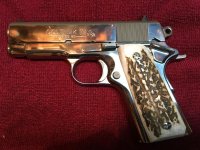
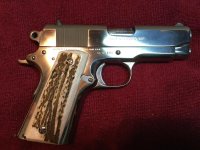
I get rather leary of trigger and action jobs. All the ones I have ever had done have been done at the respective factory. When i lived in CT, I took my 1985 Colt officer's acp and marched it right through the doors of the Colt Custom Shop. I had them polish it out to their bright stainless finish, and polish and tune the action. At the time the whole bill was 100.00. They did a great job.

I just recently put Grashorns on it
 

Attachments

  • OACPL.jpg
    OACPL.jpg
    101.1 KB
  • OACPR.jpg
    OACPR.jpg
    81.7 KB
creekman what are you expecting for a " trigger job " A commander will not be a bullseye handgun so your want ?? A smoother lighter trigger pull . Maybe a bit lighter too ?

First off what is your trigger pull weight and what do you expect . If your don't know have the former pro tell you as he should have a good trigger pull gauge . Maybe your trigger function is fine for you so decide if you only want to change it because your friends made you think it should be better .

How is the reach to the trigger for you . Does your trigger have some movement up and down , side to side ? An ed brown trigger is a bit over sized vertically and can be fit to your frame and this is a good reason to change the length of pull too if needed to a medium or short trigger assuming yours is a long reach now . Grip panel thickness also aid in grip trigger control . Beyond that does anything else really need to be "tuned up " .

Polish the trigger bow sides and radius the edges helps to improve that part . Clean the fire group is all that's needed and cheack the pull weight and feel . Only thing else you may need is tuning the sear spring for pull weight . Keep the stock 3 blade style sear spring . Better buy a few extra springs as ts easy to screw a spring up nd a 3.5lb pull weight is as light as needed for a defensive trigger handgun . Leave lighter triggers to the toy boys . Also leave some take up and over travel in a defensive trigger too . I have used graphite powder for some years in 1911 trigger groups and some revolvers an make for a very slick trigger group function hat can make the trigger pull lighter on its own .
 
Changing the recoil and trigger mainspring (I use a 17 lb mainspring) helps but do not bend the arms of the sear spring to reduce trigger weight. It can result in the hammer following the slide down if taken too far on the sear leaf.

I use a diamond knife sharpening hone to smooth up the sides of the sear, disconnector and hammer, those parts that move up and down or rotate, to reduce metal on metal drag. I also lightl polish the disconnector surfaces where they contact the rear of the trigger bow and the sear. Same with the sides (inside and out) of the trigger bow which can rub against the trigger channel and magazine and the rear disconnector face of the bow. This simply removed the high and low spots on the metalsk surface caused in the manufacturing process.

The hammer hooks must be square. And the hook height must never be below 20 thou of an inch. If you don”t have the necessary skill and tools don’t touch this area at all.

Never touch up the sear unless you have the correct sear jig and feeler gauge.

I recently polished up the parts on a new 1911. On reassembly I found the trigger crisp but heavy. Then I remembere that the sear spring had appeared quite heavy to me so I replaced it with an EGW sear spring rightnout of the packet. The change in trigger weight was significant, so first step would be to change all three springs and see what difference it makes before even stripping down the pistol and looking at the trigger parts.
 
Trigger job on any firearm is a loaded and very broad question. Can you do it yourself? Yes, there are kits out there that contain a hammer and sear, maybe even a new trigger and springs, that allow anyone with very basic skill to install an improved 1911 action. I've used some and they work rather well.

Beyond that, you either take the time, buy the jigs and stones and a few sacrificial parts and learn to do it correctly. If you don't do it correctly you can easily end up with a full auto 1911.

If neither of those options appeal to you, then factory custom shops will usually perform such work or take it to a qualified gunsmith.

Oh, and your friend felt that the trigger was a bit heavy? How does it feel to you? And what is the intended purpose of this Colt Commander? Light triggers are fine for competition pistols, but have no place on defensive firearms.
 
Back
Top