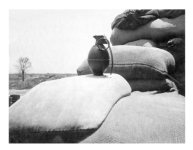
US M67 Type Hand Grenade

wood714

Member
Joined
Dec 18, 2010
Messages
5,448
Reaction score
16,985
City & State/Province
Florida
I know great multitudes of y'all are or were in the military.

Just wondering if the round style hand grenades were perfectly round or had a flat spot on the base like the fake grenades have.
 
Not sure! I’ve never got to throw one, but know guys that have done so.
 
The M67 is nominally round on the bottom, but in my experience exactly how round varied slightly. They've been made by a number of contractors over the years. They are made from two steel stampings with serrations on the inside of the case to promote fragmentation and the two halves are welded together.

main-qimg-332cca6eadd730443b6050e5e1ec2c41-c


The M69 practice grenade has a hole in the bottom to vent the gas from the fuse, which makes it "flat" on the bottom.
 
Last edited:
It has been too long (48 years) since my last return from a combat zone. I really don't remember whether or not there was a flat spot on the bottom.

Basically a sheet metal sphere over a coil of pre-segmented heavy gauge wire (providing the fragmentation effect) around an explosive charge with a threaded port at the top for inserting the cap-fuse-safety lever device. When the pin was pulled it allowed the lever to open under spring pressure with a small striker hitting the fuse igniter cap (made a little "pop" sound like a cap pistol, then a bright red burning element as the fuse cooked off toward the blasting cap).

Little smaller than a baseball. Weighed less than a pound.Typical fuse provided a 5-second delay. Bursting radius of about 5-7 meters. Most trainees were able to throw one accurately at area targets at about 50 meters distance.

Not particularly effective in open areas, but very useful in enclosed areas like buildings, bunkers, tunnels. Not at all like we see in movies, relatively little explosive force (designed to cause wounding, not destruction), sounded like a large-bore shotgun going off, only a moderate flash (hardly visible in daylight) not at all like a bomb, artillery or mortar shell.

Kind of like a multi-directional short-range shotgun.

We also used incendiary grenades; thermite, which burns through metal like a cutting torch, and white phosphorous, which is a bursting grenade releasing burning phosphorous over a target area to cause fires). Concussion grenades provided an explosive effect without shrapnel effect.

In addition to time-delay fusing there were impact-detonating fuses. Throw the grenade and it will detonate when it strikes something. These could be used with any of the different grenades, but were pretty tightly controlled because they are very dangerous little toys.
 
The M67 is nominally round on the bottom, but in my experience exactly how round varied slightly. They've been made by a number of contractors over the years. They are made from two steel stampings with serrations on the inside of the case to promote fragmentation and the two halves are welded together.

main-qimg-332cca6eadd730443b6050e5e1ec2c41-c


The M69 practice grenade has a hole in the bottom to vent the gas from the fuse, which makes it "flat" on the bottom.


I think BB57 has provided the answer. The dummy grenades are probably made up from M69 practice grenades.
 
The M67 is nominally round on the bottom, but in my experience exactly how round varied slightly. They've been made by a number of contractors over the years. They are made from two steel stampings with serrations on the inside of the case to promote fragmentation and the two halves are welded together.

main-qimg-332cca6eadd730443b6050e5e1ec2c41-c


The M69 practice grenade has a hole in the bottom to vent the gas from the fuse, which makes it "flat" on the bottom.

Thanks, appreciate it!
 
Basically a sheet metal sphere over a coil of pre-segmented heavy gauge wire (providing the fragmentation effect) around an explosive charge with a threaded port at the top for inserting the cap-fuse-safety lever device.

The notched fragmenting wire, early round, later square, was used in the M26/M61 egg-shaped or lemon-shaped grenade. That was the one used in Vietnam. The purpose of the grooves in the cast-iron body of the U. S. WWII (and later) Mk 2 "pineapple" grenade was not for fragmentation, but rather for allowing the thrower to have a better grip. Same for the British "Mills" bomb grenade. A long time ago, I saw a Mills bomb which was much larger, about the size of a real pineapple. I was told it was used by the British during WWI for dropping from aircraft onto enemy troops. I have never seen another.

Back when I was a kid, in my old home town there was an iron foundry which cast the Mk 2 grenade bodies during WWII, they didn't make grenades, just the cast iron bodies. Many of the local kids had grenade bodies as toys to play with, probably brought home by foundry workers. There were probably many other small foundries doing the same thing. That foundry is still in operation today, no idea what they make now.
 
Last edited:
I think I threw the M-61 in basic training. I don't think Paul Bunyan could throw one of those 50 meters.
 
Grenade chucking by hand was never my strong suit. I'd much rather fire off one of these (photo is of practice grenades).

John

RIFLE_PRACTICE_GRENADES_zps1truedpm.jpg


RIFLE_GRENADE-GERMANY-1945_zpshzvxbfds.jpg

Germany, 1945: M1 carbine equipped with grenade launcher.
 
Last edited:
I think I threw the M-61 in basic training. I don't think Paul Bunyan could throw one of those 50 meters.

I remember in basic in '65, most guys threw live M61's in the 25 to 30 meter range. Anyone that threw one 40 or more meters got their name put up on a board and the approximate distance. Few did.
 

Attachments

  • 02 - Apr. - May '67.jpg
    02 - Apr. - May '67.jpg
    61.7 KB
I never saw or fired a rifle grenade. M79s took their place and the 203 units were starting to come out. We had baseball frags as well as both WW2 pineapple and lemon type that replaced them. We also had thermite and gas/ smoke types too. I hear talk about cherry frags in RVN. I never
saw anything smaller than the baseball frag.
 
Back when I was a kid, in my old home town there was an iron foundry which cast the Mk 2 grenade bodies during WWII, they didn't make grenades, just the cast iron bodies. Many of the local kids had grenade bodies as toys to play with, probably brought home by foundry workers. There were probably many other small foundries doing the same thing. That foundry is still in operation today, no idea what they make now.

I've been looking for a non drilled US grenade for years.

I have a old pineapple grenade I bought back in the early 80's and had the machinist where I work press a steel plug in the hole. Years later covered it with JB Weld and it looks pretty darn close to real, but man I'd love to have a real "empty" one.
 
Most trainees were able to throw one accurately at area targets at about 50 meters distance.

US Army BCT (Basic Combat Training) March 1975, Ft. Polk, LA: I was a young (18 yrs. old), short (5'5'"), former fat boy (from 170 lbs. down to 130 lbs.), "Ore-Eye-ental recruit who couldn't see over the parapet of the pit we were throwing the hand grenades from. 2 things I recall that were unsettling to me: 1) all of the instructors were speaking to us using normal language. No insults, no threats, no name calling - unsettling to say the least, and 2) all of the instructors were alert, but very calm. When I threw my first of 3 grenades, it seems like it barely left my hand when the instructor said "nope, that's no good, stay down" as he pushed me to the bottom of the grenade pit and knelt over me. The grenade detonated and I recall some dirt falling on top of us. I thought the instructor was going to eat my lunch over my bad grenade throw. Instead, in a very calm manner he explained the blast radius of the grenade was approximately 10 meters, and that my throw was probably just under that distance. He then said "I know you can do better than that, and I expect you to hit the first bank of tires with your next throws." When I asked where the banks of tires were, I think he realized I was too short to see over the parapet, so he walked me a few yards down the pit to a small periscope where I could see banks of used tires marked "20", "30", and "40" meters.

Not wanting to disappoint the instructor, nor wanting to get injured in the grenade blast, when it was my turn to throw my grenade I placed my left hand on the edge of the parapet and levered my upper body upward while throwing the grenades. I don't know how far I threw the grenades, but I got an "atta-boy" from the instructor and passed Hand Grenade 101.

Regards,

Dave
 

Latest posts

Back
Top