War Stories

Not a WW2 story, but one that I loved to hear:
My father in law was an Air Force FB-111 pilot in Vietnam. Just before the end of our involvement over there, he was shot down and injured, but managed to make it back to friendly forces on his own. When he got out of the hospital, he was assigned light duty in the crypto room at Tan Son Nhut airbase outside of Saigon. He would stay locked in the underground vault of the crypto room for the duration of his workday. One day when he finished up, he headed out to find everyone gone. Looking outside, he saw NVA regulars swarming all over the place. He crept back downstairs and destroyed all the crypto gear and shredded all of the most secret documents. By then it was getting dark and he was able to knock out one of the NVA guys that was off by himself and donned his clothing and headgear. He was a small guy, 5’4” and slightly built like most pilots were, so he just nonchalantly strolled right past everyone keeping his eyes on the ground. He made it over to the motor pool and hopped in a 6x6 troop carrier truck and crashed the gate. The NVA started shooting at him almost as soon as the truck got rolling, but he had aimed the truck at the gate and lain on the floor and used his hands to work the accelerator and clutch. He made it out of there with just bumps and bruises and cuts from all the shattered glass. He said that when he made it to safety and finally stopped, they tried counting all the bullet holes and quit after a couple hundred.

I have to admit, I thought his story was pure BS the first time he told me, but after getting to know him over the course of many years, he was the most honest man I have ever met. He retired from the Air Force a full bird Colonel, and it made me so proud when he wore his dress uniform to give his daughter away at our wedding.
 
Not a WW2 story, but one that I loved to hear:
My father in law was an Air Force FB-111 pilot in Vietnam. Just before the end of our involvement over there, he was shot down and injured, but managed to make it back to friendly forces on his own. When he got out of the hospital, he was assigned light duty in the crypto room at Tan Son Nhut airbase outside of Saigon. He would stay locked in the underground vault of the crypto room for the duration of his workday. One day when he finished up, he headed out to find everyone gone. Looking outside, he saw NVA regulars swarming all over the place. He crept back downstairs and destroyed all the crypto gear and shredded all of the most secret documents. By then it was getting dark and he was able to knock out one of the NVA guys that was off by himself and donned his clothing and headgear. He was a small guy, 5’4” and slightly built like most pilots were, so he just nonchalantly strolled right past everyone keeping his eyes on the ground. He made it over to the motor pool and hopped in a 6x6 troop carrier truck and crashed the gate. The NVA started shooting at him almost as soon as the truck got rolling, but he had aimed the truck at the gate and lain on the floor and used his hands to work the accelerator and clutch. He made it out of there with just bumps and bruises and cuts from all the shattered glass. He said that when he made it to safety and finally stopped, they tried counting all the bullet holes and quit after a couple hundred.

I have to admit, I thought his story was pure BS the first time he told me, but after getting to know him over the course of many years, he was the most honest man I have ever met. He retired from the Air Force a full bird Colonel, and it made me so proud when he wore his dress uniform to give his daughter away at our wedding.
The FB-111 never flew in SEA.
The F-111 flew there on two different deployments.
I don’t recall any F-111 crewmembers ever got recovered after shootdown.
PM me this gents name.
I will determine true or false.
Side story -
My old Buddy Pepper was the right seater of a F-111 headed into Hanoi one dark and stormy nite.
The F-111 had for that time an advanced bomb navy system.
When you radar bomb you put your crosshairs on the aiming point, and the bombing computer computes the course and release point.
The F-111 did this for you.
Pepper selected the final aiming point, but the crosshairs didn’t go to the radar return that he expected.
So he tells his pilot, i don’t see the aiming point.
Pilot say, what do we do?
Pepper say, go back out to the IP (initial point) start again.
So they do. So they get a lot of AAA fire.
Lucky not to be shot Down!
So Pepper asks me, does that sound like something you might do?
Yes, actually it does.
But I wouldn’t tell many people about it!
You could get your smart card cancelled!
 
Last edited:
My father, one grandfather and three uncles all served in WW2, and there was a five star son-in-service flag in our window. Luckily, all came home.
One uncle enlisted in the Navy at age 16, and was in combat in the Pacific as a torpedoman on the USS Jenkins, DD-447, before he was 17. He related this story to me not long before before he died, and got choked up as he told it.
I'll borrow the tale from a shipmate of his to save a bunch of typing:

Saving Jenkins

By Paul E. Mahan, TM3/c
"This story I am about to relate is still painful almost 57 years later, but I am sure it’s not nearly as hurtful to me as it was to some of my shipmates who went through so many battles on the Jenkins prior to the one in Borneo.

In April 1945 we left Subic Bay in the Philippines and steamed down to the island of Tarakan in Borneo. They told us this was a very important oil field still in the hands of the Japanese and we were to help destroy their defenses prior to our troops landing. I can still see the huge oil tank burning after strafing by our P-38s and our bombardment.

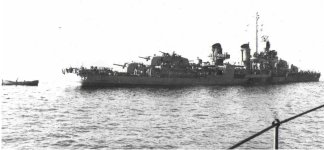
We were firing in the landing area for several hours along with other destroyers including some from the Australian Navy. As we started to leave the harbor, chow time was announced and down I went to the mess hall. I had just picked up sandwiches and sat down to eat when there was a big explosion. Every mess table hit the deck. The lights went out but almost immediately came back on. I recall going to the ladder regularly used to go down to the mess hall. The hatch was closed. I then went to the ladder where we normally exited the mess hall. It is not clear to me but I think it was gone. By this time the mess hall was almost empty and I could see the men going forward. Also by this time the sea water and oil were almost knee deep and I can still hear some of the men yelling “hold your head, hold your head.” Finally the single line of men moved through the bunking compartment and I saw the ladder and hatch where the men were exiting. However, with so many men in front of me and the water and oil rising so fast, I realized that my chance of reaching the that small opening before the compartment flooded was impossible. Since I was the last man out of the mess hall and last in line with no hope of getting out, for some reason—and I don’t know why—I looked behind me. Two men had dropped out of line and had the hatch door almost closed from the bunking area we had exited. I remain fully convinced today that this single act saved not only the lives of these two men but at least 15 more of us, because just moments later the compartment was flooded (see note ***, below).

After getting topside, a number of the last ones were covered with oil. We were told we’d blister in the hot sun and to shed our oil-soaked clothes. Somewhere I got a towel and rubbed off as much oil as I could. Since I was on the fantail, close to the compartment where I bunked, I got tired of walking around with no clothes on so I decided to go below and find a pair of dungarees. (While that area of the ship was not damaged, we were fearful of going below because there were rumors we could go down.) That was a fast trip below. Also, somewhere in this area were men from the fireroom who were burned, laying on the deck and being attended to. I had stepped over one of these men and came aft from the mess hall and always thought he had died. I found out later it was Charles McArthur. I could not believe it when I saw him at our reunion in San Luis Obispo, California, in the early nineties, and shed some tears of joy that all the men who were burned and laying on the deck had survived.

Sometime later that afternoon I remember a couple of attempts to tow us out of this Jap-held harbor but the two ropes broke. I remember being told that a sounding procedure showed the bow of our ship was resting on the bottom of the harbor. In all the confusion, I understand a chief named Cash put on a diving helmet, went into the flooded compartment and was able to get some hatches closed. Some of the crew started pumping and at daybreak we were still afloat. I tried to sleep on the deck that night and didn’t dare go below. I had plenty of company around me. I’ve often wondered if we were the only ship in the US Navy in World War II whose bow rested on the bottom of an enemy harbor, came back to life a few hours later, and was not boarded by the enemy.

I’ve also continued to wonder why every ship in this invasion force went out to sea and left us in that harbor alone overnight. This was before D-day, we had no defense, just a sitting duck for the Japs to board us. We, to my knowledge, did not know for sure that we would be afloat next morning. Someone had to be watching over the Jenkins crew. I remember the next morning some kind of ship came alongside and many of us went aboard a cruiser, either the Boise or the Phoenix (I cannot remember which one). What I do remember is being allowed to take a freshwater shower to remove the oil and grime and being furnished with clean clothes. I also remember how well the crew of that cruiser treated us on the way back to Subic Bay in the Philippines. Just a few days later, we were so happy to witness, from the deck of that cruiser, limping into Subic harbor the oil-stained, crippled Jenkins, our home. It didn’t look a lot like a Mighty J at that time in her career.

When the Jenkins went into floating drydock and the water and oil drained out of her, some shipmate came to me and said, “Mahan, we found your wristwatch down in the mess hall.” I was shocked but happy because I had missed my wristwatch. (Prior to going aboard the Jenkins, I had served with a detachment of men who landed just behind the army on Manus Island in the Admiralties. There we set up a torpedo shop and furnished at ready torpedoes to the fleet and air force for the Philippine invasion. One of the motor macs had made me an aluminum watch band from a damaged aeroplane wing and had inscribed my name on it. This it was returned to me by one of the crew.) All I could ever figure out was that the mine explosion blew the watch off my wrist there in the mess hall, yet I was not injured.

I recall the happy day when temporary repairs were finished and we left Subic Bay for home. Thanks again to Bob Rinde, my shipmate from North Dakota, I still have a small portion of the homeward bound pennant. I also recall such heavy seas we encountered as we were leaving the Philippines. Here we were, a seriously damaged ship, now in a serious sea condition. One night we were rolling and pitching so much I couldn’t stay in my bunk. Finally I just strapped myself in and went to sleep and woke the next morning to a much more friendly sea. The repairs at Subic must have been good.

We were happy to see Pearl Harbor. We spent a night there and left for the mainland next morning with one of our crew missing at muster. Somehow during the night one of our shipmates had exited the Jenkins and drowned. That brought a somber note to the crew in view of what we had just been through.

Since we had no refrigeration, we ate spam every day I do believe. I cannot recall the number of days from Subic to Long Beach. California, but it seemed forever. One thing I do remember is when we tied up at the pier in Long Beach, several men jumped off the Jenkins and kissed the ground.

Finally, do I want to go on a cruise ship to some exotic port? Never. Do I want to watch some of the recent popular movies about ships sinking? They are still to painful. When I was first approached about coming to a Jenkins reunion in the eighties, I was most reluctant because of the Borneo experience I have just described. Now, however, I am so glad some of our crew, and especially Bob Rinde, kept after me to attend. The reunions have been such great ones with such a wonderful crew; I wish they could go on forever. The people at the Nimitz Museum in Fredericksburg, Texas, where our beautiful plaque is located, told me many times that I served on a famous and highly-decorated ship. What a crew.
***Note:[At my first reunion in 1982 in Marietta, Georgia, I found out that Pat Weir was one of the men trying to get the hatch closed. Pat told me a mattress cover had lodged in it. He also told me the man helping him was named Jones. From all my conversations with some of the men in the mess hall (it was reported to be 70), no one but me witnessed this heroic deed. A number of shipmates know we tried for years to get these men the rewards they so richly deserved. Finally, after the navy brass continued to say “too many years have passed,” Pat Weir did receive a letter of commendation from the Navy but nothing remotely near to what he deserved. (Our shipmate Jones had passed away by this time.) Pat Weir will always be my hero. Part of my appreciation to him is on the first page of our Jenkins songbook which I developed a number of years ago.]

So to those of you I sailed with, I salute each and every one in a special way. To the men of the Korean and Vietnam Wars and in peace, who came behind us and also served their country aboard the Jenkins, we give you the same salute. We know you will keep the Jenkins name forever afloat long after those of us in World War II are gone."
USS Jenkins (DD-447, DDE-447) — Saving Jenkins
 

Attachments

  • USS Jenkins DD447 on bottom of Jap-held harbor.jpg
    USS Jenkins DD447 on bottom of Jap-held harbor.jpg
    98.5 KB
Last edited:
My dad was in the Navy in WWII, and was recalled to active duty during the Korean war. He and my mother divorced when I was 5, and I didn't see a whole lot of him until after I'd gotten home from the Navy myself. Dad never talked about his service, other than he was a metal smith, and after his service he worked as a body shop man and later was the body shop manager at a Ford dealership until he retired.

Dad had remarried while I was away in the Navy, and I really liked my stepmother. One day shortly before his death at age 92, my stepmother made a remark about how much longer she had lasted than his first wife. He said, "Well, you aren't my second wife...you are my third." This was quite a bombshell, since neither of us had ever known that, and neither did my mother (I asked her later.) Dad said his first wife was a Navy nurse he met and married during WWII, but she was killed in the Philippines. Dad was still pretty sharp, despite being very sick with cardiac disease, but his memories were getting a little vague. He had never been one to exaggerate or lie, so I believed him.

I wish I had followed up, because it might have been interesting history...but I don't know her name, other than he said her first name was Mary, and that he had loved her. I don't know if she took his name or not. I'm assuming there were some pretty strict regulations in place at the time about marriages between two service people, especially one being an officer and one being enlisted. I doubt that the records exist now, after so many years. My dad, mother, and stepmother are all gone now anyway, so it's kind of irrelevant anymore, and she wasn't my stepmother since I hadn't been born yet. Just a surprise about my dad that he had kept for many years.
 
I have told this tale of my uncle in Bataan before but I feel it need a re-telling.

The American forces had fought the Japanese to a stand still with neither side victorious. The Jap general Homa waited till reinforcements arrived and more ammo to press the attack. There was a lull in fighting for a while during the wait. The Americans were starving so hunting monkeys was a source of food. My uncle, a private, had won 2 45's in poker games and was using one to hunt monkeys. He shot one monkey and it hit the forest floor and scurried off wounded. On his hands and knees he was looking for a blood trail. He encountered the largest pair of feet he had ever seen. Looking up he saw a huge Jap soldier point a rifle at him. He motioned for my uncle to rise and remove his gun belt which uncle did. At this point he motioned my uncle to back up. The Jap then laid his rifle down, turned his back to my uncle and started inspecting his pistols. Upon finding the one he liked, he tucked it into his belt, dropped the other, retrieved his rifle and walked away. My uncle grabbed up the remaining 45 as was going to shoot the Jap buy did not think he could kill such a large man with such a gun. My uncle returned to base with one less pistol, no monkey and a hell of a story. Rest in peace Unk.
 
My father never spoke much of the war, but he took his discharge in Hawaii, and was a bouncer and a blackjack dealer in Honolulu. Those stories were good. Some were real good.

Lt. Col Charlie Weisel was a friends father. He told me he was a German ace, since he was shot down five times while he was a bomber pilot in the USAAF.
 
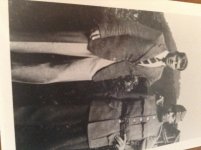
Pop (L) and his younger brother about a year before Germany invaded Poland.Two of their sisters were here in the U.S. traveling with a diplomat and his family (nannies). They couldn't go back nor communicate with home for the duration.Both married GIs during the war.One uncle trained with the 10th mtn division at Camp Hale,but was sent to the pacific theater.He never talked about it,but wouldn't own nor let my cousins buy a Japanese car.The other uncle,I didn't know.
 

Attachments

  • image.jpg
    image.jpg
    84.3 KB
I'm going to tell a couple more then I'll leave ya'll alone. I said earlier that I worked at a grocery store so I got to meet a lot of people. A lot of them were older vets. I remember one, a small man, wearing a cap that said "17th Airborne." That was sort of a new one to me, so I asked him about it, then asked if he had jumped into Normandy, to which he replied that they had missed that one, but they had jumped in what he called, "The last big push crossing the Rhine." He told me the "The Krauts had some big guns that we needed to take. In Market Garden, they had dropped paratroopers a couple of miles from the guns, and they had to march a few miles to get to their objective.

This time, they decided to drop us right on top of the guns. Can you believe it? Some guy who went to West Point came up with THIS plan no doubt. Well, those Krauts shot the XXXX out of us on the way down." Then once again, as every vet I ever met did, pulled himself up and swelled with pride..."But we took those guns."

Then one evening I was going out with an older woman, older than I was anyway. She was a tiny thing, a classic "little old lady." As we talked I commented on her accent. "You ain't from around here," I joked. She looked at me, and asked "Where do you think I'm from?" I told her, "I have no idea, somewhere in western Europe, I suppose." She smiled and said, I'm from Belgium. I was ten years old when the Germans marched into my village. I was fourteen when the British pushed them out. You can't imagine how excited I was. A few years later, I married an American, and here I am."

She got into her car, and I never saw her again. I think she would have had an interesting story.

There were others. A fellow who had been on a "Jeep" carrier at Iwo Jima, a B-24 command pilot, and one who had driven a landing boat at Okinawa. Probably some others I'll remember as I gather wool.
 
The most heart felt story I ever heard came from the mother of the first lady (Erma) I knew after my wife past. Erma past after living with me for about 3 years. Her mother told me about being a little girl in Nazi Germany and receiving an award from Hitler himself. She was so proud at the time. Then war came and they had to move all over. Then her and some family were trapped in a bombed building collapse. They were there in the dark and she was crying, an old man held her hand and assured her that it would be alright, everything was going to be OK. He continued to hold her hand and comfort her. When rescue workers dug them out. the old man was dead.

She told about fleeing the bombs and then the Russians. She never hated America, it gave her a good life. She does hate war.

Like I saidd, most real war stories are not "good" stories. Make you think stories, Yes.
 
Last edited:
My uncle was drafted in 1967 or '68 and I believe served one or two years in vietnam. I'm sorry but I don't remember the unit he was with but it was the Army. He was part of a 25 man crew including a officer that would plow down the jungle and make roads. He drove a bulldozer. One day he ran over a improvised mine or bomb and took shrapnel that hit part of his face. Many years later he finally had it removed as it was starting to bother him.

But the main story is one day, he & the rest of the crew were working, he had mechanical problems with the bulldozer and his CO told him to go ahead and head back to base since it was 4:30pm and they're done for the day at 5. As he was heading back to base, the rest of the crew were ambushed, and all were killed. He was 19 at the time and to this day, although he is very quiet about it, the guilt and the "what if" has been messing with his mind every since according to my mother. I still remember when he first came home back then, he was kinda jumpy... A backfire from a car would give him the sweats.
 
My Uncle Ernie was an engineer with Pattons army. My mom told of the time after the war when they were at a drive in & saw lightning bugs flying around. He threw her to the ground under the car thinking they were tracer rounds. Another time she woke him from a nap & he grabbed her & started choking her thinking he was being attacked by the enemy. She said he cried when he realized what he had done.
 
My dad's friends over here were mostly G.I. vets. One was a little guy who was a tail gunner in a B-17 late in the war. He saw an ME262 over Berlin. Couldn't fathom a plane so fast and it didn't have a propeller either.

Another, dad's best friend over here was a glider pilot. They went to Europe together in the 80s to check out all the spots they remembered. My dad swore he found the very spot he surrendered to the Americans. I'm sure they found quite a few drinking establishments too.
 
Last edited:
My dad was also born 100 years ago this month (Feb. 1, 1918). He served in the Pacific Theater during WW2 including Guadalcanal and Tonga, was wounded twice including a sniper bullet to the head resulting in hospitalization in New Zealand for over a year before coming home in 1946. During the Korean War, with 3 kids and a small business, the Army actually tried to call him back to active duty, bullet in the head and all.

In later life Dad suffered with neurological problems including narcolepsy (sudden episodes of deep sleep with no warning, no control, and of indeterminate duration). This resulted in the loss of more than one job. VA medical care was minimal and difficult to obtain. Dad never drew a dime of disability, worked until he died at age 62 (miacardial infarction, also known as massive heart attack). Paid into Social Security from the day it was created, drew one SS check then died, and we found his second check in his PO Box and SS Administration demanded its return before they would process his burial benefit.

Crusty old fart, but I would still like to sit down with him for a few beers.
 
Arjay, you jolted my memory. A buddy of mine Army Ranger went to the jungle training camp in Panama in, like, ‘65. He knew where he was headed, he was a HALO. Uncle Sugar sent him to Alaska.:rolleyes:

I knew a Judge, he was born in Frankfurt and came to the United States at age 12, with a brother and a cousin by way of Italy on the Kindertransport, the rest of the family being murdered shortly therafter.

The three of them were fostered by an attorney's family, went to high school. Each volonteered to serve thier new homeland towards the end of the war. The Judge, speaking fluent German was sent through an abriviated boot camp, christened an interpreter and quickly sent...

to the Philippenes.
 
Last edited:
I've posted this before in one form or another:
My stepdad was a POW on Bataan, and about the only stories he told about his experiences were about something funny or comical that happened to him; I always noticed that his fingernails and thumbnails were always dirty and misshapen, and I always assumed they were that way because he was a lifelong mechanic and he couldn't get them clean----after he passed away, that subject came up during a conversation with my younger brother, he said it was from torture during his time as a POW, they would shove bamboo splinters under his nails and light them on fire----the one thing that he mentioned to me once, that stuck in my mind, was that if a dog or cat got into the prison yard, that it was a goner. They were starving and being worked to exhaustion every day.
I don't remember him uttering a single curse word or ever complaining
about his lot in life, he did what The Army told him to do, endured the things he had to endure, and came home and went back to work.
He is my Hero!
olcop
 
My father in law was in the 101st from the beginning at Camp Toccoa all the way thru the war. He was in every major battle and was never wounded. He was one of 4 brothers who all served in heavy combat in WW2.
He never spoke of the killing. He had absolute respect for the Germans as being good soldiers.
He did say on D-Day that the sky was as bright as day and with all the anti aircraft guns - that all he wanted to do was get out of the plane.
We lost Mr. Beam in 2008. He was a father to me and I miss him to this day.
Mr. Beam is pictured in the lower right corner below.

PJAKITY.png
 
I had a friend that was stationed in a small town in northern Germany during the early seventies. He said that every morning an elderly woman would walk past the main gate pushing an old bicycle that had Sadler bags on it and by the rattle you could tell they were full of bottles. Then each evening she would come back by and stop at each post leaving a sandwich and something to drink halfway to the guard. Turns out her Family was saved by Americans during the war and she did this as a thank you. She knew not to get too close to the guards but most spoke some German and she would announce her intention's.
I also had an uncle that spent 4 years in a POW camp during WWII. He was captured his first month in Europe. Said he was glad he was captured because he wasn't sure that he could have survived otherwise. I always told him that he sold himself short. I cannot imagine what he suffered in that camp and he never spoke of it.

Sent from my XT1585 using Tapatalk
 
During the '80's and '90's, we took a series of ten foreign exchange students who lived with us for about eleven months each and went to high school here. In 1993, my wife and I took a one month tour starting from Sweden, then south in a big arc through Europe to France to visit them and their families.

Shortly before we left Paris for home, we were standing with Maude, the mother of one of our kids, at the wall at the Palais de Chaillot overlooking the Eiffel Tower. She was older than I, lived in Paris during WW2, and while we were standing there, did some reminiscing about German occupied Paris. Earlier, her parents, who were in The Resistance, told us some amazing stories and showed us pics of the fighting and liberation of Paris.
While looking at this man-made wonder, Maude told us she remembered thousands of people in the streets on VE day, and saw an airplane fly under the Eiffel Tower. She told us there was a news photographer on the mezzanine who snapped a pic for the newspaper, which appeared the next day.

After I was home and back to work, I ran into a woman I'd worked with off and on again over the years, but I hadn't seen for a while. She asked me where I'd been, and after I rattled off our itinerary ending with Paris, she sighed, "Oh, I've always wanted to see Paris."
I opined that if you liked big cities, Paris was wonderful, but I preferred other places we saw. I asked her why Paris?

She told me she was Polish, that her parents fled Poland after Hitler invaded and made their way to England. There, her father joined the Polish Wing of the RAF, fought from the Battle of Britain all the way through the war, and at the end of the war, flew his plane under the Eiffel Tower in celebration. She said he got into big trouble because the newspaper published a picture of his plane taken from the tower, with his buzz numbers plainly visible. That's why she wanted to see the Eiffel Tower.
It's a small world.

And that's the rest of the story.
 
Many years ago, I worked in a small hospital in East Texas. One of the older nurses, a lady named Hannah, was beginning to have mental lapses, and really needed to retire. We started finding bits of food stashed in the oddest places in the hospital. Unfortunately, we usually found the food once it had started to decay. We soon found that it was Hannah that was taking food from the patient's food trays and hiding them.

Our supervisor had a private meeting with our staff and explained the hospital was trying to allow Hannah to work long enough for her to qualify for retirement, and asked us to try and keep an eye on Hannah to avoid any other potential issues. I got to know Hannah better, and she had a very interesting WW-II story to tell.

it turns out that Hannah was born and raised in Germany, and her father was a high ranking clergyman who was adamantly anti-Hitler, and anti-Nazi. Evidently, though he was a real pain in the neck for Hitler, his name and position in the church prevented Hitler from taking any actions against him in the earlier days. Then, one night, Hannah said she was awakened in the middle of the night by her mother, and they had to flee their home to avoid arrest and capture by the Nazis. They were smuggled out of Germany, and eventually ended up in South America.

That didn't end it for the Nazis, and Hannah said that sometimes, in the middle of the night, she was awakened by her parents and the family had to go and hide in the jungle. Evidently the Nazis had sent people to kill her father and her family. Hannah said they sometimes had to spend several days hiding in the jungle - often without food or water in an effort to stay alive. Okay, now I understood why she was hoarding food. Mental and or emotional issues that you can control when you are younger manifest themselves in older age.

Thankfully, after a couple of years, Hannah was finally able to retire. I've known and talked to a lot of WW-II survivors and veterans, and hers is the most unique and chilling ones I've ever encountered.

Regards,

Dave
 
My dad, who would have been 100 this year, joined the Reserve in 1940 because he could see the war coming. He started in the Signal Corps, in radar support but wound up in Italy supporting the USAAF bombers going up into Austria and Germany. He got 30 days leave in 3-1/2 years of service. Good thing he did, otherwise I wouldn't have an older brother. He inspired me to join even though it was the middle of Vietnam. Now his medals hang on the wall next to mine.
 
In the mid 80s I was having a physical exam in a hospital in Germany.
One of the attendants, an older guy, was looking at my papers and saw I was from Thibodaux, Louisiana. He mentioned to me that he had been a POW near Thibodaux during WW2. I knew there had been a prison camp here during the war but never met anyone who had been in there. He went on to tell me they had done some field work and how nice the civilians were to them, giving them food talking to them etc. He said we even got to go fishing in the river (bayou) on Sundays and cooked our fish, all very nice. In the back of my mind I was thinking of how US POW's had fared in German prisons during WW2! But, bit my tounge. I knew he was't responsible for the conditions in German camps.
Steve W
 
Last edited:
Some stuff from my Dad's perspective as a child living on the very Eastern edge of London in WWII.

1) Heading back home with his dog on a country path dad passed a small stand of trees. Shortly afterwards, his dog bristled up and turned to face the trees growling. Dad asked the dog what was up, but it continued growling and started lying down on the path. Dad was in the middle of saying something like, "C'mon boy, stop being stupid, there's nobody there",.... when the stand of trees blew up, courtesy of a Luftwaffe delayed action bomb AKA "land mine". Dad said the dog was really shocked at how well Dad kept up as they ran away.

2) Twice the field behind Dad's was bombed during the Blitz. First time they put a stick of HE down the line of the small river behind the property. Dad said that he and his father tried to put the doors back up but the "upset" dogs made that impossible. The next time they laid a bunch of incendiaries most of which failed to ignite in the soft ground. Next day Dad and a neighbour kid were found wheeling the British equivalent of a Little Red Wagon down the street loaded with them. Dad's buddy even demonstrated the powder inside to the lady Air Raid Warden who stopped them. Some hilarity ensued. More hilarity followed when it was discovered that the neighbour kid had a garden shed full of these things he had collected after other raids.

3) In 1944 London was under attack from V-1s, AKA the Doodle Bug. Dad said on clear days you could climb a tree and watch them one after another. One foggy day he was up in the little town area when everybody stopped and started looking about. Yep, a V-1 was coming. It got closer and closer, and just as it sounded like it was going to pass, the motor stopped. That meant it was coming down. Dad said he never saw it, but could clearly hear the noise it made cutting through the air close by and the explosion was a lung rattler. If he knew what got hit, he never let on.

4) V-2 came down in the boggy field behind his house, without detonating, he thinks. It seems German High Command really hated that field. The Army moved in, shooed away all the local kids and dug and searched for about two weeks. After they left, declaring the site safe and clear, Dad and his buddies moved in. With ruthless efficiency they uncovered all kinds of V-2 parts the Army had missed. Dad told me his folks let him show off the lovely gyro he found for a day or two before handing it in.

5) Teacher was calling the register at Dad's school and one boy wasn't there. At lunchtime Dad and another boy were told to check up on the lad on their way home that afternoon. Dad and the other lad made the small detour to find that most of the absent boy's street was flat. It had taken a V-2 the night before. One name less to call.
 
Last edited:
Two more.
We hosted a Thai exchange student and she had a Japanese student over one day. He said in a matter of fact tone he was from Hiroshima, "had we ever heard of it"? Apparently the A bomb is not a big deal in Japan today.

A now dead friend was born in Italy, arrested while a student in New York when WW2 broke out and eventually ended up in a prison camp in Missoula. He said they would work as boredom was a problem. They were digging sugar beets with armed guards and he was visiting with the locals helping when he asked the guards? Why you gotta these guns? These a people no gotta coffee, we gotta coffe. They no gotta sugar, we gotta sugar, they no gotta vegatables, we gott'em. You keepa us in or them out? RIP Alfredo.
 
The one thing the runs through this threat is that the men who went through some of the worst of war returned home to become men of peace, seldom expressing anger, humble. Never complaining. Life had already shown them true misery, and they knew how lucky they were just to be alive. Every one of the men I have known who went through heavy combat were this way. My first wife's father was a small, quiet man who ran a Singer sewing machine shop. His wife ran his life. Never in a million years would you think of him as dangerous. He never ever spoke of war. Yet in the closet down stairs was an Army staff NCO uniform just his size, complete with large ribbon board and the top ribbon was a Silver Star.
 
Not a WW2 story, but one that I loved to hear:
My father in law was an Air Force FB-111 pilot in Vietnam. Just before the end of our involvement over there, he was shot down and injured, but managed to make it back to friendly forces on his own. When he got out of the hospital, he was assigned light duty in the crypto room at Tan Son Nhut airbase outside of Saigon. He would stay locked in the underground vault of the crypto room for the duration of his workday. One day when he finished up, he headed out to find everyone gone. Looking outside, he saw NVA regulars swarming all over the place. He crept back downstairs and destroyed all the crypto gear and shredded all of the most secret documents. By then it was getting dark and he was able to knock out one of the NVA guys that was off by himself and donned his clothing and headgear. He was a small guy, 5’4” and slightly built like most pilots were, so he just nonchalantly strolled right past everyone keeping his eyes on the ground. He made it over to the motor pool and hopped in a 6x6 troop carrier truck and crashed the gate. The NVA started shooting at him almost as soon as the truck got rolling, but he had aimed the truck at the gate and lain on the floor and used his hands to work the accelerator and clutch. He made it out of there with just bumps and bruises and cuts from all the shattered glass. He said that when he made it to safety and finally stopped, they tried counting all the bullet holes and quit after a couple hundred.

I have to admit, I thought his story was pure BS the first time he told me, but after getting to know him over the course of many years, he was the most honest man I have ever met. He retired from the Air Force a full bird Colonel, and it made me so proud when he wore his dress uniform to give his daughter away at our wedding.
Tried to PM Tlawler, his box is full!
Can only find one F-111 SEA loss where the crew bailed out and were recovered.
Most F-111 losses were single ship night low altitude missions into NVN.
But on 16 Jun 1973 Two F-111s had a daytime high altitude midair collision up in N Laos.
One plane managed to fly to a base in Thailand and land.
The other plane became unstable and the crew ejected.
And they were recovered.
The pilot of the lost plane, tail number 67-0111 was Maj. Robert McConnell.
 
Last edited:
Back
Top