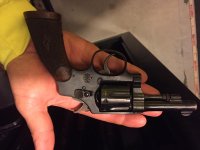
32 Long CTG

Joined
May 10, 2015
Messages
807
Reaction score
667
A coworker inherited a S&W 32 Long CTG with a serial number of 367,xxx. He was told it was from around 1906 or so, but I am wondering if that's the patent stamp date.

I don't know much else about it so I realize this is probably not enough information. I will try to get more info on it when I see him next I didn't even get to see a photo. Is this enough information to get any idea of a ship date?
 
Looks like a Regulation Police model. if the serial number is on the curved portion of the frame behind the trigger guard. Looks like it is in decent shape. These are fairly popular with some collectors. I like them, fun guns to shoot.
 
Does that 1922-23 era sound right? I'd say so with the grips but I'm sure they used them for awhile.

He was wondering if he should be worried about firing modern ammo with it. I just searched one of the online retailers and it looked like besides Sellier and Bellot, most of the loads were around 100 grains and 800 fps or less, with the S&B showing at 886 and 174 lf/ft. I don't think I'd worry about that, myself, but what do you say?

I would imagine this would have the same metallurgy as a .38 special of similar vintage, and I don't think I'd shy away from those numbers in a .38 special.

I would guess that lead is probably best for a bore of that age.
 
I was just reading my SCSW (3rd Edition) and it says that the SN could be found "on the front tang, cylinder face, barrel flat, and the front of the yoke." His is on the butt. Maybe they all are, in addition to those other places.
 
It is a .32 Regulation Police (they were also made in .38 S&W caliber) from around 1922-23. That particular model was not made until 1917. It is safe to shoot with any .32 S&W or .32 S&W Long ammunition you can find. It is not too difficult to find either caliber. In a pinch, .32 ACP can also be used, but is not highly recommended.
 
Last edited:
...right side up...

1aS_W_32.jpg
 
I like it ,and I concur with the opinion that factory ammo will be fine to shoot in it ,let us know how it does I have my eyes on one locally if I can get the deal done seller isn't " sure" .
 
Since it's from after 1920, it has a heat treated cyl, therefore very safe with current off the shelf standard loadings.

All frame serial #s are not on the grip frame butt. If it is, it's a 32 Hand Ejector. If the frame # is on the front strap of the grip frame, it's a 32 Regulation Police. The difference is the grip frame shape and the wood stock size.

SERIAL # LOCATIONS:

To confirm all parts are original, one can check for the 6 (or 7, on Triple Locks only) matching serial # locations for fixed sight pre war Hand Ejectors and all post war Hand Ejectors thru ~1956 (and a few as much as 3 years later).
NOTE: Observing serial #s for accuracy or even existence, especially on penciled stocks, requires magnification, bright light, and an attitude that it is there!

1. Gun butt – (or fore strap on I frames/single shots with grips that cover the butt)

2. Barrel - bottom of barrel or in extractor shroud

3. Yoke - on rear face only visible thru a chamber with a flashlight

4. Extractor star - backside

5. Cylinder - rear face

6. Right stock only - on back, (except most post war target stocks because individual fitting not required); stamped, scratched or penciled depending on vintage and stock material.
 
Back
Top