I just checked the barrel/cylinder gap on my 442 UC and found that a .012” feeler will go through from one side and a .013” will go half-way from the other side. Seems excessive to me. The gun shoots fine and doesn’t seem to be spitting lead. What do you guys think: leave it be or pursue it as a warranty issue? They may just tell me it’s within factory specs, anyway.

You are using an out of date browser. It may not display this or other websites correctly.
You should upgrade or use an alternative browser.
You should upgrade or use an alternative browser.
B/C gap question
- Thread starter JackM
- Start date

Alk8944
US Veteran
Based on numerous posts over the past several years, the permissible barrel-cylinder gap is now .012", and has been for several years. The smaller measurement is what prevails if the gap varies slightly side-to-side. You will be wasting your time to send the gun to S&W because it is within current tolerances for new revolvers. All you will accomplish is being without the gun for several weeks to several months just have S&W tell you the same thing! Barrel-cylinder gap is an issue greatly over-rated as it has little to no effect on either velocities or accuracy! As long as the gun isn't shaving/spitting just live with it!
Just for the record, I have reduced the B-C Gap on several revolvers of my own that had B-C gaps between .006" and some more to as little as .002", just because I was curious! Velocities as chronographed before and after the change resulted in exactly zero change in velocities because of the change/reduction of the gap!
Just for the record, I have reduced the B-C Gap on several revolvers of my own that had B-C gaps between .006" and some more to as little as .002", just because I was curious! Velocities as chronographed before and after the change resulted in exactly zero change in velocities because of the change/reduction of the gap!
Last edited:
stansdds
Member
Since you said the revolver shoots fine and there is no spitting, I'd leave it alone. The fix is not exactly cheap as the barrel must be removed, the crush shoulder turned back, barrel reinstalled and properly torqued, then recut the barrel extension for proper gap.

Green Frog
Member
I’m a little surprised at the experimental results obtained by ALK8944. I have seen other reports where there was significant variation in velocity with large vs small BC gap. Articles where similar S&W revolvers, differing primarily in BC gap! Showed a decrease in velocity as gap increased to a degree greater than the difference between 4” and 6” barrels.
Of course it was held by target shooters as an article of faith that a tighter gap was better. It is also true that fouling will begin to cause drag when the BC gap is tight, so it’s a trade off.
Recent reports of inquiries of S&W concerning their current spec for acceptable BC gap seem to be running at .012”, so the OP’s revolver is within current spec, but this has definitely changed in recent years. At one time, factory spec was reported to be .004-.006”. Less fouls to quickly and more brings loss of velocity.
If the OP’s revolver is functioning well otherwise and not spitting lead, I’d say he has all he can expect from a new S&W. If he’s losing a little velocity, it is probably not significant in the big scheme of things.
Froggie
Of course it was held by target shooters as an article of faith that a tighter gap was better. It is also true that fouling will begin to cause drag when the BC gap is tight, so it’s a trade off.
Recent reports of inquiries of S&W concerning their current spec for acceptable BC gap seem to be running at .012”, so the OP’s revolver is within current spec, but this has definitely changed in recent years. At one time, factory spec was reported to be .004-.006”. Less fouls to quickly and more brings loss of velocity.
If the OP’s revolver is functioning well otherwise and not spitting lead, I’d say he has all he can expect from a new S&W. If he’s losing a little velocity, it is probably not significant in the big scheme of things.
Froggie
Lou_NC
Member
This would be an easy experiment for me to run since I have a Dan Wesson model 15. Unfortunately it will have to wait till next March when I retire........
You are trying to fix a problem you do not have. With the reputation the factory has earned, a trip to the maker will only relieve you of your handgun for a couple months before it is returned with the “meets factory specs” note enclosed.

8shot
Member
My previous trr8 had a .008 cylinder gap and was spitting terribly. My 386 is .006 and appears to be working fine. If it’s not spitting it should be ok
Did you ever check the timing with a range rod? Lead spitting is associated with lack of cylinder/barrel alignment. (ie worn cylinder lock)
Last edited:

Ballistics by the inch took a Uberti 1873 Cattleman Single Action Revolver in 357 and set it with no gap, .001 gap and .006 gap and fired a variety of ammo through it first with 18" of barrel, then 16" then 14" and so on all the way down to 2"
BBTI - Ballistics by the Inch :: Cylinder Gap
In almost every case the loss from zero to .001 was greater than the difference from .001 to .006 especially when the barrel was 6" or less
For instance the Cor-Bon 125gr 357 lost 49fps from zero to .001 and just 13fps from .001 to .006 with a 4" barrel.
There are some interesting variations, but most of the time the change from .001 to .006 was similar to most ammo's standard variation.
While i like .004 to -006 I don't believe a gap of .012 really losses that much velocity over .006.
They have a lot of information pertaining to barrel length, gab and different revolvers using .identical ammo, especially if you click on the raw data link and explore it
p.
But, my conclusion is there are several factors that will effect velocity as much or more than B/C gap
BBTI - Ballistics by the Inch :: Cylinder Gap
In almost every case the loss from zero to .001 was greater than the difference from .001 to .006 especially when the barrel was 6" or less
For instance the Cor-Bon 125gr 357 lost 49fps from zero to .001 and just 13fps from .001 to .006 with a 4" barrel.
There are some interesting variations, but most of the time the change from .001 to .006 was similar to most ammo's standard variation.
While i like .004 to -006 I don't believe a gap of .012 really losses that much velocity over .006.
They have a lot of information pertaining to barrel length, gab and different revolvers using .identical ammo, especially if you click on the raw data link and explore it
p.
But, my conclusion is there are several factors that will effect velocity as much or more than B/C gap

.455_Hunter
Member
- Joined
- Jul 26, 2007
- Messages
- 1,673
- Reaction score
- 2,347
- City & State/Province
- Front Range of Colorado
It's pretty pathetic that my 1916 wartime emergency production Webley MKVI has a tighter cylinder gap than many new S&W products. I understand that in the BP days, .012" would have been necessary due to expected fouling, but now anything more than .006" is lazy and sloppy.

- Joined
- May 5, 2008
- Messages
- 5,958
- Reaction score
- 9,673
- City & State/Province
- Peoples Republic of Calif
I had one corrected that was spitting very badly. I bought it used cheap, probably because it spit so badly. The forcing cone was cut at a noticeable angle. I had the barrel set back one turn and everything trued up. It now shoots very, very well indeed. I also had a Colt b/c cleaned up as part of some other work being done. Generally if it isn't spitting and doesn't otherwise bother you it is an unnecessary "fix."
Green Frog
Member
Ballistics by the inch took a Uberti 1873 Cattleman Single Action Revolver in 357 and set it with no gap, .001 gap and .006 gap and fired a variety of ammo through it first with 18" of barrel, then 16" then 14" and so on all the way down to 2"
BBTI - Ballistics by the Inch :: Cylinder Gap
In almost every case the loss from zero to .001 was greater than the difference from .001 to .006 especially when the barrel was 6" or less
For instance the Cor-Bon 125gr 357 lost 49fps from zero to .001 and just 13fps from .001 to .006 with a 4" barrel.
There are some interesting variations, but most of the time the change from .001 to .006 was similar to most ammo's standard variation.
While i like .004 to -006 I don't believe a gap of .012 really losses that much velocity over .006.
They have a lot of information pertaining to barrel length, gab and different revolvers using .identical ammo, especially if you click on the raw data link and explore it
p.
But, my conclusion is there are several factors that will effect velocity as much or more than B/C gap
What this testing regimen omits is the B/C gap range from .006” to .012”, which is apparently the change in allowable specs from S&W over the last few decades. There have been several less scientific comparisons that suggest velocity change through this range may have been shown to be significant.
The NRA did the barrel length shortening test as early as the 1930s if somebody wants to look it up. Theirs was done with a 357 Mag, IIRC.
Froggie
While it doesn't include.006-.012 testing the fact that the first .001 causes more V loss than thee next .005 does indicates increasing the gap has a diminishing effect on V
As
Maybe next time I go to replace a barrel I will check it then trim it and check again. But I do always set mine fairly tight when I work on them
As
Maybe next time I go to replace a barrel I will check it then trim it and check again. But I do always set mine fairly tight when I work on them
Last edited:
As a matter of interest, S&W Customer Service told me today that their B/C gap parameters are .004”-.010”. Mine is at .012”, as stated in my original post. They’ve sent me a shipping label. Yes, I’ll be without it for a month or two, but I’ve got others. For that kind of money, I want it right.

- Joined
- Apr 5, 2012
- Messages
- 9,234
- Reaction score
- 15,901
- City & State/Province
- Northern NY-AdirondackMts
As a general answer, I normally say if t works good leave it alone!
Only the owner/shooter can make that determination.
Only the owner/shooter can make that determination.

Jack, just because they sent a shipping label doesn’t mean they’re going to do anything meaningful to it.
If you’re a machinist, .012” is a country mile. There’s no excuse for that. The last 4 Colts that I bought, they’re 4-6 thousandths b/c gap. They all shoot fast.
If you’re a machinist, .012” is a country mile. There’s no excuse for that. The last 4 Colts that I bought, they’re 4-6 thousandths b/c gap. They all shoot fast.
While I wouldn't get to concerned about it myself on a carry gun like the 442, I have to admit that it would seam pretty easy to tighten the gap on 2 piece barrels. A hand operated reamer with the correct shape could remove .006 from the shoulder in an alloy shroud pretty fast and allow the barrel to turn back a bit.
I have a 431 32 mag I pocket carry in a pocket holster a lot. I have fired quit a few rounds through it with no problems, but have never bothered to check the gap. I fail to believe 20 fps is going be what makes the difference if I ever need to use it. I also have a 642 I converted to 32 mag with a 2" barrel, its gap is .005.
But, it is pitiful that the factory doesn't make a bit more effort and put out a superior product.
I have a 431 32 mag I pocket carry in a pocket holster a lot. I have fired quit a few rounds through it with no problems, but have never bothered to check the gap. I fail to believe 20 fps is going be what makes the difference if I ever need to use it. I also have a 642 I converted to 32 mag with a 2" barrel, its gap is .005.
But, it is pitiful that the factory doesn't make a bit more effort and put out a superior product.
Last edited:

A gap of .012 seems wide. I have one revolver that is that "loose" - a RIA M200 Colt clone. Measures .012 or better. It spits powder on me, but shoots wadcutters where I aim, so I'm ok with it. My Smiths vary from my 637 at .008, 617 at the same. Measured .006 - .008 for my 60's, 70's, 80's J's. Very old Smiths (older than me) are tight - .005 seems to be average. My .44 HE (1923) is so tight I declined to stick a .002 gauge in it.

I find it ironic that folks are more worried about barrel/cylinder gap than group size.
fakahatchee
Member
Purchased a mod 27 classic in march, cylinder gap was 12 thou on one side and 13 thou on the other side, contacted S&W warranty and they said that it was excessive and to send it back. Got the pistol back in five weeks with a new barrel installed, so they will correct it.
Purchased a mod 27 classic in march, cylinder gap was 12 thou on one side and 13 thou on the other side, contacted S&W warranty and they said that it was excessive and to send it back. Got the pistol back in five weeks with a new barrel installed, so they will correct it.
That’s the impression I got. Well see.

- Joined
- Apr 4, 2006
- Messages
- 21,108
- Reaction score
- 35,451
In general, a larger B/C gap means more loss of velocity at the muzzle. It is also a recipe for more lead spitting. If down the road end shake needs shims to reduce it, the B/C gap will also increase to unacceptable levels.
Like a few have stated, for most of the last century the B/C gap was .002" - .006". I personally believe in those spec's and would not be happy with a B/C gap of more than .006". Unfortunately, S&W raised their tolerance to .012" which to me is just too much and if it were me, I'd personally ask them to correct the B/C gap to at least half of that.
Like a few have stated, for most of the last century the B/C gap was .002" - .006". I personally believe in those spec's and would not be happy with a B/C gap of more than .006". Unfortunately, S&W raised their tolerance to .012" which to me is just too much and if it were me, I'd personally ask them to correct the B/C gap to at least half of that.

In an era where so many Kool-Aid drinkers tout the superiority of modern manufacturing, usually spouting something or another that includes “CNC eliminates the need for hand fitting”, you would think maintaining a B/C gap tolerance of .003-.006” would be a simple matter.
If nothing else, it would provide a reference point to prove their boisterous claims.
But, no.
After decades of being told how important B/C gap is to revolver performance, the same gaslighters now say, “No big deal! .012” is good enough”.
OK. Thanks.
Meanwhile a guy with a frame wrench and the skill set to use a hand file can repeatedly set back a barrel with a consistent .002” B/C gap.
If nothing else, it would provide a reference point to prove their boisterous claims.
But, no.
After decades of being told how important B/C gap is to revolver performance, the same gaslighters now say, “No big deal! .012” is good enough”.
OK. Thanks.
Meanwhile a guy with a frame wrench and the skill set to use a hand file can repeatedly set back a barrel with a consistent .002” B/C gap.
Last edited:
I do believe modern machining and part production is superior. But, it is all for naught when coupled with poor assembly personnel, methods and control and then compounded by a lack of solid quality control.
Large gaps, poor forcing cones, poor function are not the result of the initial machining. They are the result of shoddy, we don't really care that much, meet your quota assembly culture. That mind set doesn't usually start at the bottom and once entrenched it is difficult to turn around.
If the factory gave me all the parts needed to assemble 100 guns of one model, I would bet I could produce over 90 nice ones an a few that would never be right without several replacement pieces. Some of the completed ones would take way more time to assemble than others. Unless your initial parts production is 100% perfect, your going to find minor mismatches that need dealt with.
When I assemble one from were I swap parts around from various gun, I sometimes get lucky, but often have to do some fiddling. The barrel don't time just right, the center pin is a bit long or short, same with rod, the DA sear isn't quite right etc etc. All those take time to take care of.
Large gaps, poor forcing cones, poor function are not the result of the initial machining. They are the result of shoddy, we don't really care that much, meet your quota assembly culture. That mind set doesn't usually start at the bottom and once entrenched it is difficult to turn around.
If the factory gave me all the parts needed to assemble 100 guns of one model, I would bet I could produce over 90 nice ones an a few that would never be right without several replacement pieces. Some of the completed ones would take way more time to assemble than others. Unless your initial parts production is 100% perfect, your going to find minor mismatches that need dealt with.
When I assemble one from were I swap parts around from various gun, I sometimes get lucky, but often have to do some fiddling. The barrel don't time just right, the center pin is a bit long or short, same with rod, the DA sear isn't quite right etc etc. All those take time to take care of.
Last edited:

I agree that modern machinery allows for tighter tolerances. But think about how barrel to cylinder gap is generated. You have a design that specifies the length of the barrel, the length of the threads, etc. But getting that thread to start at the precise location to get the exact gap is not easy. If you've ever changed a barrel, you know that no two are alike as to clocking or B/C gap. So it you have too little gap, you cut material from the stick thru, if you have too much, you cut from the shoulder on the barrel. if it clocks correctly but has too much gap, now you are cutting a full turn. Easy to see why the manufacturer would not bother for a few thousands that does not matter to the vast majority of gun owners. The only gun I own for which I know the gap is one I replaced the barrel on. And it took several tries to get it right, including filing the front of the frame. After that exercise I decided that I was a mediocre machinist and a worse gunsmith.

muzzlestuffer2012
Member
- Joined
- Feb 24, 2022
- Messages
- 475
- Reaction score
- 331
I'm not sure what revolver the op is referring to but if I recall when I was working on my 617 and 629 when I got them power customs had some type of shims to close that gap, I remember Ron said the ideal gap is about 6-7 thou.
On the 2 piece barrels like the 442 the gap isn't set by the shoulder like on the one piece barrel. It is set by a shoulder on the forward part of the barrel pressing against a ledge in the shroud. You do not have to remove enough for the barrel to make a full turn as the sight and ejector lug are on the shroud which doesn't turn. If you removed .006 from the shroud ledge OR the barrel shoulder. the barrel would turn in .006 further while the shroud remains in its original position.
I have adjusted the gap on numerous 1 piece barrels and installed 2 of the 2 piece barrels. A 2 piece barrel would be easy to adjust once you get them apart. I stuck a piece of square stock in the barrel and then poured it full of low temp solder. I have some that melts at 138f. Then used a normal frame wrench on the frame and use the square stock sticking out the muzzle to turn the barrel. Once you correct the gap a heat gun on low will melt the solder and a couple of passes with a brass brush and your good to go. I was making a 38 +p magnum J frame into a 32 mag
On my 500 I cut the shroud down, threaded the barrel and made a nut to fit. Just set the gap and tighten the nut and your good to go. Very similar to a Dan Wesson
There is no great way to close the B/C gap with shims. You must either move the cylinder forward or the barrel back. Just moving the cylinder forward will create more headspace and endshake. You could trim the yoke shaft then put a shim on the ejector shaft so it was between the back side of the star and the cylinder, which would move the cylinder forward and eliminate the added endshake from shorting the tube, and it would hold the ejector back letting the rim headspace correctly on ejector arms, but not on cylinder face itself. You would also have the shim riding in and out on the ejector as you used it.
It would work, but not the best option which is always going to be make sure the yoke fits right, then set the headspace, adjust the endshake, then adjust the barrel to the face of the cylinder.
I have adjusted the gap on numerous 1 piece barrels and installed 2 of the 2 piece barrels. A 2 piece barrel would be easy to adjust once you get them apart. I stuck a piece of square stock in the barrel and then poured it full of low temp solder. I have some that melts at 138f. Then used a normal frame wrench on the frame and use the square stock sticking out the muzzle to turn the barrel. Once you correct the gap a heat gun on low will melt the solder and a couple of passes with a brass brush and your good to go. I was making a 38 +p magnum J frame into a 32 mag
On my 500 I cut the shroud down, threaded the barrel and made a nut to fit. Just set the gap and tighten the nut and your good to go. Very similar to a Dan Wesson
There is no great way to close the B/C gap with shims. You must either move the cylinder forward or the barrel back. Just moving the cylinder forward will create more headspace and endshake. You could trim the yoke shaft then put a shim on the ejector shaft so it was between the back side of the star and the cylinder, which would move the cylinder forward and eliminate the added endshake from shorting the tube, and it would hold the ejector back letting the rim headspace correctly on ejector arms, but not on cylinder face itself. You would also have the shim riding in and out on the ejector as you used it.
It would work, but not the best option which is always going to be make sure the yoke fits right, then set the headspace, adjust the endshake, then adjust the barrel to the face of the cylinder.
Last edited:
Folks are taking issue with one arbitrary number being replaced with another arbitrary number. There really isn’t any science involved here that can spit out a perfect number. In my world the photo depicts the result of a .006 barrel/cylinder gap. It renders a D/A revolver inoperable in short order. Also the target has no way of knowing the speed of the bullet so that is mostly a moot point. I have opened up more than a few barrel/cylinder gaps. Never had to tighten one up and never had a problem with lead spitting. Also I don’t bother measuring the gap unless the gun gives me problems.
Attachments
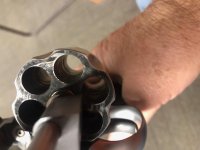
There is no way that gun had an actual .006 gap unless it had problems like huge endshake, the yoke was way messed up or it had a misalignment or forging cone issue and lead was left to built up for hundreds of rounds.
I have sent a lot of cast lead bullets down range from 45s 44s, 357s, 32s and 22s with a lot of round between cleaning and have never ever had that from a gun with an actual .006 gap.
There is a very simple way to tell the speed of bullets and that is to fire them over a chronograph, which are now relatively inexpensive and easy to use.
I do doubt that an .012 gap loses 30fps over a .006 gap and I agree that the velocity loss velocity won't be what makes or breaks the result of the shot
I will also say that I believe a little play in an actual defensive hand gun is probably a good thing. If everything is minimum tolerance any piece of lint or other debris is far more apt to tie up a tight gun than a slightly loose one
I have sent a lot of cast lead bullets down range from 45s 44s, 357s, 32s and 22s with a lot of round between cleaning and have never ever had that from a gun with an actual .006 gap.
There is a very simple way to tell the speed of bullets and that is to fire them over a chronograph, which are now relatively inexpensive and easy to use.
I do doubt that an .012 gap loses 30fps over a .006 gap and I agree that the velocity loss velocity won't be what makes or breaks the result of the shot
I will also say that I believe a little play in an actual defensive hand gun is probably a good thing. If everything is minimum tolerance any piece of lint or other debris is far more apt to tie up a tight gun than a slightly loose one
Last edited:
Similar threads
- Replies
- 10
- Views
- 658


- Replies
- 12
- Views
- 885


