
Bathroom vent/fan

Joined
Jun 3, 2009
Messages
6,325
Reaction score
6,472
City & State/Province
Deepest, darkest, Indiana
I live in a small house built in '43. The whole neighborhood is populated by such homes built during WWII to accommodate families with the breadwinner working in steel mills and heavy industry around here. The brick ones like mine are 2 floors with a basement. There's 2 bedrooms and the only bathroom upstairs. They look and are so much alike that when I was drinking I had a florescent beer sign in the front window so I could find my way to the right place.
None of these places have ceiling vents in the bathroom so it fills with steam pretty quick and opening the bathroom window is the only way to clear the fog. If I shower i open the window. New neighbors moved in next door with 2 adults and 3-4 kids. They asked me about a fan/vent for the bathroom that doesn't require an outside vent. They don't want to go through the brick wall or roof. I believe such a device does not exist and if it did exist would be much like black majic or voodoo. But I have not kept up with such things and you never know. Is there a device that remotely resembles a non-vented bathroom fan.
 
Last edited:
A dehumidifier comes to mind.

5 Best Cordless Dehumidifiers for Bathroom and Buying Guide

10 Best Dehumidifiers For Bathroom in 2020 - The House Talk

Bathroom-Dehumidifiers1.jpg


Best-Dehumidifier-For-Bathroom.jpg
 
Last edited:
My go-to company for all things fan, is Fantech. Their soffit vent will do what you ask. It vents to the underside of the soffit overhang. You just need to spec out the ducted fan for it.

[ame="https://www.amazon.com/Fantech-UEV-Soffit-Vent-Duct/dp/B000GXF8IU"]Fantech UEV 4 Soffit Vent, 4" Duct: Ducting Components: Amazon.com: Industrial & Scientific[/ame]

Sent from my Moto G (5) Plus using Tapatalk
 
Last edited:
Mine uses the vent for the septic system . You should have a vent/s on your roof for different things . Seeing as yours is older they will probably be cast iron . Either yourself or a plumber can cut the one closest to the bathroom , put a tee in it and connect the hose from the bathroom vent to it . You'll have to have someone cut the hole in your ceiling for the vent/fan , run electric to it , but then your problem is fixed .
 
Ours vents into the attic, but the house was built in 1962.

No mold or anything that would indicate it is getting wet in the attic,
but then we don't have a lot of humidity to begin with.
 
Some are just vented into the attic and don't go through the roof. I would not think there is enough moisture to harm anything.


My upstairs bathroom vents to the attic. Been that way for 36 years. I admit to being skeptical of that situation in the beginning but it has not been a problem.


Sent from my iPhone using Tapatalk
 
Some are just vented into the attic and don't go through the roof. I would not think there is enough moisture to harm anything.

Moved into this house in 1998...was built in 1992.

First week there I noticed the bath mirrors steamed up
heavily. Took a look in attic, couldn't find the vent fans...
went back down, turned em on, went back up--could hear
em, still couldn't see em!

Turns out they were mounted, no exhaust hoses, and
buried under six inches of blown cellulose insulation.
I put some 3" dryer hose on both fans, and the steamy
mirrors no longer steamed.

A contractor told me that "code" requires either an
exhaust fan or window in a bathroom, but makes no
requirement on how the exhaust fan is ducted (or not).

I don't understand how original occupants lived there
for several years, without noticing.
 
Last edited:
New house next door has theirs's vented thru the soffit.

Vented outside with no holes in the roof. Never seen or thought about doing it that way, but it seems like a good and easy idea.

I'm guessing they'll put some kinda cover over it to keep things from getting in.

0930200203-X2.jpg
 
In the 70’s and 80’s vent fans would got installed in bathrooms without windows and vented into the attic.

I’ve had a couple contractor’s tell me recently that current building code requires bathroom vent fans be vented outside. Those may just be local rules though.
 
Last edited:
I lived in a house that was built in 1936 and had no fans in the bathroom. I just left the door open a little bit and it helped a lot. It was great in the winter with forced air heat.
 
From the Florida Building Code, Residential:

M1507.2Recirculation of air.

Exhaust air from bathrooms and toilet rooms shall not be recirculated within a residence or to another dwelling unit and shall be exhausted directly to the outdoors. Exhaust air from bathrooms and toilet rooms shall not discharge into an attic, crawl space or other areas inside the building.
 
Bath fans need to be vented to the outside, either thru the roof or to the soffit. Needs to be away from a window that can be opened if in the soffit.I wouldn’t suggest connecting to a plumbing vent, the risk of sewer gasses coming back into the house aren’t worth it.
Yes, in South Florida that’s what the building code requires.
 
... insulated exhaust piping should be used especially in cooler climate areas. Do it once and do it correctly vent to the outside. Exhaust Fans made by Panasonic run silent for a very long time, can't say that about Broan. Hopefully the information provided by many here will encourage you or change the "unvented" idea to vented outside.
 
Last edited:
I can tell you after living in a house with bathroom vents dumping into the attic for 30 years that it causes no harm. Attics are vented to the outside. No mold issues at all.

I've had the same experience in two houses - no issues whatsoever. It's not like you're pumping steam up there, it's only moist air.
 
My upstairs bathroom vents to the attic. Been that way for 36 years. I admit to being skeptical of that situation in the beginning but it has not been a problem.


Sent from my iPhone using Tapatalk

My house was built in the early 1980's and both upstairs bathrooms vent into the attic. Was skeptical also when I discovered it. The roof had a ridge vent as well as the vents on each end of the house to ventilate the attic space. Recently had the roof replaced and the new roof does not have a ridge vent but a low profile automatic electric fan with thermostat control was installed to come on at 120 degrees to pull hot air out and ventilate the attic space. The roofing company said the ridge vent was not taking enough hot air out of the attic causing premature deterioration of shingles from heat.

Codes and methods are always changing.
 
Last edited:
I believe the easiest and best way to run a vent is through the eve fascia or soffit. I have two that run above the ceiling right out to the eve with a standard flapper and hood. Never caused a problem and worked for 40 years. The key is to run flexible vent from the hole in the ceiling for the new vent fan and push it out to the eve fascia. Cut a hole in the eve and find the vent pipe, connect and attach the flapper assembly to the vent pipe, then push it back into the hole. Wire the fan and done. Personally, I would insulate the vent pipe so you do not have a problem with condensation on the outside of the pipe in certain seasons.

You may run into insulation, which will require you to go into the attic and run the vent on top of the insulation or remove it to place the vent on the ceiling drywall and reinstall the insulation after done.
 
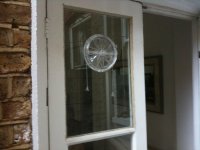
Call a glazier and have him cut in an Extractor fan. I have not seen one of these in years but I had a house years ago that had one of these mounted right in the glass. It works very well and needs no electricityhttp://smith-wessonforum.com/attachment.php?attachmentid=473260&stc=1&d=1601474160
 

Attachments

  • fan.jpg
    fan.jpg
    85.8 KB
Another angle on the vent fan to the outside is that it takes conditioned air from inside your home and dumps it outside, and the home makes up for that exhaust by leaking air from outside to the inside through drafts. With six occupants using that bathroom and it's exhaust fan, that's a lot of infiltrating air needing to be heated or cooled.

Perhaps a HRV (Heat Recovery Ventilator) instead of just a vent fan might be an option. They are larger and relatively expensive to purchase compared to bathroom fans, but the payback through energy savings after being used by six occupants might offset quickly because they lower the load on your HVAC equipment. They might also qualify for utility rebates and tax credits.


VHR70R ES Fresh Air Appliance - Fantech
 
THANK YOU ALL for all information and suggestions. I really appreciate it. I kind of thought with all the knowledge on this board I'd get some great solutions. I may print them out or email them to the neighbor and let him figure out what to do. You all are making me look like I know what I'm doing to my new neighbor.

Thanks again, Jim
 
Before 1974 many bath fans were just ducted into the attic, In the northern climate that has become a major Black mold issue. When I worked for our cities 2nd largest slum lord we had Section Housing Authority require us to remove the mold in the attic it two buildings. The first was cleaned with a approved Bio-cyde (high priced bleach water) and then the entire surface area sealed with Bullseyes paint. After that the other build was due for a new roof, we got a one year extension and installed new decking (plywood) and new shingles. That ended up being the cheaper method.

Now days bat vents are ducted all the way out doors to the soffit or to the hat/ridge vents.

Ivan
 
New house next door has theirs's vented thru the soffit.

Vented outside with no holes in the roof. Never seen or thought about doing it that way, but it seems like a good and easy idea.

I'm guessing they'll put some kinda cover over it to keep things from getting in.

0930200203-X2.jpg

Are you sure that is not the dryer vent? I have seen many dryer vents vented through the attic and then through the roof. Not something I would want but it is done often.

As far as venting a bathroom exhaust fan into the attic I have never seen one cause any moisture problem as they don't pull enough moisture to do harm. If you have moisture problems in the attic it is a lot more than a bathroom exhaust fan causing the problem.
 
Just my opinion but it seems if the fan is already ducted to the attic it's not a Herculean task to attach some piping or flexible duct to run it outside and not be concerned if the moisture is affecting the attic space.

It seems this may be more an issue in colder climates as the moisture freezes and creates frost on cold areas of the attic rather than dissipating as it would in a well vented warmer attic space.
 
Last edited:
There isn't a fan or ceiling vent in their roof yet. There's no insulation in the attic, neither the floor or walls. It will get cold up there but heat lost through the bathroom ceiling should be enough to keep it from freezing.
 
Back
Top